Ex-INEC officials pick holes in amended Electoral Act
Nigerians have been urged to prioritise objectivity and electoral integrity in their quest for technology infusion into the nation’s electoral system.
This is as former Independent National Electoral Commission (INEC) officials, civil society activists and election experts picked holes in amended Electoral Act 2026 recently signed into law by President Bola Ahmed Tinubu, citing ambiguities in the new law.
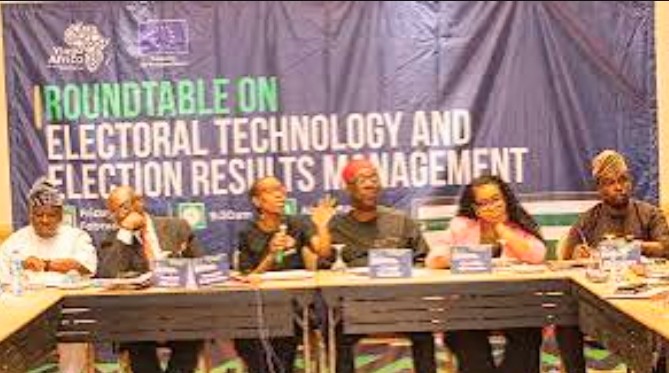
They were speaking on Friday in Abuja at the presentation of Election Manipulation Risk Index (EMRI) report and roundtable discussion themed “Electronic Transmission and Electoral Integrity: Safeguarding the Vote under the Electoral Act 2026”, organised by the Yiaga Africa.
The ex-INEC officials, including former National Commissioner Festus Okoye, former Resident Electoral Commissioner (REC) Mike Igini, and former ICT Director Engr. Chidi Nwafor warned that conflicting provisions on the electronic transmission of results could undermine electoral integrity if not urgently addressed.
Okoye, who was chairman of the commission’s Information and Voter Education Committee, cautioned lawmakers against embedding specific technological names in statutes, arguing that technology evolves rapidly.
According to him, said while the Bimodal Voter Accreditation System (BVAS) remained a very good and innovative device, the 2026 Act contains drafting inconsistencies that could create confusion in implementation of such.
He recalled that the Smart Card Reader (SCR) was initially introduced through INEC guidelines but was not expressly recognised in the Electoral Act until the 2022 amendment.
He noted that the National Assembly has now replaced references to the SCR with BVAS in some sections of the 2026 Act but failed to make the substitution uniformly across the law.
He said, “Where BVAS appears in the principal section, Smart Card Reader is still retained in other parts of the Act. The National Assembly needs to clean up the drafting to avoid ambiguity
“Don’t write a particular technology into the law. Allow the electoral body discretion to adopt appropriate technology at any given time. Each time technology changes, you cannot keep amending the Act.”
He explained that BVAS was designed as a multifunctional platform capable of voter registration, biometric accreditation, result upload, and even future electronic voting if activated.
He, however, noted that while the device has the capacity for full electronic transmission of results, that function has not been fully operationalized.
Another contentious issue discussed at the roundtable was the discussion was Section 60 of the 2026 Act, which mandates electronic transmission of polling unit results to the IReV, but includes a proviso that Form EC8A, the manually completed result sheet remains the primary source of collation and declaration.
Okoye argued that a careful reading of Sections 60 and 65 reveals two separate transmissions: one to IReV for public viewing and another to the collation system.
He cited Section 155, which defines “transmit” as sending manually or electronically, suggesting that the law provides room for both methods.
He, however, said that where discrepancies arise, electronically transmitted results to the collation system should carry greater weight if interpreted creatively and strategically.
He said, “I am not factoring IReV into the equation of collation because the Supreme Court has defined it as a viewing portal. But the law also provides for transmission to the next level of collation, and we must interrogate that carefully.”
Als, a former INEC ICT Director, Engr. Chidi Nwafor recalled Nigeria’s technological electoral reforms to early digitised voter registration efforts in 2003 and the eventual introduction of biometric systems under former INEC Chairman, Prof. Attahiru Jega.
He noted the ‘political resistance’ to reforms, lamenting that stakeholders often support technology when in opposition but frustrate it when in power.
He said that the BVAS was designed to accommodate voter registration, authentication, electronic voting, and transmission, stressing that even when the network fails, data captured on the device remains intact and can be synchronised once connectivity is restored.
“BVAS was not just designed for accreditation. It was designed as a comprehensive electoral device — registration, authentication, result upload, and even future electronic voting. We were thinking ahead,” Nwafor said, dismissing claims that network failures render electronic transmission ineffective.
“Even if there is no network at the polling unit, the result captured on the BVAS does not disappear. It remains stored securely on the device and transmits automatically once it detects connectivity. That is how it was engineered.
“The greatest obstacle to electoral technology in Nigeria is not technical weakness. It is political resistance. Those who oppose these systems today often supported them when they were not in power.”
Recounting the controversies that trailed the introduction of the SCR, he said, “We were summoned to defend the Smart Card Reader before lawmakers. Yet the same technology later became the reason some leaders acknowledged that elections were more credible. The irony is not lost on us.”
On his part, a former REC, Mike Igini, said that democracy is anchored on predictable, periodic, free, and credible elections, warning that the proviso in Section 60(3) of the 2026 Act represents a regression.
Citing Section 160 of the 1999 Constitution, he argued that INEC has constitutional powers to regulate its own procedures and make binding guidelines.
He noted that the Supreme Court’s earlier characterisation of IReV as merely a viewing portal, weakened public confidence in electronic transmission, and that the new proviso that makes Form EC8A the primary source of collation could override the gains made through technology.
“A proviso purports to create an exception. By subordinating electronic transmission to manual forms, we risk backsliding from the electoral thresholds we have crossed,” Igini said.
He insisted that electronic transmission should be central to Nigeria’s democratic architecture, arguing that real-time transmission enhances transparency, reduces human error, and strengthens public trust.
The Director of ICT at the Nigerian Society of Engineers (NSE), Engr. Oluwadara Oluwalana noted the network limitations as a practical challenge to seamless electronic transmission in the nation’s electoral system.
Citing reports from the Nigerian Communications Commission (NCC) and the Universal Service Provision Fund (USPF), he noted that while 2G coverage stands at about 93 per cent, 3G and 4G coverage remain below full national penetration.
“For effective transmission of clear images and data, at least 3G should be the minimum requirement. Compressed images over weaker networks may defeat the objective of clarity and transparency,” he said.
He called for a comprehensive technical audit involving INEC, NCC, and professional bodies to address infrastructure gaps before full-scale electronic transmission is implemented nationwide.
On her part, Programs Director for Yiaga Africa, Cynthia Mbamalu, defended the role of BVAS and real-time upload of polling units (PUs) results.
She noted that the PUs remains the most transparent stage of the electoral process.
Mbamalu explained that BVAS performs three key functions: biometric accreditation, capturing and uploading Form EC8A to IReV, and transmitting accredited voter data to the collation level.
“At the polling unit, results are in their purest form because you have voters, party agents, observers, and media present. Oversight is strongest there. Once you move to collation centres, that level of oversight reduces,” she said.
She said that real-time upload simply means capturing and transmitting results immediately after counting and completion of Form EC8A, in full view of stakeholders, irrespective of network challenges.
Discover more from TheTimes Nigeria
Subscribe to get the latest posts sent to your email.