A coalition of the nation’s leading civil society organisations (CSOs) have rejected the the newly signed Electoral Act 2026, describing it as a “missed opportunity for transformative reform” and warning that unresolved loopholes could threaten the credibility of the 2027 general elections.
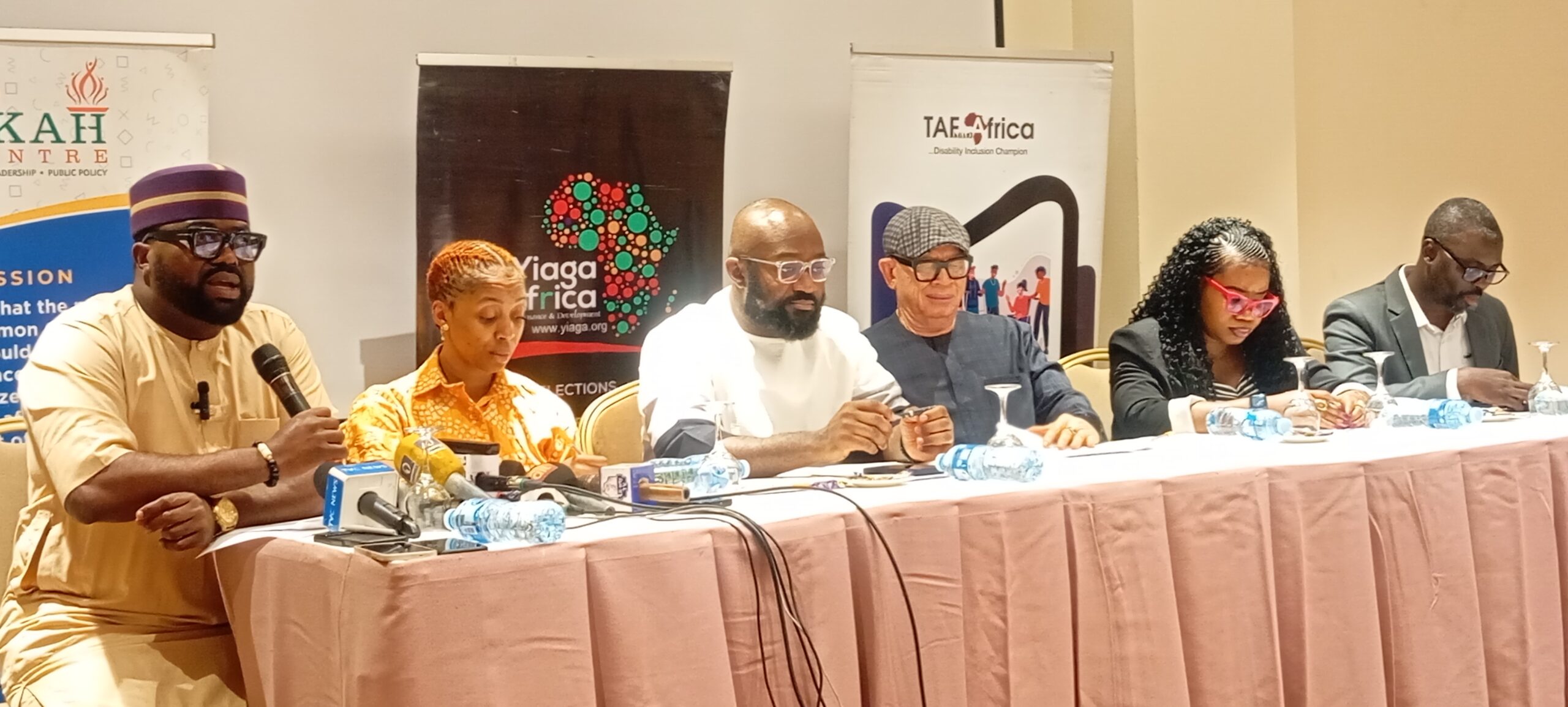
At a press conference on Thursday in Abuja, hours after President Bola Ahmed Tinubu signed the Bill into law, the coalition including the Centre for Media and Society (CEMESO), The Kukah Center, International Press Centre (IPC), ElectHer, Nigerian Women Trust Fund (NWTF), The Albino Foundation (TAF Africa), and Yiaga Africa said that the content of the new law and the manner of its passage by the National Assembly undermined democracy and entrenchment of the rule of law.
Ambassaor Jake Epelle, Founder and CEO of the TAF Africa, who led the presentation of the coalition position stressed that the new Electoral Act 2026 does not sufficiently address key challenges affecting Nigeria’s electoral process, as expected by the majority of Nigerians.
Yiaga Africa Executive Director, Samson Itodo; Vaneza Gregory of the NWTF; Cynthia Mbamalu of Yiaga Africa; and George Annayi of TAF Africa among other CSOs leaders and pro-democracy activists also attended the briefing.
Ambassador Epelle also expressed concern over the speed and opacity of the legislative process, saying the development raised questions about transparency and commitment to credible electoral reform.
According to him, the law preserved some provisions of the 2022 framework but left critical loopholes and introduced barriers that could weaken participation and electoral integrity.
He lamented the adoption process, saying the last-minute amendments were neither published nor adequately reviewed before approval by both chambers.
Epelle said that limited debate on key clauses, including electronic transmission of results, undermined informed legislative consent and public confidence in democratic lawmaking.
He faulted the presidential assent granted despite protests and appeals for safeguards such as real-time transmission, downloadable voter cards and clear electoral timelines.
He, however, welcomed some provisions including downloadable voter cards (Section 18), which allow voters to obtain their cards from INEC’s website, reducing disenfranchisement linked to unissued or missing cards; and a disability-inclusive register (Section 9), requiring voter data to be disaggregated by disability type in line with Nigeria’s obligations under the UN Convention on the Rights of Persons with Disabilities.
Also is stronger anti-fraud penalties (Sections 62 and 71), which impose a mandatory minimum of 10 years’ imprisonment for returning officers who falsify results and a three-year jail term for presiding officers who fail to sign result sheets.
“These are among the strongest anti-fraud sanctions in Nigeria’s legislative history,” the statement noted. We register our profound concern about the process through which the Electoral Bill that was passed between the third reading and adoption of the harmonised version of the bill.
“The final version of the Bill voted upon reportedly contained last-minute amendments that were neither published nor made available to civil society or the broader public prior to adoption.
“More concerning is that the harmonised Bill produced by the Conference Committee was adopted by both chambers via voice vote without prior distribution of the final consolidated text to all members as was reported by some legislators,” Epelle said.
He warned that ambiguities around transmission failure, compressed electoral timelines, restrictions on result review and high party registration fees could undermine inclusiveness and credibility.
According to him, one of the most contentious provisions in the new law, is Section 60(3), which mandates electronic transmission of results but allows physical result forms to become the primary source for collation in the event of “communication failure.”
The coalition warned that the term remains undefined, with no independent verification mechanism or penalties for deliberate sabotage disguised as technical glitches.
He said, “The 2023 elections demonstrated how this ambiguity can be exploited. This loophole will be tested again in 2027.”
Other concerns raised include restrictions on result reviews (Section 65), which allow only the Independent National Electoral Commission (INEC) officials to trigger a review of election results within seven days, barring political parties, candidates, and accredited observers from initiating the process even with compelling evidence.
They also criticised the N50 million party registration fee (Section 75(6)), describing it as a “financial moat” that could exclude youth-led and grassroots movements from political participation.
On the mode of party primaries (Section 84), the coalition argued that limiting nomination methods to direct primaries or consensus eliminates indirect primaries and may increase vulnerability to vote-buying and elite manipulation.
With the law now in force, the civil society groups shifted focus to implementation, pledging vigilant monitoring ahead of 2027.
They urged the INEC to urgently publish a revised election timetable to meet the new 300-day notice requirement and to issue comprehensive regulations clarifying key provisions, especially those relating to electronic transmission failures and party primaries.
The coalition also called for a nationwide simulation of the IReV electronic transmission system across all 176,866 polling units, with independent observers present and a publicly released technical report detailing connectivity gaps and vulnerabilities.
They tasked political parties to publicly commit to defending electronic transmission at every polling unit and to document suspicious communication failures in real time.
The groups further called on the National Assembly to immediately publish the final signed version of the Electoral Act 2026 to ensure transparency and legal clarity.
The coalition concluded that while the Electoral Act 2026 is “imperfect” and “incomplete,” it remains the framework under which the 2027 elections will be conducted.
“It is our responsibility as citizens, media, and civil society to ensure that elections conducted under this law are credible, transparent, inclusive, and reflective of the will of the Nigerian people,” they said.
Also speaking at the briefing, the Spokesperson of the House of Representatives, Hon. Akin Rotimi, said that the parliamentary process followed constitutional and procedural requirements in the interest of Nigerians.
He said that the law mandates electronic transmission of results, while manual submission serves only as a fallback where transmission fails for valid reasons.
According to him, strict penalties exist for returning officers who fail to transmit results without justification and called for broader public education on other strengthened provisions of the Act.
Rotimi commended calls for the to test transmission systems and release a revised electoral timetable to enhance certainty and preparedness among stakeholders.
“I want to assure you that in terms of the process, every single thing was done in keeping with the Constitution, in keeping with the House rules, the Senate rules, and all of that.
”I always like to say that democratisation, of which elections is a critical ritual, is a process. We are at this point, and it doesn’t preclude the fact that there are opportunities in the future to amend the Electoral Act further when we have more facts and details before us,” he said.
The lawmaker assured Nigerians that the 10th Assembly would continue efforts to rebuild public trust, describing recent developments as part of democratic evolution toward free, fair and credible elections.
Discover more from TheTimes Nigeria
Subscribe to get the latest posts sent to your email.