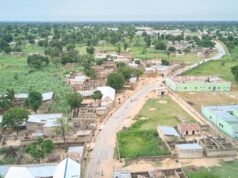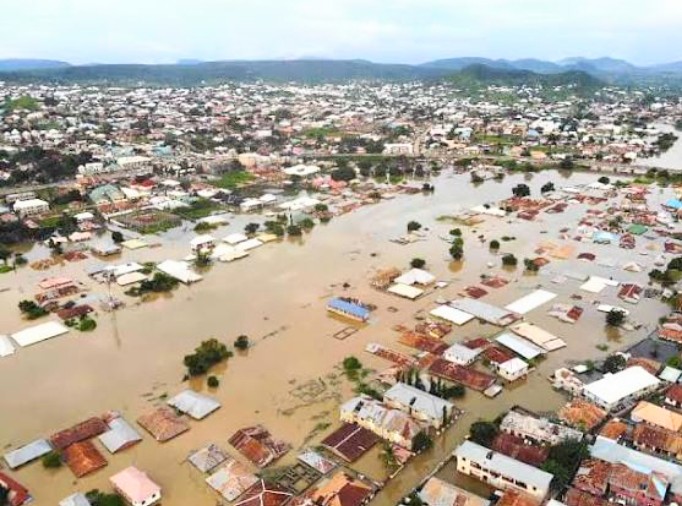
The Federal Government has raised the alarm that 14,118 communities in 266 local government areas across 33 states and the Federal Capital Territory (FCT) face the risk of high flooding in 2026.
The Minister of Water Resources and Sanitation, Prof. Joseph Terlumun Utsev, disclosed this on Wednesday at the presentation of the 2026 Annual Flood Outlook (AFO) with the theme: Smart Water Resources Management-Moving from Oil to Water Based Economy.
The event, organised by the Nigeria Hydrological Services Agency (NiHSA), provides evidence-based predictions that enable the government, stakeholders, agencies, state authorities, local governments and communities to prepare ahead of the flood season.
While giving the highlights of the 2026 forecast, the Minister said, “14,118 communities in 266 Local Government Areas (LGAs) in 33 States and FCT fall within the high flood risk areas.”
He listed the states as Abia, Adamawa, Anambra, Bauchi, Bayelsa, Benue, Borno, Cross River, Delta, Ebonyi, Edo, Enugu, Gombe, Imo, Jigawa, Kaduna, Kano, Kebbi, Kogi, Kwara, Lagos, Nasarawa, Niger, Ogun, Ondo, Osun, Oyo, Plateau, Rivers, Sokoto, Taraba, Yobe, Zamfara and the Federal Capital Territory.
Part of the statistics also showed that “15,597 Communities in 405 LGAs 35 States except Ekiti State will experience moderate flood risk and Incidences of minimal flood is expected in 923 communities in 77 LGAs in 24 States.
“The States are Adamawa, Anambra, Bauchi, Bayelsa, Benue, Borno, Cross River, Delta, Ebonyi, Edo, Jigawa, Kaduna, Kano, Kebbi, Kogi, Nasarawa, Niger, Ogun, Ondo, Osun, Oyo, Sokoto, Taraba and Zamfara.”
Prof. Utsev added that the high flood Risk Areas is expected between the months of April and November, 2026, adding that, “agriculture, livelihoods, livestock and infrastructure, and the environment will be affected.
He said, “This year, 9,021 communities in 188 LGAs across the country fall within the High Flood Risk areas in the months of April, May and June; while 14,158 communities in 263 LGAs in the months of July, August and September; and 11,575 communities in 224 LGAs in the months of October and November, 2026 are within the High Flood Risk zones.”
He also said that Moderate Flood Risk will be between the months of April and November, 2026 and the impacts were expected in 8,225 communities in 228 LGAs within the months of April, May and June; and 15,621 communities in 407 LGAs within the months of July, August and September; and 9,263 communities in 272 LGAs within the months of October and November, 2026.
According to him, flash and urban flooding are projected in major cities in the country due to high rainfall intensities, low attention to management of water facilities including drainage systems, waterways and lack of flood resilience structures.
The flash flood will affect Cities like Abakaliki, Abeokuta, Abuja, Asaba, Benin City, Birnin–Kebbi, Calabar, Ibadan, Kaduna, Kano, Lagos, Makurdi, Nguru, Onitsha, Oshogbo, Port Harcourt, Sokoto, Warri and Yola, among others.
Also expected within the period under review is Coastal and Riverine Flooding in areas like Bayelsa, Cross River, Delta, Lagos, Ogun, Rivers and Ondo due to rise in sea level and tidal surge, adding that it would have impact on fishing, wildlife habitation and river navigation.
The Minister urged state governments, local authorities, disaster management agencies, farmers, and community leaders to carefully study the findings and advisories in the document and take the necessary steps to prepare for the coming flood season.
Earlier, the Director General of NiHSA, Umar Ibrahim Mohammed, said the 2026 AFO aligned with the Federal Government’s Renewed Hope Agenda, particularly in areas such as economic diversification, infrastructure development, climate resilience, food security and sustainable water management.
According to him, the AFO as a vital planning tool that provides early warnings, supports decision-making and helps coordinate emergency responses nationwide.
He said that the agency has improved its forecasting process by adopting advanced systems.
“The AFO has evolved into an important national planning instrument that provides early scientific prediction of flood risks in the country, evidence-based guide for decision-makers and platform for emergency coordination among stakeholders.
“In producing this year’s forecast, the agency undertook a comprehensive and data-driven process to provide tailored information for high-risk flood zones and flash floods in urban cities and towns. Building on the success achieved through AFO publications, we have upgraded from reporting flood forecast to flood risk intelligence architecture and from the traditional modelling to Hybrid AI-Integrated Modelling system to improve forecast reliability, reduce false alarms and improve the lead time accuracy.
“Not these alone, the modelling for the 2026 forecast have been conducted in-house. This marks a strategic shift toward enhancing capacity building, manpower development and institutional resilience,” Mohammed said.
He also said that NiHSA’s Flood Dashboard had been upgraded into a full decision-support geo-intelligence system that allowed real-time monitoring and analysis of flood situations. The system is supported by a mobile application to make flood alerts more accessible, with trained personnel available to respond to inquiries.
In his remarks, the Director General of NiMet, Prof. Charles Anosike, acknowledged the persistent challenges flooding poses in Nigeria and across Africa, but noted that improved technology was helping to predict and manage such disasters.
He also commended NiHSA for its efforts and reaffirmed NiMet’s commitment to working closely with the agency to strengthen flood prediction and response systems. He also called for a shift in development priorities to place greater emphasis on water resource management.
President Bola Ahmed Tinubu, who was represented at the event by the Minister of Environment, Balarabe Lawal, reiterated the administration’s commitment to improving emergency response and promoting sustainable development.
He said the government recognised the importance of rescue teams in managing disasters and was taking steps to strengthen relevant institutions for quicker and more effective responses.
The president also highlighted the role of communication in addressing emergencies, noting that better coordination and public awareness would improve outcomes.
Discover more from TheTimes Nigeria
Subscribe to get the latest posts sent to your email.