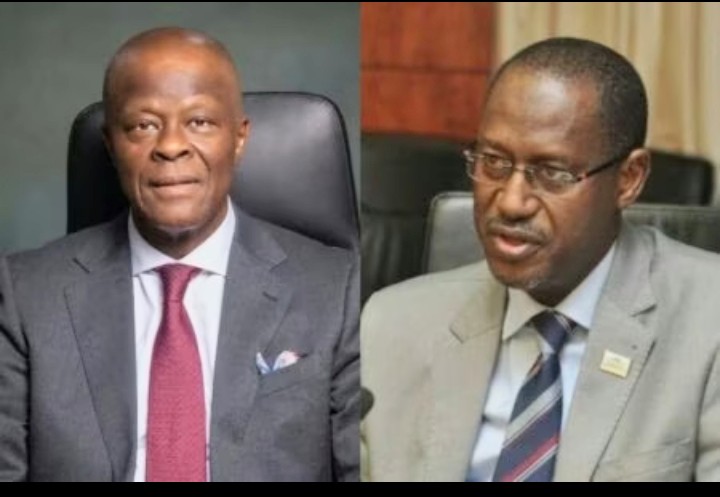
…Elevates Oyedele to Finance Minister; Darma ministerial nominee
President Bola Ahmed Tinubu has approved a minor cabinet reshuffle in the membership of the Federal Executive Council.
According to a memo signed by the Secretary to the Government of the Federation (SGF), Senator George Akume, two cabinet members, Mr. Wale Edun and Arc. Ahmed Musa Dangiwa are to leave the cabinet while their replacements have been named.
Edun, until the latest development, was the Minister of Finance and Coordinating Minister for the Economy. He has been directed to hand over to Mr. Taiwo Oyedele who is now to take over as Minister of Finance and Coordinating Minister of the Economy.
Oyedele was formerly a Minister of State in the ministry.
Also Dr. Muttaqha Rabe Darma has been named as the ministerial nominee and minister designate for the Housing and Urban Development Ministry.
The memo also directed Dangiwa to hand over to the Minister of State in the ministry.
The memo stated that “all handing over and taking over processes should be completed on or before close of business on Thursday 23rd April, 2026.”
Explaining the President’s decision, Akume said: “These changes are aimed at strengthening cohesion, synergy in governance as well as achieving more impactful delivery on the economy to Nigerians, through the Renewed Hope Agenda.”
He said the President, in approving the cabinet reshuffle, has fully exercised his powers as conferred on him by Sections 147 and 148 of the Constitution of the Federal Republic of Nigeria (1999, as amended).
The President thanked the outgoing ministers for their services to the nation while wishing them the best in all their future endeavours.
The President, Akume noted, equally assured all cabinet members that “the process of reinvigoration shall be continuous.”
There were reports in October 2025 that President Bola Ahmed Tinubu was considering appointing a new Minister of Finance and Coordinating Minister for the Economy, following the deteriorating health condition of Mr Wale Edun, who has been a key figure in the administration’s economic management team since August 2023.
Edun, a seasoned economist, banker, and former Lagos State Commissioner for Finance, has been widely credited with steering Nigeria’s fragile economy through some of its most challenging moments since Tinubu assumed office.
Edun’s appointment as Finance Minister and Coordinating Minister for the Economy on August 21, 2023, was one of the earliest signals of President Tinubu’s intent to assemble a reform-driven cabinet.
A long-time ally and financial adviser to the president, Edun was tasked with restoring fiscal discipline, stabilising the exchange rate, and attracting investment into critical sectors of the economy.
Under his stewardship, the Ministry of Finance initiated several bold reforms aimed at repositioning the economy for sustainable growth.
Chief among these was the coordination of the federal government’s fiscal and monetary policy alignment with the Central Bank of Nigeria (CBN), which helped stabilise the naira after months of volatility.
Edun also oversaw the introduction of new fiscal transparency measures, including the automation of public revenue collection systems and the expansion of the Treasury Single Account (TSA) framework to block leakages.
These initiatives boosted government revenue and improved fiscal accountability across Ministries, Departments, and Agencies (MDAs).
Among Edun’s major achievements was the formulation and implementation of the Accelerated Fiscal Policy and Tax Reform Committee, which produced policy recommendations that simplified Nigeria’s complex tax system, enhanced ease of doing business, and improved compliance.
He was also instrumental in the federal government’s decision to remove fuel subsidies and redirect savings into productive investments, such as infrastructure, agriculture, and social welfare programmes.
Though controversial, the move was seen by international partners and local economists as a necessary step toward fiscal sustainability.
Another key milestone during his tenure was the debt restructuring framework, which focused on reducing the cost of debt servicing through innovative instruments and negotiations with multilateral lenders. This helped free up resources for critical development projects.
The minister further championed Nigeria’s re-engagement with global development finance institutions, leading to renewed support from the World Bank, the African Development Bank (AfDB), and other international partners for infrastructure financing, climate transition funding, and youth empowerment programmes.
Edun’s leadership also saw the successful introduction of the Economic Stabilisation and Growth Plan (ESGP) — a blueprint for boosting domestic production, attracting foreign direct investment, and promoting job creation.
Discover more from TheTimes Nigeria
Subscribe to get the latest posts sent to your email.