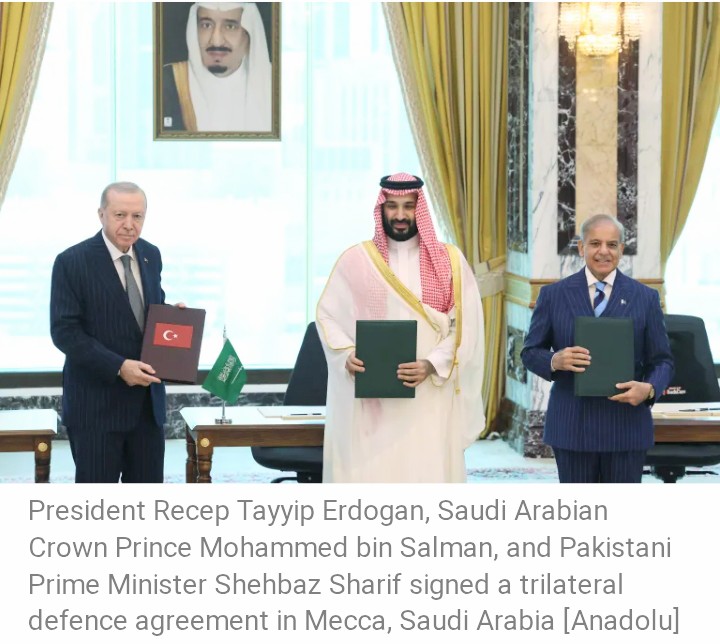
The agreement states that an attack on any one of the three countries is an attack against them all…
Saudi Arabia, Pakistan and Turkiye have signed a joint defence agreement, deepening security cooperation amid heightened military tensions and conflicts in the Middle East.
A joint statement shared by Pakistan’s Ministry of Foreign Affairs and Saudi state media on Friday says the agreement states that an armed attack on any one of the three countries would be regarded as an attack against them all.
It reflects “the three states’ shared commitment to further strengthening their collective security and to promoting peace, security, and stability in the region and beyond, in pursuit of a secure and prosperous future,” the statement said.
The deal comes a day after Pakistani Prime Minister Shehbaz Sharif, accompanied by powerful army chief Asim Munir, arrived in Saudi Arabia and performed the Umrah pilgrimage in Mecca.
Turkish President Recep Tayyip Erdogan also travelled to Saudi Arabia on Friday to meet Saudi Crown Prince Mohammed bin Salman, whose country has been struck repeatedly by Iran, as well as by Tehran’s Houthi allies in Yemen and Shia armed groups in Iraq, since the US and Israel attacked Iran on February 28.
The conflict has imperilled Saudi Arabia’s oil exports and ambitious development plans, and raises big questions about the reliability of its longstanding US security umbrella.
While Turkiye and Pakistan have avoided significant direct attacks, both are anxious to calm regional conflicts that threaten their security and economies.
The deal, named the “Mecca Joint Defence Agreement”, follows nearly a year of negotiations. Sealing the agreement in Mecca, the holiest site in Islam, adds symbolic heft to a pact that builds on longstanding bilateral military ties.
Pakistan has provided training and technical assistance to Saudi forces for decades, while Turkiye and Pakistan have exchanged warships and training aircraft. In 2023, Riyadh agreed to buy Turkish drones in what Ankara called its largest defence export contract.
Abdulaziz Alghashian, a senior non-resident fellow at the Gulf International Forum, told Al Jazeera that the tripartite alliance sought to merge “deterrence and diplomacy”.
While the pact is not against any specific actor, the analyst said it was a formula to move the region towards more stability.
Retired Pakistani major-general Zahid Mahmood expressed a similar view, saying the intent was “collective security”. By joining forces, the three signatories would “collectively approach the challenges the region is facing, and help achieve stability and peace,” he said.
While the joint statement did not specify the exact military commitments or operational obligations under the agreement, it said the partnership seeks to strengthen regional security while promoting peace, stability and cooperation.
A Turkish official described the agreement as purely defensive, stressing that it was not targeted at any specific country.
“The agreement is defensive in nature, is not directed against any specific actor, is open to other regional countries, and does not abrogate or replace any existing bilateral or multilateral arrangements,” the official said.
The three countries have expressed growing concerns over the deteriorating security situation in the Middle East, particularly amid heightened military tensions involving Israel and Iran.
The regional crisis has intensified following attacks involving Iran, its allied groups and Israeli forces, with several Gulf states facing missile and drone threats while maritime trade through the strategic Strait of Hormuz has also been severely disrupted.
Speaking on the significance of the agreement, Chairman of the Gulf Research Center, Abdulaziz Sager, said the alliance reflects a growing desire among influential Muslim nations to coordinate more closely on regional security.
“The political symbolism of the summit is significant. Three of the Muslim world’s most influential states are convening at a moment of heightened uncertainty, showing a growing willingness among regional and middle powers to coordinate more closely on security matters,” Sager said.
He added: “If institutionalised and translated into concrete cooperation, the trilateral framework could strengthen the three countries’ collective diplomatic and defence weight while contributing to the emergence of a more regionally driven security architecture.”
Turkey possesses NATO’s second-largest military, Saudi Arabia remains one of the world’s leading oil producers and custodian of Islam’s two holiest mosques, while Pakistan is the only Muslim-majority nation with nuclear weapons.
The defence agreement comes as Saudi Arabia continues to face security challenges from attacks linked to Iran and allied armed groups, while Gulf countries remain concerned about the impact of the conflict on regional stability and global energy supplies.
The pact also builds on existing defence cooperation among the three countries. Pakistan has provided military training and technical support to Saudi Arabia for decades, while Turkey and Pakistan have maintained extensive defence collaboration involving naval assets, military aircraft and joint training programmes.
In 2023, Saudi Arabia signed what Ankara described as its largest defence export agreement for the purchase of Turkish drones.
According to Reuters, Pakistan has also deployed approximately 8,000 troops, fighter jets, drones and air defence systems to Saudi Arabia as part of broader security cooperation between both countries.
Analyst Mansoor Ahmed of the Australian National University’s Strategic and Defence Studies Centre said the partnership combines Pakistan’s and Turkey’s defence manufacturing capabilities with Saudi Arabia’s financial and technological resources.
However, he noted that the agreement is unlikely to extend to Pakistan’s nuclear capabilities, which remain primarily focused on its strategic rivalry with India.
The defence pact follows nearly a year of negotiations and reflects increasing efforts by regional powers to develop home-grown security arrangements amid persistent instability across the Middle East.
Discover more from TheTimes Nigeria
Subscribe to get the latest posts sent to your email.