…Speaks on IS school hijab crisis
The Sultan of Sokoto and President-General of the Nigerian Supreme Council for Islamic Affairs (NSCIA), Alhaji Muhammad Sa’ad Abubakar, has urged Nigerians to rise above ethnic and religious differences, stressing that national unity, mutual respect and peaceful coexistence remain indispensable to the country’s progress and development.
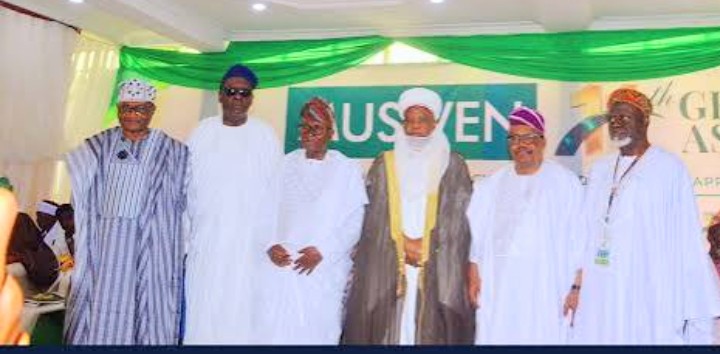
The Sultan, who spoke Sunday at the 11th General Assembly of the Muslim Ummah of South West Nigeria (MUSWEN), held at the University of Ibadan Central Mosque Auditorium, Ibadan, Oyo State, warned against allowing ethnic considerations to determine relationships, leadership positions or the unity of Muslims across the country.
The event was themed, “Insecurity in Nigeria: A Technology-Driven and Collective Approach for National Development”.
Addressing Muslim leaders, traditional rulers, Islamic scholars and other dignitaries at the gathering, the Sultan described Muslims across Nigeria as members of one family, irrespective of their ethnic backgrounds, and urged them to place their faith and commitment to the teachings of Islam above sectional interests.
He said, “We are one big family. There is no ethnicity that will determine who is number one, who is the second. Allah created us and ordered us to worship Him and Him alone.”
The Sultan maintained that religious devotion, piety and service to humanity should guide the conduct of Muslims, noting that the strength of the Islamic community lay in its unity, discipline and commitment to the principles of justice and peaceful coexistence.
He commended MUSWEN for sustaining its activities since its establishment in 2008, recalling his consistent participation in its General Assemblies and acknowledging the contributions of the organisation to the advancement of Islam and the welfare of Muslims in the South-West. He also urged Muslims to pay greater attention to their health, stressing that sound health was essential to effective service to Allah and humanity.
The Sultan also reacted to comments that he has refused to talk on the controversies surrounding the use hijab by female Muslim students, particularly at the International School, University of Ibadan, being the Chancellor of the university.
Sultan Abubakar while urging Muslims to hold on to the unity of the Ummah, said, “People should remember that Muslims are law-abiding people and they cannot take up arms, because there must be peace, stability and development of the country.
“We have been doing what is expected of us on the issue of hijab privately and silently as a leader. We don’t have to go to the media to say publicly what we have been doing. We cannot make public statement since the issue is in the court, to avoid contempt of court,” the Sultan said.
He called on the Muslims, especially in the South-West states having challenges on the hijab issue, to be patient, law-abiding and follow the rules of law, adding that it was unfortunate that this was happening.
Abubakar called on Muslims organisations agitating on the use of hijab to continue, adding that victory would surely come at the end of the day.
“The constitution guarantees us the freedom of religion, and nobody can stop us from doing what is expected of us as Muslims.
“What is happening to us as Muslims is a challenge from Allah, because we have been sleeping for too long and we must wake up from our slumber.
“Muslims are divided and we must be united; we should not allow politicians to take us for a ride, because every issue has been politicised in the country. Muslims, not only in Nigeria but throughout the world, are facing serious challenges and have bigger task ahead of them,” he said.
As part of efforts to promote educational development, 12 female medical students, comprising two beneficiaries from each of the six South-West states, are to benefit from the Sultan Abubakar Female Medical Student Scholarship Scheme.
The Chairman of the MUSWEN Board of Trustees, Dr Abdul Rauf Olawale Babalakin, SAN, urged stronger collaboration among Muslim organisations in the South-West, saying unity and a shared sense of purpose were essential for the community to make greater contributions to society.
Babalakin identified education, technology and sustainable funding as key pillars for the organisation’s growth.
He also urged Muslims to reject extremism and embrace peaceful engagement, noting that a stronger institutional structure would enable MUSWEN to deliver more effectively on its objectives.
In his remarks, the outgone Executive Secretary of MUSWEN, Prof. Dawud Noibi, urged Muslims to come out strongly against attempts by some external forces to divide them along political, ethnic and regional lines.
Noibi called on them to work harder to stop what he called sad developments, in the interest of Islam and the peace of the nation.
The executive secretary, whose tenure end on Sunday after spending 11 years, appealed to the peace-loving people of Nigeria, especially Muslims and Christians, not to succumb to agents of division and remain at peace with one another, in spite of their religion and ethnic differences.
While delivering his lecture entitled “Muslim Unity and Contemporary Political Challenges in Nigeria”, Prof. Muhib Opeloye called on Muslims in the parliament to always unite, not only on matters concerning Islam, but also on issues of national interest, irrespective of their political affiliation.
The assembly also witnessed the inauguration of Alhaji Rafiu Adisa Ebiti as MUSWEN President, alongside Tabit Wale Sonaike as Deputy President I and Jamiu Ekungba as Deputy President II.
In his inaugural address, Ebiti, who succeeded Alhaji Rasaki Oladejo, pledged to strengthen the organisation’s commitment to national unity, interfaith harmony, educational advancement, economic empowerment and social welfare, while maintaining its non-partisan character.
He said MUSWEN would continue to engage governments constructively on issues affecting Muslims and the wider society, insisting that religious extremism, ethnic bigotry and discrimination had no place in a country whose diversity should be managed through justice, mutual respect and peaceful coexistence.
Against the backdrop of preparations for the 2027 general elections, Ebiti called on political parties, candidates and their supporters to conduct their campaigns peacefully and reject violence, intimidation, hate speech and vote-buying.
He equally urged Muslims to participate actively in the electoral process by obtaining their Permanent Voter Cards (PVCs) and voting conscientiously for candidates with the capacity to deliver good governance.
Ebiti, who served as deputy president I under Oladejo for six years, identified education, youth and women’s empowerment, healthcare, social welfare and sustainable economic development as major priorities of his administration.
He also pledged to strengthen the MUSWEN Endowment Fund, which stood at N437 million as of October 21, 2026, with a view to expanding its capacity to provide sustainable financing for the organisation’s programmes and interventions.
Earlier, the outgoing president, Oladejo, disclosed that MUSWEN recorded a financial surplus of N52.963 million in 2025, compared with N44.443 million in 2024, representing an increase of approximately 19 per cent.
He also announced plans to award bursaries to 120 deserving students in 2027, with a long-term target of increasing the number of beneficiaries to 600 annually.
Discover more from TheTimes Nigeria
Subscribe to get the latest posts sent to your email.