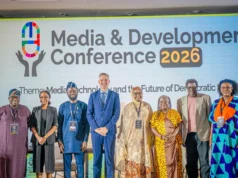
The founder of Connected Development (CODE), Mallam Hamzat Lawal, has resumed duty after one year of study leave at the University of Sussex, United Kingdom, saying his return is not a mere homecoming but a return to work for humanity.
Lawal, who stepped aside on September 1, 2025 to pursue a Master’s degree in Governance, Development and Public Policy at the Institute of Development Studies as a Chevening Scholar, announced his resumption in Abuja on Monday, at a media parley.
He thanked the Board of Trustees (BoT) and Acting Chief Executive, Hyeladzira James Mshelia, who led the organisation in his absence.
“Hyeladzira did not keep the seat warm. She led,” Lawal said.
He noted that under Ms Mshelia leadership, “Follow The Money tracked public funds across 12 African countries in 2025, including 4,772 schools, and launched in Sierra Leone. CODE also trained over 450 students, launched Project Track-BHCPF in Adamawa and Kano, and was selected for the CIVICUS Digital Democracy Initiative to scale iFollowTheMoney.
Launches new report: Online Misogyny Pays
Lawal used his resumption to launch a new report, ‘Gender and Feminist Misrepresentation in Nigeria’s Digital Environment’, by Social Voices Media and Development Foundation, with support from the Hamzat Lawal Initiative and CODE.
The media parley was also attended by Agemo Olubukola Miriam, Trade Facilitation Liaison, International Trade Center; and Oluwasuen Durojaiye, Managing Editor, Social Voices Media, who asked citizens to consider the shrinking space for Nigerian wormen as a serious matter that must be concertedly addressed for steady national development.
The study, ahead of the 16 Days of Activism against Gender-Based Violence, observed 282 posts and threads on Facebook and X from August to October 2025.
It found that feminism is widely misrepresented online as anti-men, anti-marriage or culturally deviant, while women who identify as feminists are framed as bitter or morally flawed.
“Misogyny pays. Posts that ridicule, demean or sexualise women consistently attract the most interaction. Some influencers deliberately stoke ‘gender wars’ to farm engagement,” Lawal said.
The report also found that survivors of abuse are doubted, misinformation travels faster than corrections, and women are judged on morality, not merit. It called for stronger moderation, digital literacy and clearer legal protections.
Lawal called on platforms to act faster on gendered abuse, and on parties and candidates to publicly reject online attacks on women.
Asks citizens to vote and audit promises
Lawal also formally announced CODE’s 2027 Election Observation Mission.
He noted that Nigerians will vote on Saturday, January 16, 2027 for Presidential and National Assembly elections, and on Saturday, February 6, 2027 for Governorship and State Houses of Assembly elections.
The CODE CEO said that the organisation will deploy Uzabe, its citizen-led observation platform built with Ushahidi, which powered its observation of the 2015, 2019 and 2023 elections.
He recalled that in 2023 alone, CODE deployed over 20,000 observers across the 36 states and FCT.
He said, “We are not interested in who wins. We are interested in how they win.”
He also said that observers will monitor PVC collection, vote buying, BVAS performance, secrecy of ballot, and crucially, electronic transmission of results to IReV. He warned about Section 60(3) of the Electoral Act 2026, which allows manual results to take over in case of undefined “communication failure.”
“We will document every instance in which that exception is invoked,” he said.
State of the nationOn the state of the nation, Lawal bemoaned the insecurity plaguing the country.
He noted that Thursday, November 26, marks one year since the Federal Government declared a nationwide security emergency after over 500 people were abducted, including over 300 pupils and teachers from a Catholic school in Niger State.
“Families are still paying ransoms they cannot afford, and farmers are still afraid to go to their farms,” he said.
On the economy, he said headline inflation eased to 14.06 per cent in October 2026, but food inflation stood at 19.13 per cent, higher than 16.30 per cent a year ago.
“Macroeconomic gains that do not reach the kitchen table are not yet gains for the poor. The new tax laws which took effect January 1, 2026 must come with accountability. A tax system without accountability is not reform. It is a burden,” he said.
He also queried budget credibility, noting that the N68.3 trillion 2026 budget carries N5.71 trillion for unfinished projects, while only about 18 per cent of the 2025 capital budget had been released by September 2025.
On local government, he said councils have received about N10.48 trillion since the July 2024 Supreme Court ruling on direct allocation, with 2026 alone projected at N6.5 trillion, yet direct payment is still not fully working.
On health, he said only 8,309 of over 31,000 primary health centres are functional under BHCPF, while over N32 billion sat largely unaccessed.
On education, he cited UNICEF and UNESCO estimates of 10 million to 18.2 million out-of-school children.
On civic space, he cited 245 violations documented in 2025 by the Wole Soyinka Centre, with state actors involved in 219.
“Asking questions of those who govern us is not a crime. It is the duty of every citizen. My message to the citizenry, especially young Nigerians is ‘Don’t just vote. Audit the promise’,” Lawal said.
Future ahead
Lawal equally said that he has a succession plan for the CODE as he cannot perpetually lead organisation and that he may venture into academics, politics or development activities among other plans.
Discover more from TheTimes Nigeria
Subscribe to get the latest posts sent to your email.