The Al-Habibiyyah Islamic Society (AIS) has charged religious leaders to understand and imbibe the concept and culture of philanthropy, as part of measures to tackle poverty in the country.
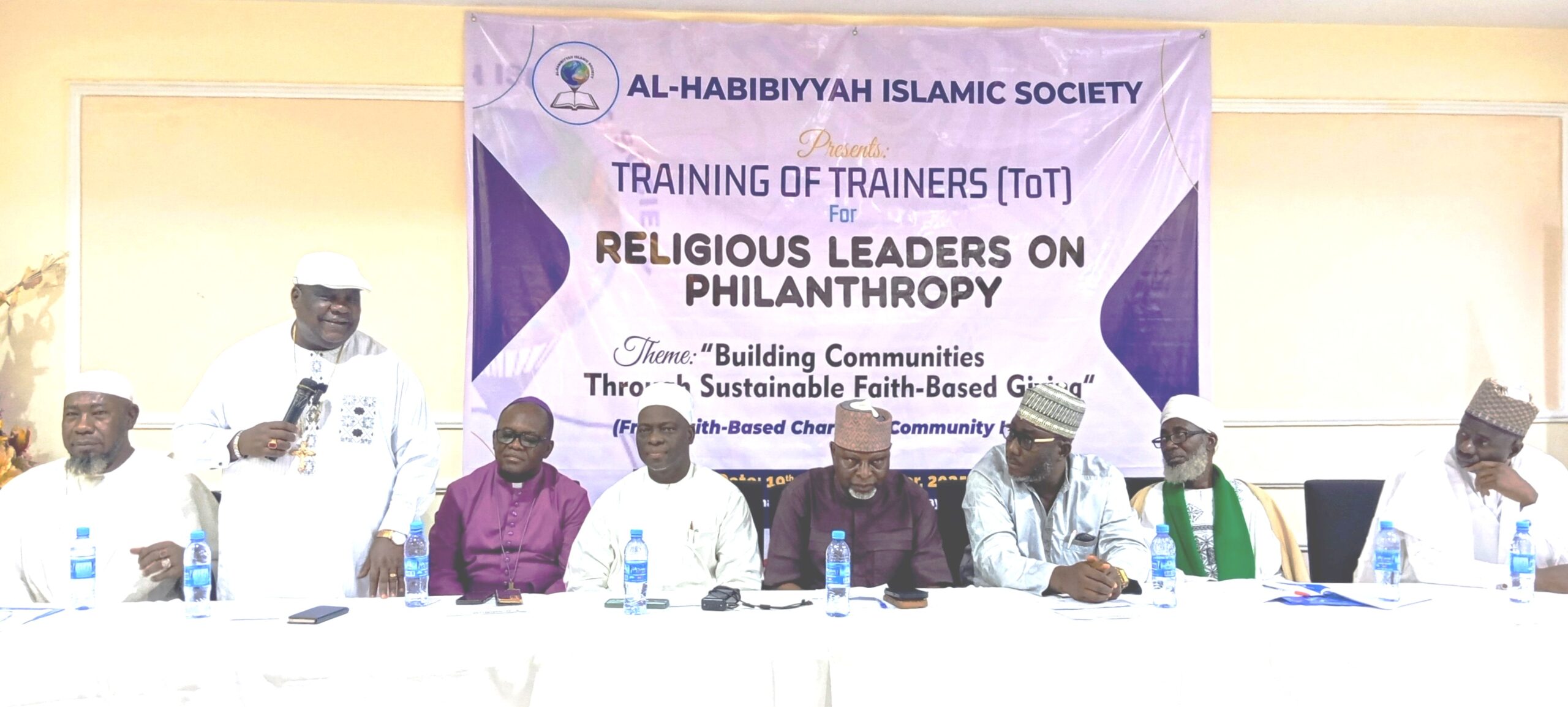
The organisation gave the charge in Abuja, during the formal openings of a three-day Training of Trainers (ToT) for Religious Leaders on Philanthropy, with the theme: “Building Communities Though Sustainable Faith-Based Giving”.
The programme organised by AIS with support from MacArthur Foundation, witnessed no fewer than 60 Muslim and Christian leaders been trained on the concept of understanding, propagating and imbibing the culture of philanthropy.
The Executive Director and National Chief Imam of Al-Habibiyyah Islamic Society, Sheik Fuad Adeyemi, said the training was organised for both faith leaders because poverty and hunger do not recognise religion.
According to him, the training was also to promote prosperity and unity among Nigerians as government could not do it alone, thus the need for solution to be collective.
“We want both faith leaders to understand the concept of giving, the concept of organising how to give in a structured way, and to go and teach people in their localities. We have to expose ourselves to tools and ways of doing things so that we can have enough resources to do things by ourselves without government.
“We want to train ourselves on how to do it so that other people here will go home and begin to practicalise it and train others. We believe the training would become widespread and touch everybody,” Adeyemi said.
He also said that imbibing the culture of philanthropy is a win-win for everyone.
“If you want to be rich, if you want to be happy, you have to make the people around you to be happy. If you want to be comfortable, you have to make the people around you to be comfortable.
“If you are thinking of yourself alone, you might be successful, but your mind will not be at rest. When we move together, we will understand ourselves better,” Adeyemi said.
The renown Muslim cleric also said that philanthropy is technical, noted that the concept of giving should be structured for maximal benefits.
He said, “We have been doing philanthropy, but it is not structured, and it is not good enough. Structured giving is imperative because we have been giving haphazardly. If it is structured giving, we know what you want to use it for.
“We can continue to pay somebody’s school fees from beginning to the end, it should be structured in such a way that he does not need to come to you again. You do not need to say where are you. You will know when it is due. You are the one who just sends it to him.”
Also speaking at the event, the Archbishop of Abuja, Northern Province, African Church, Rev. Peter Ogunmuyiwa, said the training was an eye-opener, impactful and a wonderful initiative for a religious body.
He said, “This programme speaks volume, especially to our philanthropists, who we generally called big men of our time. This is a programme that commits people’s resources to lifting people up. Many people are endowed with wonderful resources, but they do not know how to actually invest them in such a way that it will touch lives.”
Ogunmuyiwa commended the Al-Habibiyyah for synergising with the Christian community in a way that suffering will be alleviated in country.
On her part, the General Coordinator, Women’s Interfaith Council (WIC), Mrs Elizabeth Abuk, said the WIC is an association of Muslim and Christian women working together for a peaceful co-existence.
“I am happy that we are thinking alike, and we have the same idea; struggling to see that Nigeria is one, to see that we talk about humanity before any religion. If we understand this perspective in life, then we can live together as one family,” she said.
Also, Rev. Cosmos Asuquo a leader from Hand of God Church in Mararaba, Nasarawa State, commending the programme, said that he learnt a lot from the resource persons particularly on the concept of philanthropy.
Sheikh Muhammad Nuru Khalid, also known as the ‘Digital Imam’, commended Imam Faud for his efforts to being solutions to Nigeria’s challenges.
“Al-Habibiyyah represents one of the solutions that Nigeria needs. Particularly in the Northern region, we face numerous issues such as insurgency and mistrust. However, if all Islamic scholars in Nigeria, especially in the North, operated with the vision of Imam Faud, we would not witness claims of Christian genocide in Nigeria.
“His commitment to interfaith dialogue demonstrates that he transcends sectarian divisions within the Islamic community. The Nigerian populace is signaling to the world that the government cannot meet all our needs—be it in education for our children, healthcare for our women, or overall quality of life.
“The solution lies in the wealthier members of society contributing financially through corporate social responsibility initiatives. We must understand that religion is not solely about worship; it must also address our social issues. Initiatives like this foster social connections and corporate responsibility towards one another,” Sheikh Khalid said.
On his part, the founder and chairman of Ashraaf Islamic Foundation, Dr Sharafudeen Aliagan, said that the theme of the event has lots of connotations.
According to him, if an imam or pastor, is stingy as individuals, it would not work.
“Until you have a spirit of giving, there cannot be sustainability. What do we now do with imams and pastors that ae stingy? We need to speak with them first so that this idea can work and be well established.
“Worshiping in the mosques and churches does not solve certain problems. Why should the imams or pastors be getting richer and the followers getting poorer? So we have to create jobs for the followers,” Aliagan said.
Discover more from TheTimes Nigeria
Subscribe to get the latest posts sent to your email.