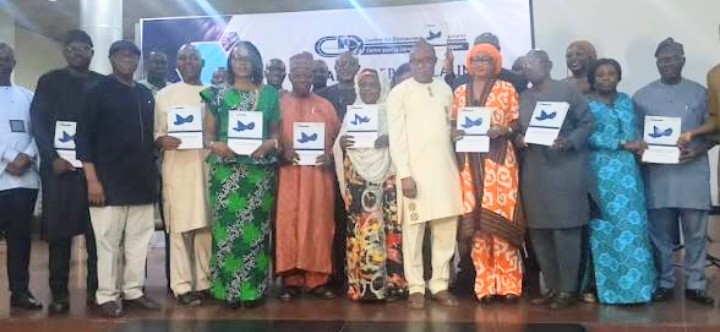
The Centre for Democracy and Development (CDD West Africa) has formally unveiled a report examining the political, security and development challenges in the Sahel.
The report has a priority focus on the growing influence of military-led governments in the region.
The research, jointly carried out by CDD-West Africa and Ivoirian Observatory for Human Rights, was tagged: “Security, Resource Governance and Development Trajectories: A Comparative Assessment of Post-Coup Governance in the Sahel”.
Speaking at the unveiling of the report in Abuja, the Director of CDD-West Africa, Dr. Dauda Garuba, said it reflected the centre’s commitment to deepening democracy, promoting conflict prevention and advancing people-centred development across West Africa.
According to him, the Sahel had continued to face complex and evolving challenges, particularly the rise in military takeovers, with significant socio-economic and political consequences for affected countries.
“The report provides a comparative and multi-dimensional assessment of governance, security and development trends in the region.
“It explores how military administrations influence resource allocation, civil liberties and cross-border mobility, while also analysing the strategies adopted by the Alliance of Sahel States (AES) to consolidate legitimacy and respond to terrorism threats,” Garuba said.
He noted that the report builds on its earlier ones on military populism and the formation of the AES bloc, offering deeper insights into measurable trends, societal impacts and regional interdependence.
Garuba expressed hope that the report would stimulate informed debate and provide practical policy direction for governments, civil society and other stakeholders.
The CDD boss stressed the need for collaborative efforts to address insecurity, while balancing cooperation, trust and strategic interests in a rapidly changing West African landscape.
Presenting the findings of the report, Dr Lassane Ouedraogo, said that the most pressing and long-term challenge facing West Africa was not terrorism itself but the deep disunity it had created across the region.
According to him, while terrorism remained a serious concern, its wider consequences were even more troubling.
“These include military takeovers, the formation of new political alliances and the withdrawal of some countries from ECOWAS. All of these developments are interconnected and continue to reshape relationships within the region.
“In examining the relationship between ECOWAS member-states and their Sahelian neighbours, it becomes clear that countries are responding differently to the crisis.
“Some nations have adopted a pragmatic approach, separating their security concerns from economic and diplomatic relations, and continuing engagement, where necessary.
“Others, however, treat these issues as inseparable, responding with a more rigid stance that combines security, political and development concerns into a single framework.
“This divergence in approach is contributing to growing disunity and weakening cooperation among regional institutions. Instead of fostering collective action, it is leading to disengagement and fragmentation across West Africa,” Ouedraogo said.
In his part , a former Director of CDD-West Africa and Chairman of the occasion, Prof. Jubrin Ibrahim, called for a reflection on why citizens in the Sahel favoured presently military regime.
Ibrahim, a senior fellow at the CDD-West Africa, said the report urged a shift from focusing solely on terrorism to addressing the fundamental needs and livelihoods of citizens.
He said that military regimes in the Sahel, in spite of democratic setbacks, were gaining popular legitimacy and prompting a broader reflection on the effectiveness of democracy in West Africa.
“They are engaged in trying to demonstrate to their citizens that they are there to address issues that are fundamental to the lives and livelihoods of the ordinary people in the Sahel,” Ibrahim said.
In a goodwill message, the First Secretary, High Commission of Canada in Nigeria, Colton Brydges, said any investment in prevention of coups and stabilisation of democratic government was important.
He said, “In a region where democracy hasn’t delivered for so many people, hasn’t delivered economically for so many people, alternatives, whatever they may be, are attractive to people.
“It’s good to see that there’s been some progress toward reinvigorating regional alliances around security. We hope that those will continue to bear fruit.”
On his part, the Secretary-General, Conference of Speakers and President of African Legislators (COSPAL), Amb. Dapo Oyewole, said that the organisation believed that no unconstitutional change of government could substitute the long-term benefits of democracy.
He said that the development without inclusion is unsustainable, adding that resource governance without transparency and parliamentary oversight is an invitation to conflict.
Discover more from TheTimes Nigeria
Subscribe to get the latest posts sent to your email.