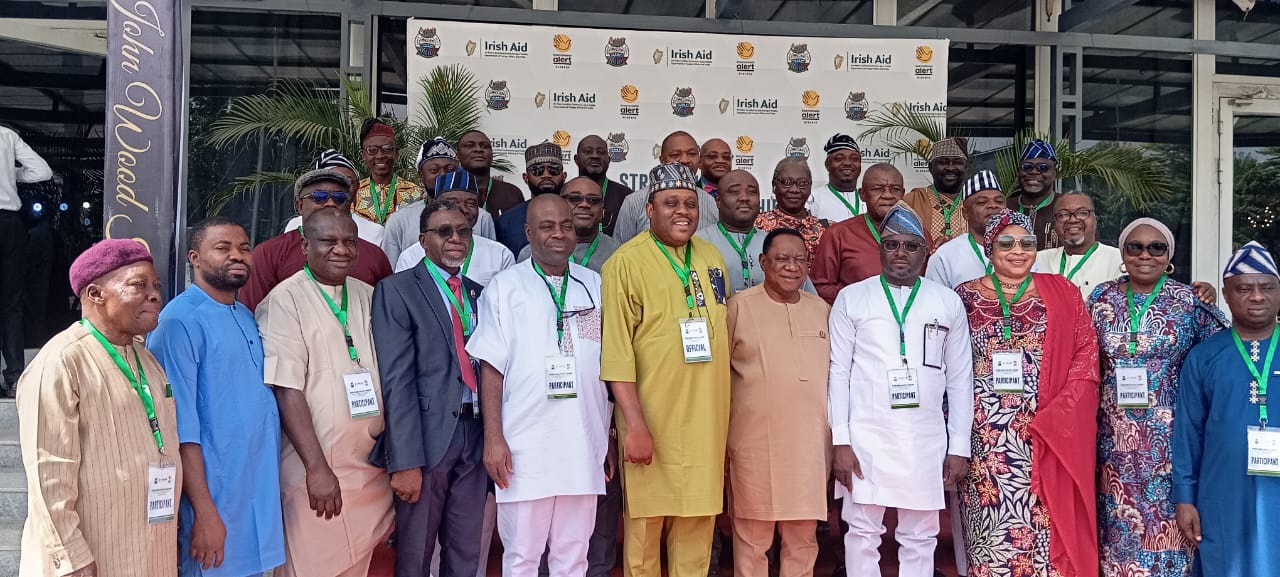
The International Alert-Nigeria, in collaboration with Benue State Government, with support from Irish Aid has trained the Benue State Assembly lawmakers to enhance their understanding on climate change governance for better legislative actions.
The one-day training and sensitization on climate change for members of Benue State House of Assembly, was part of measures to tackle farmer-herders clashes, flooding and other negative impacts associated with climate change in the state.
It was also part of consideration of the resolutions of the 2025 United Nations Climate Change Conference (UNFCCC) or commonly known as Conference of the Parties (COP), with the 30th session or COP30 held at the Hangar Convention Centre in Belém, Brazil, from 10 to 21 November 2025.

Speaking at the event, Governor Hyacinth Alia of Benue assured of the commitment of his administration to strengthening climate resilience and environmental governance with a view to address the climate change challenges with immediate and lasting measures.
Governor Alia, represented by his Principal Private Secretary, Dr. Emmanuel Chenge, called for urgent legislative support to strengthen climate governance and safeguard Benue’s future.
The training, with the theme ‘Strengthening Legislative Leadership for Developing Climate-Resilience and Carbon Budgeting in Benue State’ was organised by International Alert and Benue State Council on Climate Change (BSCCC) with support from Irish Aid.
The governor noted that climate change now posed an existential threat to Benue’s agriculture, environment, security and economy.
He said that Benue, which is recognised as Nigeria’s Food Basket, is experiencing increasing environmental shocks that endanger its people and economy.
He listed key challenges including recurring floods in Makurdi, Guma, Agatu, Katsina-Ala and other riverine LGAs, erratic rainfall leading to reduced crop yields, rising temperatures affecting health and water security, forest degradation and biodiversity loss, worsening pressure on natural resources due to population growth and poverty.
He also linked climate change directly to Benue’s long-standing security challenges, especially farmer–herder conflicts.
“The drought in the north and Benue’s fertile lands pushed herders downwards, leading to clashes. Climate change is at the centre of our security crisis,” Alia said.
He said that tackling climate change required strong legislative backing and urged lawmakers to strengthen the legal framework by passing and updating the Benue State Climate Change Law.
He urged the lawmakers to collaborate with the Climate Change Council to develop a carbon budgeting framework among others.
Speaking earlier, the Country Director of International Alert Nigeria, Dr. Kingsley Udo, commended Benue State for establishing Benue State Climate Change Council, describing the council as ‘a visionary, genius structure’.
Udo linked climate change directly to food insecurity and growing conflict across Nigeria.
“The food basket of the nation is no longer producing as before. It is not because the farmers are lazy, they are willing to work. The climate has changed. Poor soil quality, unpredictable weather and flooding have reduced yields,” he said.
The International Alert country director said the training is essential because Benue’s declining agricultural productivity is worsening hunger and could trigger more conflict.
He said, “When the food basket of the nation can no longer feed the country, hunger will increase, and conflict will rise. That is why this convergence is important.”
Also, the Director-General of the Benue State Council on Climate Change, Dr Aondofa Mailumo, said that accessing global funds such as the Green Climate Fund and Adaptation Fund required strong state laws, clear carbon budgeting structures and strict climate reporting obligations.
“Without supportive legislation, climate policies remain aspirations. With strong laws, they become instruments for real transformation,” he said.
The Speaker of Benue House of Assembly, Alfred Emberga, pledged the lawmakers’ commitment to passing strong climate laws in collaboration with the Climate Change Council.
Emberga highlighted the dangers of indiscriminate tree felling for charcoal and the need for stringent penalties.
“The Assembly will continue to work with the Executive to introduce bills that strengthen climate protection and carbon budgeting,” he said.
On her part, the Benue State Assembly Deputy Speaker, Lami Ogenyi, drew attention to the gendered impacts of climate change, noting that women, especially widows and single mothers, bear the brunt of floods, displacement and declining farm productivity.
She said, “Women work harder now to get enough crops for their families. Flooding has rendered many homeless and vulnerable.”
She promised to champion gender-responsive climate budgeting to ensure more funds to address the challenges.
On his part, Dr. Andrew Shember, the Special Adviser on Climate Change to Borno State Governor Babagana Zulum, said that a strong subnational climate governance, requires both legislative leadership and coherent carbon positive frameworks that guide transition to resilience. He noted that the Benue State Climate Change Act that has recently been operationalized is quite a commendable step forward to achieving these objectives and the gathering provides an opportunity to translate policy into coordinated collective action.
He said, “For us in Borno State, where the impact of climate change intersects decades of conflict, as you are all aware, the urgency of building climate resilience is not theoretical, but has to be practical. And this can be seen in the practical steps that are being taken by both the Borno State House of Assembly and our able governor, Prof. Babagana Umara Zulum.”
Discover more from TheTimes Nigeria
Subscribe to get the latest posts sent to your email.