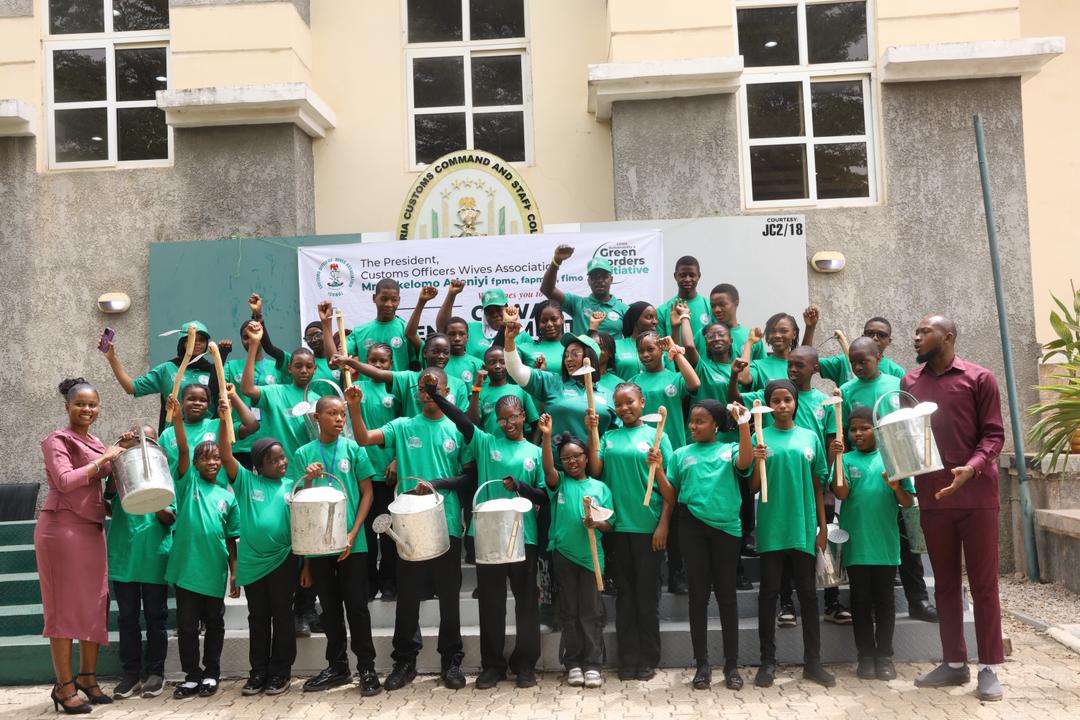
The Customs Officers’ Wives Association (COWA) has hosted an Environmental Education Workshop in Abuja under its Green Borders Initiative, formally launching a coordinated national climate action framework to be implemented across State Commands.
The workshop, held on February 19, 2026, at Ahmed Makarfi Hall, TRADOC, Gwagwalada, brought together senior government officials, COWA members, Customs barracks residents, environmental agencies, private sector stakeholders, civil society organisations, and youth representatives.
The initiative aligns with national environmental priorities advanced by the Federal Ministry of Environment and the National Council on Climate Change.
Speaking at the event, COWA President, Mrs. Kikelomo Adeniyi, described environmental responsibility as an extension of national service.
She said sustainable communities are vital to national prosperity and noted that the Green Borders Initiative institutionalises structured environmental action across Customs communities. She added that the programme remains open to strategic partnerships to expand its impact nationwide.
Delivering the keynote address, the Honourable Minister of Environment, Balarabe Abbas Lawal, commended COWA for aligning its theme, “Green Barracks, Green Borders: Advancing Environmental Stewardship for a Sustainable Future,” with the country’s environmental restoration agenda.
The minister highlighted ongoing nationwide sensitisation campaigns, land restoration efforts under the ACReSAL project, investments in recycling infrastructure, and the issuance of a Sovereign Green Bond as part of structured environmental financing efforts.
In a goodwill message delivered on behalf of the Director-General of the National Council on Climate Change, the council reiterated Nigeria’s climate commitments under the Paris Agreement and its Nationally Determined Contributions (NDC 3.0), which target net-zero emissions by 2060. The council described the Green Borders Initiative as a practical citizen-led model capable of promoting sustainability, advancing green economy principles, and strengthening resilience in border communities.
The workshop focused on three thematic areas: understanding climate change and its local impacts; the role of trees in carbon absorption, flood prevention, and air purification; and the 3Rs of waste management — Reduce, Reuse, and Recycle. Participants also received practical demonstrations on waste separation and responsible consumption.
At the end of the session, participants adopted several resolutions, including the institutionalisation of Monthly Clean Barracks Days, the launch of structured state-level tree planting programmes, the establishment of youth eco-clubs, adoption of a national tree planting protocol, and a commitment to quarterly environmental impact reporting.
The Abuja workshop marks the beginning of a national rollout across State Commands. Planned activities include structured tree planting programmes, waste management initiatives, environmental education workshops, and youth engagement platforms.
COWA said it would contribute to a national target of planting 50,000 trees and reaffirmed its commitment to promoting measurable, women-led environmental action aimed at strengthening institutions, improving public health, and supporting national development.
Discover more from TheTimes Nigeria
Subscribe to get the latest posts sent to your email.