The Federal Government has harped on implementation of comprehensive, data-driven, and effective Early Warning and Early Response (EWER) system to address the multitude of peace and security challenges confronting the world.
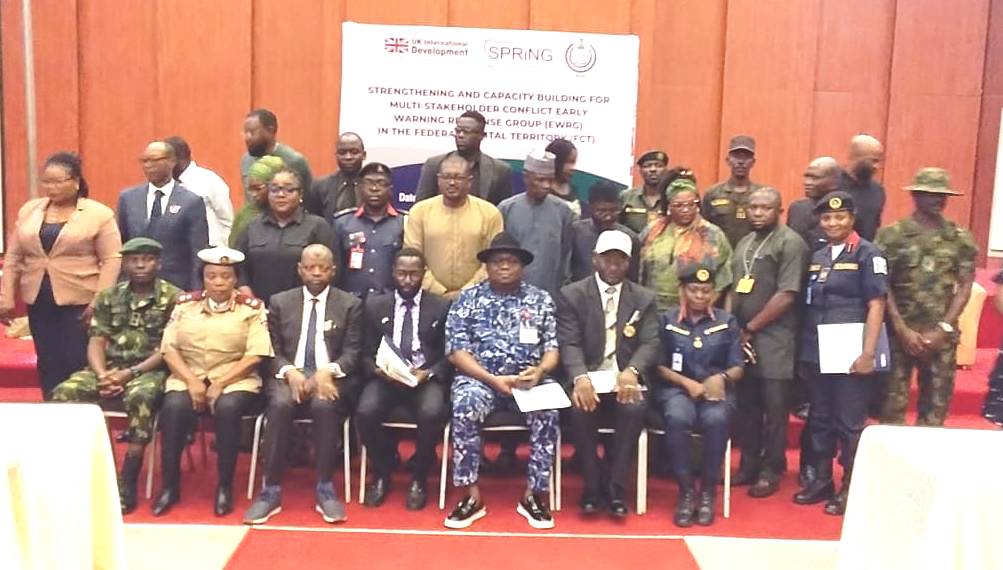
The Minister of Foreign Affairs, Ambassador Yusuf Maitama Tuggar made the call Wednesday at the Engagement Session on “Strengthening and Capacity Building of the National Early Warning Response Group (EWRG)”, held at the Institute of Peace and Conflict Resolution (IPCR) Abuja.
The event, organised by the IPCR in collaboration with Strengthening Peace and Resilience in Nigeria (SPRiNG), a project of the British Foreign, Commonwealth and Development Office (FCDO), was described as a reflection of the strong bilateral cooperation between Nigeria and the United Kingdom.
The minister represented by Spokesperson, Ministry of Foreign Affairs, Mr. Kimiebi Imomotimi Ebienfa, highlighted major drivers of these challenges to include climate change and the proliferation of Small Arms and Light Weapons (SALW), which continue to undermine livelihoods and socio-economic development, particularly in the Sahel and across Africa.
“We must acknowledge the imperative of a comprehensive, data-driven, and effective Early Warning and Early Response (EWER) system in addressing the multitude of peace and security challenges confronting the world.
“The global community has, over time, grappled with violent conflicts and insecurity, including political instability, banditry, terrorism, violent extremism, and transnational organised crime,” he noted.
While recognizing that the engagement session is an initiative of one of the foremost institutes under his supervision, the IPCR, in collaboration with the SPRiNG -a laudable project of the FCDO, he emphasized that the partnership reflects not only the strength of Nigeria’s bilateral cooperation with the FCDO but also foresight in deepening engagement and collaboration among members of the EWRG towards building an effective EWER system.
“This initiative, without a doubt, demonstrates your dedication and commitment to fulfilling your mandate, particularly in preventing conflict, building resilience, enhancing security, promoting regional cooperation, and ensuring socio-economic development in Nigeria and across Africa.
“Nigeria has continually evolved strategic pathways to confront these challenges and address threats to peace and security both within our nation and across Africa,” he said.
The minister identified that these interventions are in line with the tenets of the 4-D Foreign Policy Doctrine of President Bola Tinubu’s administration, which prioritises development, diaspora, demography and the pursuit of democratic consolidation, regional stability, and global peace.
He said, “Our intervention in the recent coup in the Benin Republic underscores Nigeria’s proactiveness and effectiveness in responding to political crises and insecurity across the continent.
“The convening of today’s Capacity Building Engagement Session further accentuates Nigeria’s resolve to strengthen its Conflict Early Warning and Early Response System for peaceful coexistence, security, and stability.
“In essence, we are committed to enhancing collaboration, improving early warning reporting, and strengthening corresponding responses from stakeholders across the peace and security ecosystem in Nigeria and Africa.”
He also expressed confidence that the engagement will serve as a pathway to holistically preventing violent conflicts, fostering unity and peaceful coexistence, enhancing justice and inclusivity, improving food security, and ensuring economic growth and development.
Speaking earlier, the IPCR DG, Dr. Joseph Ochogwu, noted that over the years, Nigeria’s EWER framework has remained fragmented, insufficiently collaborative, and weakly coordinated.
According to him, these challenges have significantly constrained the ability to deliver timely, integrated, and proactive responses to the diverse and complex security threats confronting our communities.
He said that addressing these gaps is imperative if we are to prevent the escalation of conflicts and build sustainable peace.
“The EWRG was established on 1 August 2023 to enhance rapid and coordinated response mechanisms at the national, state, and community levels. The national EWRG at the federal level, based here in the FCT and also referred to as the Steering Committee, occupies a critical and strategic position within Nigeria’s peace and security architecture.
“In many instances, early warning signals are generated and disseminated, yet responses are delayed or, in some cases, do not occur at all. Compounding this challenge is the limited trust by some citizens in security agencies, which discourages the timely sharing of early warning information that could trigger effective response.
“These and other systemic challenges informed the establishment of the EWRG at the national, state, and community levels,” Ochogwu said.
He said that the IPCR and SPRiNG recognize the indispensable role of security agencies, as well as key non-security actors, in the effective functioning of this Steering Committee.
He said, “The EWRG is central to accelerating timely and coordinated responses to conflict across all levels. Indeed, the response component remains the most critical element of the EWER value chain. Without an efficient and effective response mechanism, early warning signals lose their relevance and impact.”
He said that their cooperation and commitment as members of the Steering Committee are highly solicited, as their leadership and actions as response stakeholders will also serve as an example to other peace and security structures, reinforcing confidence-building, conflict prevention, and mitigation efforts across the country.
“To achieve a more robust, effective, and coordinated response to early warning signals, IPCR and SPRiNG are adopting the use of technology as a key enabler of conflict prevention. Through technological integration, we aim to harmonize and strengthen collective response efforts at the national, state, and community levels,” Ochogwu said.
Discover more from TheTimes Nigeria
Subscribe to get the latest posts sent to your email.