By Armsfree Ajanaku and Alexandra Giannopoulou
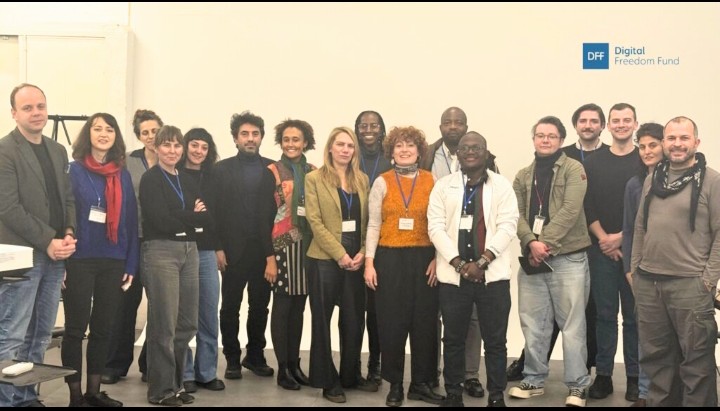
For two days in February, human rights activists, journalists, legal experts, and litigators from Europe, Africa and the Americas defied the freezing temperatures of Berlin and were brought together by the Digital Freedom Fund (DFF) to reflect, brainstorm, and strategize on the state of digital democracy.
Launch of the Digital Democracy Strategic Litigation Hub
Together, we explored how to counter human rights violations using legal pathways that hold platforms and governments accountable.
DFF used this Digital Democracy Workshop (Workshop) to launch its second Strategic Litigation Hub focusing on the topic of digital democracy, which it defines as the use of digital technologies to influence democratic conditions, institutions, practices and processes.
The premise of the Digital Democracy Strategic Litigation Hub (Hub) is that digital platforms have come to embody new forms of power over our societies — regulating speech, shaping political participation, and enabling governments to categorise, discriminate against, and monitor individuals and communities.
These platforms enable and oftentimes promote counter-democratic practices, and deepening threats to democratic institutions and processes across the world.
The objective of the Hub is to foster collaboration on strategic litigation that holds Big Tech, governments, and others accountable for technology-driven harms to democracy and human rights.
Although DFF’s primary focus is on the Council of Europe, the Hub was also opened to participants working on these issues in Africa and Latin America. More than thirty organisations were selected to work on their strategic litigation cases throughout a two-year period.
Digital Democracy Workshop Content
Through a process of co-creation and interactive facilitation, the Workshop enabled participants to reflect on common threats and specific ways to counter tech-facilitated harms to democracies across different jurisdictions.
Human rights defenders, activists, journalists, technologists and legal experts all in the frontline of human rights strategic litigation and advocacy dedicated two full days in jointly reflecting how to respond to the shrinking of civic space globally.
Throughout the two Workshop days, we unpacked many threats to digital democracy such as spyware and surveillance of activists and human rights defenders, surveillance of people on the move, hate speech and content moderation practices which lead to misinformation and technology-facilitated gender-based violence.
We took deep dives in how spyware and surveillance unfold across different jurisdictions, political systems and realities.
Participants took the opportunity to learn from each other’s experiences, whether as litigators, journalists, or as people victimised by spyware and surveillance and to explore best practices for supporting each other and those most affected.
There was consensus that human rights violations such as the ones discussed during the Workshop, have significant global ramifications.
The Workshop was filled with diverse perspectives and experiences, presenting many opportunities to discuss litigation projects and explore common challenges from many different jurisdictions across the world.
For example, under the skilled facilitation of Paloma Lara-Castro from Derechos Digitales, we were able to focus on the first judgment of the Inter-American Human Rights System addressing technology-facilitated gender-based violence.
Similarly, tèmítópé lasade-anderson from Glitch invited us to explore alternate forms of redress outside of the criminal justice system for tech-facilitated harms. In one of the last sessions of the workshop, and using the excellent framework provided by Fembloc, participants mapped out best practices and strategies for preservation and handling of digital evidence.
Against the backdrop of a democracy in peril, participants used the Workshop as an opportunity for peer learning and knowledge-sharing especially around the lived experiences of human rights defenders in diverse political contexts.
This would in turn prove crucial in the task of implementing strategic plans for future action.
The Workshop closed with the hopeful session of imagining how the Digital Democracy Hub can contribute to the intentions, goals, strategies set by participants.
We discussed in small groups and learnt about each other’s strategic litigation projects. Hub participants explored possibilities for collaboration and joint action based on similarities in the relevant issues of interest.
This way, the Workshop ended in the hopeful anticipation for developing the necessary strategies jointly to counter the destructive influence of BigTech in our democracies.
Following the insightful discussions of the Hub’s first event, we are excited to host the first online call of Digital Democracy Hub soon!
• Armsfree Ajanaku, is Executive Director, Grassroots Center for Rights & Civic Orientation (GRACO)
• Alexandra Giannopoulou, Digital Freedom Fund
Discover more from TheTimes Nigeria
Subscribe to get the latest posts sent to your email.