…Retains manual transmission of results in Electoral Act
The Senate on Tuesday rescinded its earlier decision on Clause 28 of the Electoral Act Amendment Bill, reducing the period within which the Independent National Electoral Commission (INEC) must publish a notice of election from 360 days to 180 days.
It re-amended the clause to provide that INEC shall publish a notice of election not later than 300 days before the date of the election.
The upper chamber said the rescission became necessary after it discovered errors in about 22 clauses of the bill, including Clause 60, which prescribed that electronic transmission of results be optional rather than mandatory.
With the new provision, the presidential and National Assembly elections may now be conducted in December 2026 or January 2027.
The rescission was approved after a majority of senators supported it through a voice vote at the Committee of the Whole, where the affected clauses were re-amended and reconsidered.
Last Friday, INEC Chairman, Prof. Joash Amupitan, announced that the 2027 presidential and National Assembly elections would be held on 20 February 2027.
Going by the announcement, the elections will fall within the 2027 Ramadan period.
Since then, some Muslim groups have called for a rescheduling of the polls to avoid coinciding with the fasting period.
During plenary, lawmakers re-amended the Electoral Act to empower INEC to adjust the 2027 presidential and National Assembly election dates to avoid a clash with Ramadan.
The decision followed a motion moved by the Senate Leader, Opeyemi Bamidele.
Mr Bamidele, who represents Ekiti Central Senatorial District, said holding the elections during Ramadan could adversely affect voter turnout, logistical coordination, stakeholder engagement, and the overall inclusiveness and credibility of the electoral process.
He noted that upon detailed scrutiny of the bill, discrepancies were identified in the Long Title and Clauses 6, 9, 10, 22, 23, 28, 29, 32, 42, 47, 51, 60, 62, 64, 65, 73, 77, 86, 87, 89, 93 and 143, affecting cross-referencing, serial numbering and internal consistency.
Bamidele further stated that INEC had consulted members of the National Assembly following concerns raised by some Muslim stakeholders who demanded that the elections be shifted to avoid coinciding with Ramadan.
He said INEC requested that the Electoral Act amendment be reviewed to grant the commission the constitutional authority to adjust its election timetable where necessary.
Plateau South Senator, Simon Lalong, who chairs the Senate Committee on Electoral Matters, seconded the motion.
Senator Lalong, a member of the ruling All Progressives Congress and a former governor of Plateau State, noted that lawmakers had worked on the amendment bill for over two years.
He said that the election timetable announced by the INEC chairman followed an existing template developed by the commission’s immediate past leadership, covering election cycles from 2019 to 2031.
He urged Nigerians to be fair to the INEC chairperson, arguing that the law provides room for amendments when necessary.
The senate president subsequently put the motion to a voice vote, and the majority of lawmakers supported it.
Rowdy Session
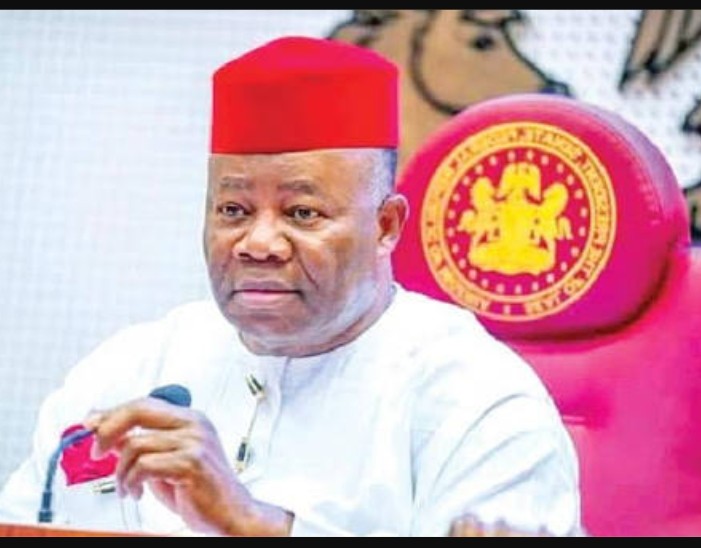
Earlier, proceedings in the Senate were literally slowed down when the table of the President of the Senate, Godswill Akpabio, was surrounded by senators during the clause-by-clause consideration of the Electoral Act, 2022 (Repeal and Re-Enactment) Bill, 2026, following a motion to rescind the earlier amendment.
The motion to rescind the bill was formally seconded, paving the way for the upper chamber to dissolve into the Committee of the Whole for detailed reconsideration and reenactment of the proposed legislation.
During the session, Akpabio reeled out the clauses one after the other for deliberation.
However, the process stalled at Clause 60 when Senator Enyinnaya Abaribe (APGA, Abia South) raised a point of order, drawing immediate attention on the floor.
Following the intervention, murmurs spread across the chamber as lawmakers began speaking in small groups and approaching the Senate President’s desk for consultations.
A long pause ensued, and unable to resolve the issue, the Senate went into a closed session that lasted almost an hour.
When the doors reopened, the arguments continued more forcefully, with Abaribe citing Order 72(1) and calling for a division on Clause 60(3), specifically concerning the provision that if electronic transmission of results fails, Form EC8A should not serve as the sole basis, calling for the removal of the proviso that allows manual transmission in the event of network failure.
Citing Order 52(6), the Deputy Senate President, Barau Jibrin, argued that it would be out of order to revisit any provision on which the Senate President had already ruled.
This submission sparked another uproar in the chamber, during which Senator Sunday Karimi (APC, Kogi West) had a brief face-off with Abaribe.
The Senate Leader, Opeyemi Bamidele, reminded lawmakers that he had sponsored the motion for rescission, underscoring that decisions previously taken by the Senate were no longer valid.
He maintained that, consistent with his motion, Abaribe’s demand was in line.
Akpabio suggested that the call for division was merely an attempt by Abaribe to publicly demonstrate his stance to Nigerians.
The Senate President sustained the point of order, after which Abaribe rose in protest and was urged to formally move his motion.
Abaribe eventually had the chance to call for the division after intervention from the Senate Leader that it was within his privilege to do so.
To the President of the Senate, the beauty of democracy was in full action as he moderated the votes, asking senators to signify their positions by standing up and raising their hands.
At the end of the voting process, 55 senators, including the Deputy Minority Leader, Oyewunmi Olalere (PDP, Osun West), voted to retain the proviso to allow manual transmission where the network fails.
It was a crushing defeat for Abaribe and 14 others, mainly from the opposition, who insisted on mandatory electronic transmission of election results in real time.
According to Akpabio, those who voted for the proviso for manual transmission had just saved Nigeria’s democracy, even as he hailed Abaribe and others for standing their ground.
With this development, the Senate has, for the second time in one week, effectively rejected real-time transmission of election results, retaining its earlier position that where the network fails, the signed Form EC8A (manual transmission) becomes the primary source of election results.
Discover more from TheTimes Nigeria
Subscribe to get the latest posts sent to your email.