By Sabo Kpade
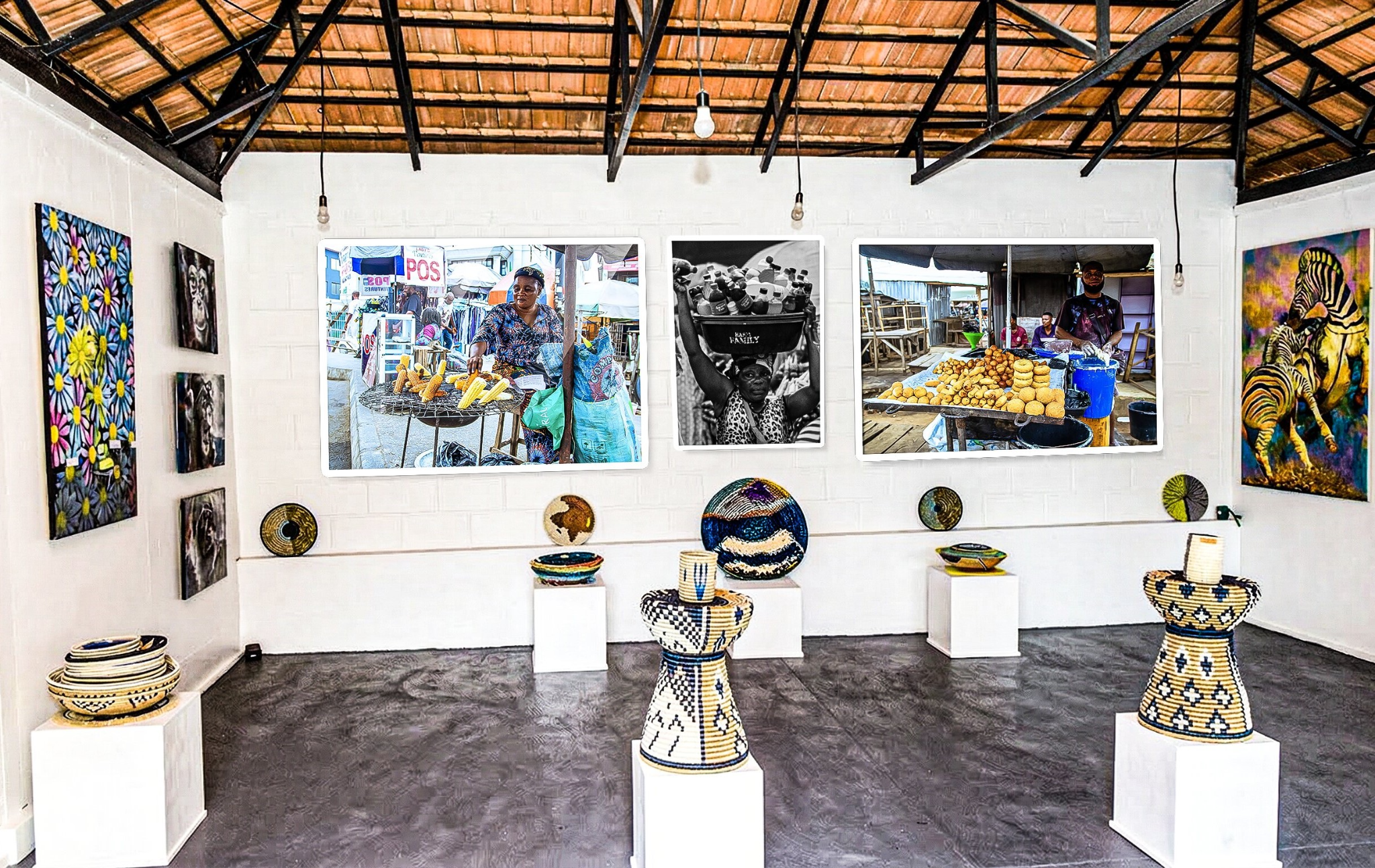
Presented at MADS Art Gallery,Kigali from April 1 to May 10, 2024, Esther Okon’s Hands that Feed the City develops a body of photographs that examines labor, material culture, and the often overlooked human infrastructures that sustain urban life. Through a sequence of carefully composed images, Okon explores how acts of preparation, exchange, and nourishment quietly shape the rhythms of the contemporary city, transforming these everyday gestures into carefully structured photographic compositions.
Okon’s photographs are distinguished by a controlled visual language that merges elements of portraiture and still life. Installed along the gallery’s white walls in a restrained linear arrangement, the photographs unfold as a visual continuum rather than as discrete moments. The presentation allows viewers to move gradually through the series, encountering recurring gestures, hands arranging food on trays, bodies leaning over grills, containers balanced above the head. These movements appear ordinary at first glance, yet Okon’s framing transforms them into a sustained meditation on the physical and material structures of labor.
What distinguishes the work is its sensitivity to surfaces and textures. The photographs linger on the tactile qualities of everyday materials: roasted corn laid out on wire grills, trays piled high with fried dough, and plantains blistered over open flames. These objects dominate the foreground of many images, forming dense fields of color and texture that shape the composition of the frame. Rather than serving merely as context, food becomes a central visual element through which Okon constructs photographic space.
Within these arrangements, the human figure appears both grounded and dignified. Vendors stand or work within environments composed of tools, containers, and goods that define the act of selling. The relationship between body and object becomes an organizing principle across the series. Hands move through the frame not only as instruments of labor but also as markers of continuity, gestures repeated countless times in the daily circulation of food and sustenance.
One of the most striking photographs in the series depicts a woman carrying a basin of bottled drinks balanced on her head. Shot in black and white, the image isolates the subject against a subdued background, directing attention toward the geometry of her raised arms and the weight she supports above her. The triangular structure created by her posture transforms the act of carrying into a sculptural gesture, while the basin itself—marked with the words “Happy Family” introduces a subtle commentary on the broader social systems sustained by such labor. By removing color from the frame, Okon directs attention toward posture and structure, allowing the image to function almost as a sculptural study of balance.
Across the series, Okon demonstrates a strong awareness of the aesthetic potential embedded within ordinary materials. Plastic buckets, woven baskets, newspapers used as wrapping paper, and metal grills are rendered with a clarity that gives them visual weight equal to that of the figures themselves.
This attention to the everyday aligns Okon’s practice with a broader trajectory in contemporary African photography that explores how social meaning can be located within the textures of daily life.
In this respect, Okon’s work resonates with the photographic practice of Zwelethu Mthethwa, whose portraits similarly situate individuals within richly detailed environments shaped by labor and material culture. Both artists employ strong color and frontal composition to transform familiar spaces into sites of quiet contemplation.
At times, however, the series relies on a compositional structure that repeats across multiple images: food arranged prominently in the foreground, the vendor positioned centrally, and the surrounding environment framing the act of work. While this visual consistency reinforces the coherence of the exhibition, a greater variation of perspective might introduce additional tension into the body of work.
Yet it is precisely this steadiness that gives Hands that Feed the City its contemplative quality. Okon’s photographs resist dramatic narrative. Instead, they invite a slower form of looking, in which the small gestures that sustain urban life cooking, arranging, carrying, and selling become visible as forms of embodied knowledge.
Seen together, the images suggest that the city is held together not only by infrastructure and architecture but by a network of human actions that often remain unnoticed. Okon’s photographs bring these gestures into focus, revealing the quiet choreography through which communities nourish themselves.
Hands that Feed the City ultimately positions photography as a medium capable of rendering the everyday newly visible.
In Okon’s work, the ordinary spaces of food preparation and exchange become sites where labor, material culture, and visual form intersect, reminding viewers that the city is sustained through the steady movements of countless hands.
Discover more from TheTimes Nigeria
Subscribe to get the latest posts sent to your email.