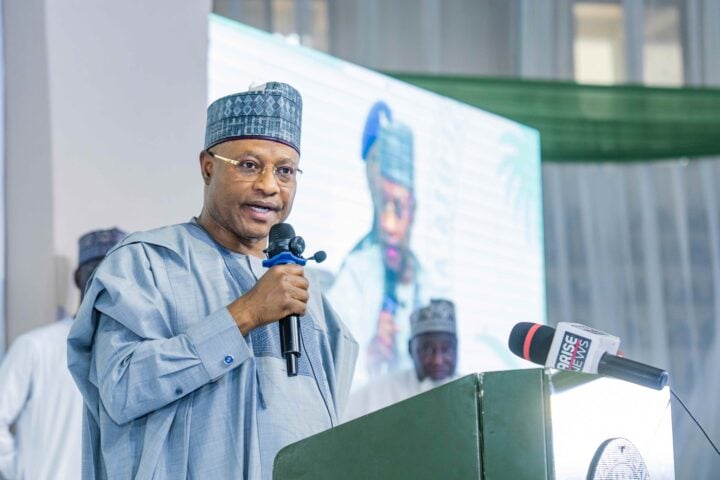
Uba Sani, governor of Kaduna, says his administration has implemented difficult but necessary reforms to stabilise public finance, strengthen governance and create a predictable business environment in the state.
The governor spoke on Saturday at the opening ceremony of the 47th Kaduna International Trade Fair, where he was represented by Patience Fakai, commissioner for business innovation and technology.
Sani said the reforms are already yielding results, citing Kaduna’s performance in fiscal transparency.
“Kaduna state has consistently ranked first in Nigeria’s subnational fiscal transparency index for two consecutive years, reflecting our commitment to openness, accountability, and prudent public financial management,’’ he said.
He noted that the theme of the trade fair, ‘From Reforms to Results: Economic Transformation through Sustainable Local Content Development’, aligns with the state government’s economic agenda.
The governor recalled that the Kaduna state fiscal responsibility commission organised a capacity-strengthening workshop last Monday for public fund managers on the transparent and accountable use of public resources.
According to him, the initiative was necessary because “investors go where governance is clear, rules are predictable, and public finance is credible”.
“Evidence shows that subnational governments with higher fiscal transparency attract more private investment and enjoy stronger investor confidence due to reduced information asymmetry and governance risk,” he said.
“Kaduna state’s performance, therefore, directly enhances trade, lowers the cost of doing business, and positions the state as a reliable destination for both domestic and international investors.”
Sani added that the trade fair provides an opportunity to translate investor confidence into partnerships, stressing that the state’s focus on local content development is deliberate.
“Industrialisation must be rooted in local enterprise, local skills and strong local value chains,” he said.
“From agribusiness and solid minerals to manufacturing, ICT and services, Kaduna state remains committed to policies that support indigenous businesses while remaining open to global capital and expertise.”
In a keynote address, Nura Abba Rimi, permanent secretary at the ministry of industry, trade and investment, said Nigeria’s trade policy has moved to the execution stage.
He noted that the concept of local content is expanding beyond the oil sector and is becoming central to Nigeria’s industrial growth.
“Our success is measured by the new factories and exports crossing our ports, benefiting local traders and innovators,” Rimi said.
“By prioritising Nigerian-made goods, we keep wealth within the country and support a circular economy.”
Rimi added that digital platforms have been introduced to track trade, encourage local sourcing and eliminate bureaucratic bottlenecks, thereby enabling faster market access for Nigerian exporters.
He said the federal government is also addressing infrastructure gaps and improving access to finance for businesses that source inputs locally.
In his welcome address, Farouk Suleiman, president of the Kaduna chamber of commerce, industry, mines and agriculture (KADCCIMA), said reforms alone do not create prosperity.
Suleiman said the new leadership of KADCCIMA is pursuing an institutional turnaround agenda to position the chamber as a policy advocate, business accelerator and skills development platform.
He added that youth and women skills development remain the chamber’s top priority, describing them as its greatest resource.
“Only production creates prosperity. Only skills create jobs. Only enterprise creates wealth,” he said.
“Under our new direction, KADCCIMA will champion vocational and technical skills acquisition, digital and ICT training, agro-processing and light manufacturing skills, entrepreneurship incubation, mentorship and market access, and affordable financing linkages.”
Suleiman said the chamber will work with government, development partners and the private sector to establish skills acquisition and enterprise development centres to enable young people and women to create jobs rather than search for them.
Discover more from TheTimes Nigeria
Subscribe to get the latest posts sent to your email.