…Only 45% of Nigerians believe INEC ‘ll conduct credible elections
Ahead of the 2027 General Elections, the Yiaga Africa, a leading civil society organisation, has released findings from its Round One nationwide survey on national voting intentions.
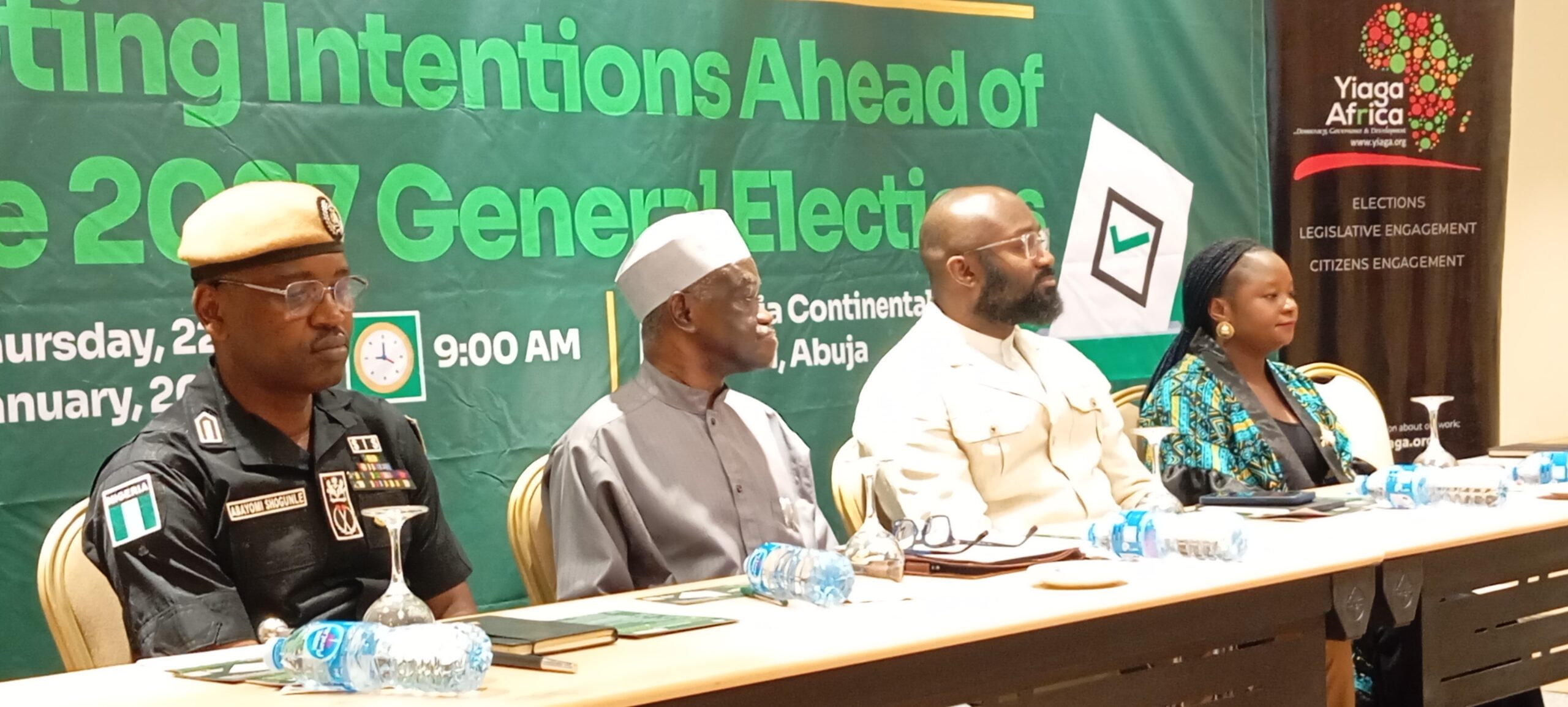
The 26-page report, titled “2027 General Elections: Who Will Vote?”, was presented during a policy roundtable on voting intentions ahead of the 2027 polls on Thursday in Abuja organised by Yiaga Africa and the UK International Development (UKID).
Presenting the findings, Executive Director of Yiaga Africa, Samson Itodo, said the survey showed that voters in the North-West and North-East geopolitical zones recorded the highest level of interest in participating in the 2027 elections when compared to their counterparts in the southern regions.
He said that the survey polled 1,500 respondents nationwide through telephone interviews, covering all 36 states and the Federal Capital Territory (FCT) on December 1 and 5, 2025.
He said the sample was nationally representative, with a 95 percent confidence level and a margin of error of ±4.26 percent.
“One of the things that we found is that in the northwest and the northeast of the country, the strongest level of voting intention exists. So, in the northwest, about 67% and in the northeast, 45% demonstrate high interest to vote.
“But if you look at the regions where we record low enthusiasm to vote, it’s in the southern part of the country. And that’s the southeast at 25% and then south-south at 29%. So, in the northwest and the northeast, there’s higher intention to vote,” Itodo said.
He said the survey revealed that 77 per cent of respondents nationwide expressed willingness to vote in the 2027 elections.
He said, “Of those that were sampled, 77% of respondents indicated that they have intentions to vote in the 2027 elections. However, 42% of them feared violence or insecurity. So, when you look at voting intention, it’s quite high. 77% we consider it quite high.
“But the bigger challenge is how do we ensure that this 77% actually turn up in February next year. That’s the bigger and the bigger stats. Because as of today, our turnout for general elections is perhaps somewhere around 25%.”
The Yiaga Africa boss also said that the security situation, quality of candidates and prevailing economic conditions were identified as the top factors that would influence voting choices in 2027.
“Therefore, the whole candidate nomination process needs to be democratic, and it needs to ensure that it throws up candidates that have high quality, else it might destroy voting,” he said.
…Only 45% of Nigerians believe INEC ‘ll conduct credible elections
Itodo added that the survey showed that 45 per cent of Nigerians expressed confidence in the Independent National Electoral Commission (INEC), though trust levels varied across regions.
It said despite the low confidence in INEC, the report shows strong voter interest in the 2027 elections, with 77 percent of respondents saying they are likely or very likely to vote.
He also noted that the enthusiasm is threatened by widespread insecurity and fear of electoral violence noting that the regions with higher voting intentions also expressed huge security concerns and fear of electoral violence.
“Although 76% of Nigerians believe their vote can influence election outcomes, only 45% express confidence in INEC’s ability to conduct credible elections. That’s what the survey says. But when you look at the regional distribution, which part of Nigeria is the level of distrust in INEC higher?
“We actually found that in the south-south and in the south-eastern part of the country. The trust level for INEC in these other regions is quite high compared to these two other regions. Distrust in INEC is highest in southern Nigeria, especially in the South-South and South-East, while trust is higher in the North. This differential trust patterns could influence perceptions of election credibility in the 2027 elections.”
“This tension between democratic aspiration and security apprehension defines the current electoral environment. Therefore, the challenge for 2027 is ensuring that the 77% who want to vote can actually do so safely and with confidence in the process,” Itodo said.
Acknowledging the support of the Foreign Commonwealth and Development Office (FCDO) for funding the survey, Itodo disclosed that data from Round Two of the survey, conducted in collaboration with NOI Polls, would be released in March this year.
The report said respondents identified improved security, credible candidates and better election management as key factors that could boost turnout in 2027, urging security agencies to deploy comprehensive election security frameworks, particularly in high-risk areas; and urged INEC to improve the integrity of the voter register and conduct confidence-building initiatives in regions with low trust.
The organisation also urged INEC to strengthen the integrity and accuracy of the voter register through timely revalidation of registration records, while calling on the National Assembly to conclude the passage of the electoral bill by January 2026 to ensure legal certainty ahead of the polls.
According to Yiaga, this shift places greater responsibility on political parties to ensure transparent and credible nomination processes ahead of 2027.
Also speaking at the event, INEC National Commissioner in charge of voter education, Mallam Mohammed Kudu Haruna, commending Yiaga Africa for the survey, describing it as a right step in right direction.
He also reaffirmed the commitment of the electoral body to ensuring a conducive voting environment.
“For our part, INEC firmly committed to creating an environment in which every eligible Nigerian can exercise their right to vote freely, safely, and with confidence that their vote will count.
“Since the last general election, the Commission has continued to renew its processes strengthening the use of technology, enhance transparency, and engage stakeholders at all levels of the electoral committee. We recognize, however, that building trust and increasing participation requires sustained collaboration and consistent effort.
“I wish to emphasize that boosting voter turnout requires credible political competition, responsible political behavior, effective voter education, improved security, and socio-economic policies that restore security and democracy as a vehicle for positive change.
“Civil society organizations, research institutions, political parties, the media, security agencies, and government institutions all have indispensable roles to play. This policy roundtable therefore provides a valuable platform for constructive dialogue and shared learning,” Haruna said.
On his part, the National Chairman of the Inter-Party Advisory Council (IPAC), Dr Yusuf Mamman Dantalle, expressed concern over declining voter turnout, noting that only about 27 per cent of registered voters participated in the 2023 presidential election.
He said sustained efforts were required to rebuild trust in the electoral system and encourage broader citizen participation.
Speaking earlier, Safiya Bichi, the Head of Knowledge Management and Learning Department at Yiaga Africa, said that as the 2027 general elections approach, concerns are mounting about declining voter turnout, particularly in light of the historically low participation recorded in recent elections.
According to her, these concerns are driven by a range of factors, including voter apathy, trust deficits, socio-economic pressures, and evolving political attitudes.
She said that in response, Yiaga Africa is engaging NOI Polls to conduct a series of National Voter Intention Surveys aimed at testing prevailing assumptions about voter interest and participation, while identifying the key drivers and barriers to citizen engagement ahead of the 2027 elections.
Also, Serigne Mamadou, Head of the Electoral Assistance Division, Directorate of Political Affairs, ECOWAS Commission, noted that what facilitates voter apathy goes beyond INEC but also starts from INEC because the electoral management bodies (EMBs) are the ones that do the preparation and have the responsibility to build the confidence of voters.