For decades, the landscape of Nigerian agriculture has been shaped by the concrete monuments of unfulfilled potential: multi-billion-naira dams, uncompleted canals, and idle pumping installations that measured success by ribbon-cutting ceremonies rather than water reliably reaching crops.
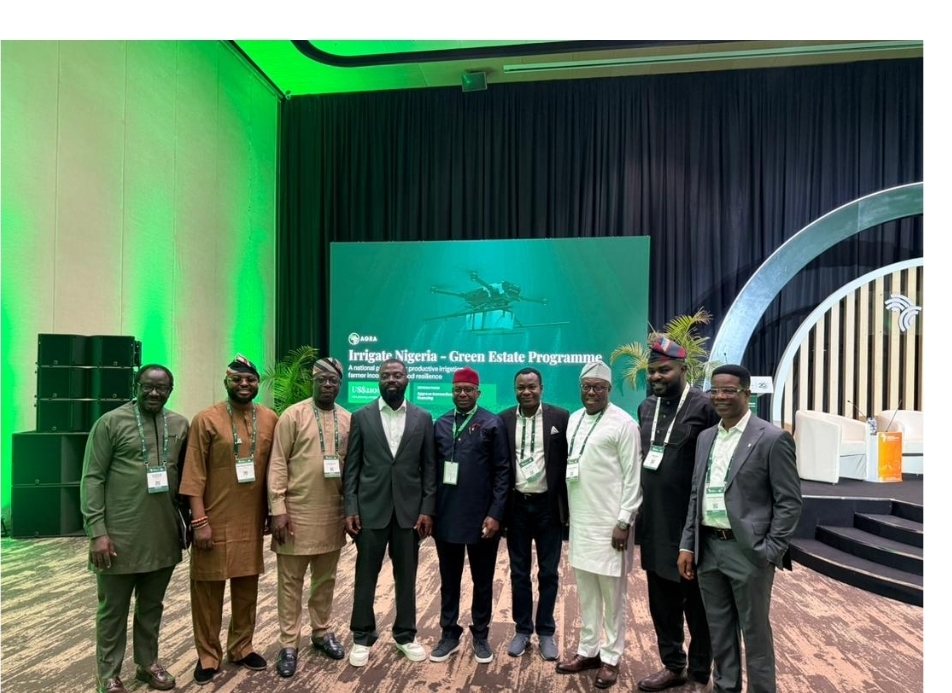
Inside Deal Room at the Kigali Convention Centre, the Nigerian delegation to the 20th Africa Food Systems Forum Summit made a deliberate break with that approach. Presenting before development finance institutions, commercial lenders, and private infrastructure developers, officials unveiled the investment architecture for the Irrigate Nigeria Green Estate Program (INGEP)—a flagship initiative engineered to convert underutilized water resources into a high-performance, climate-resilient national production engine.
The strategic premise presented to investors dismissed conventional engineering dogmas. Addressing the room, lead transaction advisor Samuel Haidome, Head of Deal Advisory at Hawksworth Advisors, argued that Nigeria’s irrigation deficit has never been an engineering bottleneck, but a structural breakdown in investment design.
“Historically, we have tended to finance irrigation as infrastructure—you build a dam, you dig a canal, and you measure success by how many hectares are nominally equipped,” Haidome told the room. “That is not bankable. An investor earns no return simply because concrete exists, and a farmer earns no income until water reliably reaches the root zone, the harvest is sold, and cash flows return to support operating costs. Our irrigation challenge is not fundamentally an infrastructure problem; it is an investment architecture problem.”
The stakes were framed by AGRA Country Director for Nigeria, Dr. Rufus Idris, who emphasized that the status quo of rain-dependent cultivation is mathematically obsolete for Africa’s demographic giant.
“Nigeria holds a deeply strategic position, but we are still struggling to feed a population of 240 million that is on track to cross 400 million by 2050,” Idris told the Deal Room. “We cannot continue to rely on seasonal farming, waiting on erratic rains when climate shocks are visibly disrupting planting calendars. Between 1.5 and 3.2 million hectares of potential exist, yet barely 293,000 hectares are equipped. We have to do something fundamentally different to scale production, feed our people, and step into our role as the food basket of West Africa.”
Spearheaded under a presidential mandate from the Federal Government of Nigeria through the Office of the Vice President—in active collaboration with the Federal Ministry of Water Resources and Sanitation and the Federal Ministry of Agriculture and Food Security under Senator Abubakar Kyari—the program replaces fragmented public works with an integrated Public-Private Partnership structure.
Drawing directly on regional benchmarks like Rwanda’s Nasho Project—which integrated 63 center pivots, 3.3 megawatts of solar photovoltaic generation, and 2.4 megawatts of battery storage across 1,173 hectares—the Nigerian model adapts cluster-based commercial design to federal hydrology. Over a 10-to-15-year horizon, the national framework targets a $6.0 billion investment envelope across all 36 states and the Federal Capital Territory, encompassing $5.3 billion in capital expenditure and $700 million in institutional support to bring one million hectares and 360,000 farmers under dependable, year-round cultivation.
Rather than seeking speculative billions upfront, the transaction team presented a disciplined Phase-1 pilot across representative state environments covering 30,000 hectares and 8,000 farmers. The initial cohort establishes diversified learning platforms: testing tertiary rehabilitation and modernization in Oyo State, lean dryland solar pumping for climate resilience in Gombe, and high-productivity river basin corridors in states like Kogi, Benue, and Cross River.
The financial architecture rests on a synchronized, three-layer capital stack. Layer 1 deploys $210 million for core infrastructure, structured with 30 percent Government Viability Gap Funding, 25 percent concessional development finance, 20 percent commercial debt, 10 percent climate finance, 10 percent grants, and 5 percent farmer equity. Layer 2 unlocks $40 to $60 million in asset-secured farmer credit through microfinance institutions and commercial banks, while Layer 3 injects $20 to $30 million in portfolio guarantees and risk-sharing instruments to de-risk private lending books.
“The 30 percent viability gap contribution from government must be understood by lenders not as a subsidy program, but as pure credit enhancement,” Haidome explained. “It is disbursed as results-based finance tranches tied to independently verified water delivery at three, six, and twelve months post-commissioning. We are paying for actual performance, not merely installed equipment, establishing the operational track record commercial lenders need to deploy balance sheets with confidence.”
Field evidence from northern Nigeria under GIZ-MOVE solar pilot benchmarks demonstrated the underlying economics: rice yields rose from 4.5 tons to 6.3 tons per hectare while unlocking up to three annual cropping cycles instead of one rain-fed harvest. That productivity leap drives an estimated fourfold uplift in net farmer income, generating reliable cash flow to service indicative seasonal irrigation tariffs of $200 to $300 per hectare. Sensitivity analysis across eight variables confirmed that even under a 15 percent currency depreciation, project internal rates of return hold firmly above the 11 percent floor within an 11 to 18 percent range, alongside an economic rate of return above 25 percent.
Responding to inquiries on commercial viability and farmer protection, Dr. Kingsley Uzoma, Senior Special Assistant to the President on Agribusiness and Productivity Enhancement (Office of the Vice President), emphasized that the model combines agronomic optimization with secured off-take channels. By pairing precision irrigation with improved crop management, farmers preserve healthy profit margins even during market dips, while integration with Special Agro-Industrial Processing Zones ensures consistent industrial demand for increased farm output.
Closing the pitch, Haidome issued an operational invitation to international financiers, including representatives from First Abu Dhabi Bank and Gulf investment offices reviewing the initial $10 million project preparation facility: “We are not asking the market whether Nigeria needs irrigation. The invitation is to look at the three layers of the capital structure and decide which risk profile matches your balance sheet. When water, clean energy, farmer organization, and off-take are designed as one operating system, irrigation in Nigeria ceases to be a public liability and becomes an investable, bankable asset class.”
Discover more from TheTimes Nigeria
Subscribe to get the latest posts sent to your email.