The Centre for Social Justice (CSJ) has demanded more tribunals to be put in place to speedup trials of corruption cases in the country.
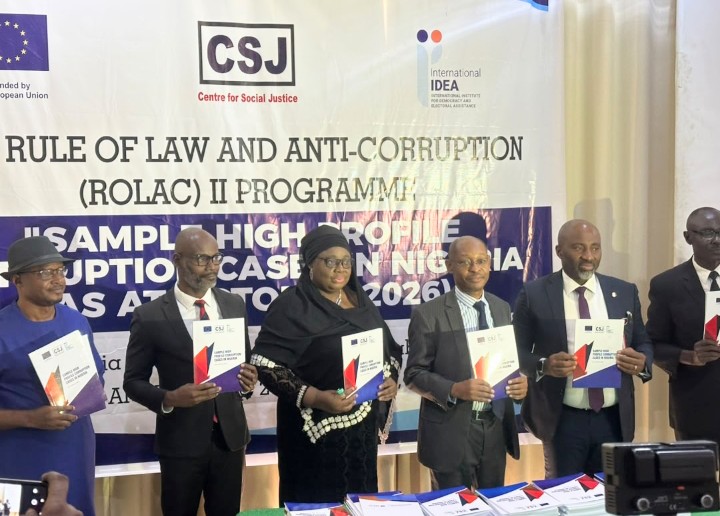
The Lead Director, CSJ, Eze Onyekpere, Esq., made the call on Thursday in Abuja at the sidelines of the public presentation of Sample High Profile Corruption Cases in Nigeria (As at October 2026).
The programme was organised by the CSJ, with the support of European Union (EU), IDEAS and the Rule of Law and Anti-corruption Project (ROLAC2).
He noted that as corruption continues to undermine national development, public service delivery, and citizens’ livelihoods in Nigeria, the need for more tribunals to address the bottlenecks and speedup trials of corruption cases.
Onyekpere expressed concerns over the long period of prosecuting corruption cases following only one tribunal that is established to handle such cases, which he said has made the process boring as justice is delayed.
The CSJ boss noted that the publication provides an empirical review of 30 high-profile corruption trials pending across Nigerian courts alongside a detailed audit of pending cases before the Code of Conduct Tribunal (CCT).
It identifies key systemic, procedural, and institutional bottlenecks prolonging trials and proposes actionable legal, technological, and constitutional reforms, including a legislative memorandum for strengthening the CCT.
“For the trials before the Code of Conduct Tribunal, we noticed that it’s only one tribunal composed of three persons for the whole federation. And we are saying more tribunals should be established, especially at the level of the geopolitical zones for now.
“And thereafter, we can now have them at the state level because we are discussing a scenario where from the President of the Federal Republic to the cleaner at the local government is supposed to declare his assets and liabilities. And therefore, if you look at the number, you will be discussing six or seven million persons.
“One tribunal sitting in Abuja cannot solve the challenge of the number of cases filed across the federation before that tribunal, and from the report, you saw many cases were adjourned since 2009, 2010, and nothing has been done since then. 2010 to now, how many years is it? Is it not about 16 years? 2009, about 17 years,” Onyekpere said.
He said that such delays affect Nigerians, “Because if the properties are recovered back to treasury, and the monies are invested in education, health, roads, power sector, it will benefit everybody, including the proverbial common man or woman.”
He also said plea bargain is not the way to go in the fight against corruption, saying, “We are not recommending plea bargain. We talked about non-conviction-based asset recovery, which is the one where it is not a question of proving beyond reasonable doubt.
He said, “The prosecution simply states, or the state simply says, these properties are believed or are likely to be the process of crime or that obtain them illegally. So if you claim to own them, you come forward and show not only that you own the properties, but that you acquired them legally. Show us your source of income from where you acquired it.
“So it’s easier for the state to get those properties back, like has been done in the Malami case. It didn’t take so many years, and the case is resolved, unless he decides to go on appeal, and his chances on appeal will only be when he shows the sources of funding, which are legal and legitimate.”
He also tasked the judiciary, saying, “The judiciary should be up and doing. They should do proper case management, and the matters of transfers and elevation should be managed in such an empirical way that so many cases do not need to start anew.
“It can be properly managed without jeopardising the chance of the judicial officer to get elevated to the court of appeal or any other court.
On his part, Chairman of the Economic and Financial crimes Commission (EFCC), Ola Olukoyede, said that its monetary recoveries exceeded N1.233 trillion, alongside substantial recoveries in foreign currencies, between 2023 and 2026.
“Despite huge challenges, the Commission has continued to make significant progress. Between October 2023 and July 2026, we received 49,673 petitions, investigated 39,615 cases, filed 14,476 cases before the courts and secured 10,872 convictions.
“These achievements reflect the dedication of our investigators and prosecutors, the cooperation of our institutional partners and the important contribution of the judiciary. From my experience at the Commission, prolonged criminal trials are rarely attributable to a single institution or circumstance.
“Repeated adjournments, interlocutory proceedings, difficulties in securing witnesses, delays in obtaining documentary evidence, congested court schedules and the reassignment of part-heard cases all contribute to the problem. Investigating and prosecuting agencies must equally acknowledge their responsibility where inadequate preparation or deficiencies in evidence contribute to unnecessary delays,” Olukoyede said.
Also, Chairman of Nigerian Law Reform Commission (NLRC), Prof. Dakas C.J. Dakas, SAN, represented by Ozo Osarodion, said that corruption is the single most corrosive threat to Nigeria’s development, democracy, and the trust between the Nigerian State and its citizens.
According to him, Nigeria’s challenge was not the absence of anti-corruption laws but fragmentation, overlapping provisions, weak enforcement, and the gap between legislation and its practical implementation.
“Having many laws is not the same as having an effective legal framework. Our challenge is not the absence of law. It is fragmentation, overlap, delay, weak enforcement, and a gap between the law on paper and the law in practice,” Dakas said.
On its part, the Nigerian Bar Association (NBA) President, Mrs Oyinkansola Badejo-Okusanya, SAN represented by the association’s Second Vice President, Nuhu Egya, raised concerns over the consequences of prolonged corruption trials, warning that delays are weakening public confidence in the justice system and diminishing the deterrent effect of anti-corruption laws.
The NBA said that the effectiveness of anti-corruption efforts should not be measured solely by investigations commenced, arrests made or charges filed, but also by the fairness, credibility and ultimate outcomes of judicial proceedings.
Citing Section 36(1) of the 1999 Constitution, as amended, NBA stressed that the constitutional right to fair hearing within a reasonable time must be protected even as the country pursues accountability for corruption.
“The objective must be to achieve both accountability and fairness: a justice system that is effective without being arbitrary, expeditious without compromising due process, and firm in the enforcement of the law without sacrificing constitutional guarantees,” she said.
The association identified the Administration of Criminal Justice Act (ACJA) 2015 as an important framework for improving criminal justice delivery. But it stated that its effectiveness depended on proper implementation, institutional cooperation, adequate resources, improved case management and strategic deployment of technology.
On its part, the Code of Conduct Bureau (CCB), identified delays in determining corruption-related cases as a major challenge to the administration of justice, calling for stronger case management systems, improved institutional capacity and greater use of technology.
The Director, Legal Service Department of the bureau, Mrs. Sambo Sa’adat Omotayo, delivering a goodwill message on behalf of the CCB Chairman, said the fight against corruption required more than the investigation and prosecution of offenders.
She said strong institutions, effective legal frameworks, efficient judicial processes and citizens’ commitment to integrity in public service were equally essential.
Omotayo described the CSJ publication as a timely contribution to the national discourse on corruption and accountability, particularly its examination of 30 high-profile corruption trials and an audit of pending cases before the Code of Conduct Tribunal.
She explained that the bureau occupied a strategic position in Nigeria’s anti-corruption architecture, with constitutional responsibilities that included receiving and examining asset declarations by public officers, investigating breaches of the Code of Conduct for Public Officers and referring appropriate cases to the tribunal.
She reaffirmed the bureau’s commitment to strengthening its institutional processes, improving its investigative and legal capacities, promoting inter-agency collaboration and exploring appropriate mechanisms for addressing breaches of the Code of Conduct.
Discover more from TheTimes Nigeria
Subscribe to get the latest posts sent to your email.