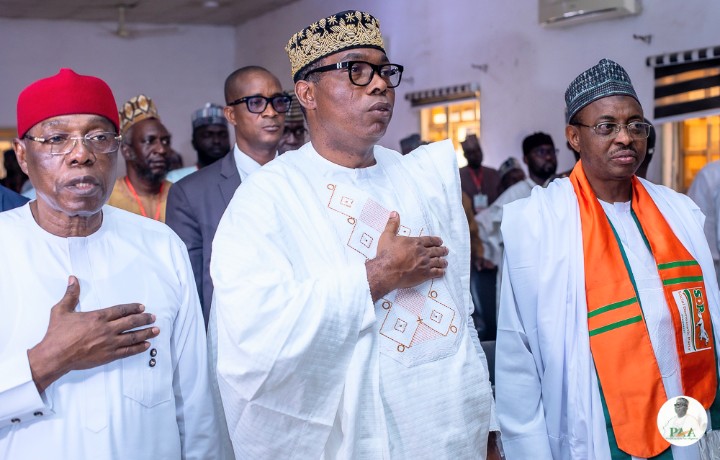
The Social Democratic Party (SDP), has called on Nigerians to move beyond ethnic, religious and regional sentiments in choosing political leaders, saying competence, character and commitment to good governance should determine leadership choices ahead of the 2027 general elections.
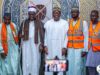
The SDP National Chairman, Dr. Sadiq Umar Abubakar Gombe; presidential candidate, Prince Adewole Adebayo; and vice-presidential candidate, Dr. Usman Bugaje, made the call at the Arewa Movement for Good Governance (AMGG) conference in Kaduna State.
Addressing participants, Adebayo said Nigeria’s political challenges could not be resolved through regional calculations, arguing that poverty, insecurity, unemployment and underdevelopment were national problems requiring collective action.
“Tinubu has unseated himself. I am not one of those talking about Tinubu. Tinubu has already unseated himself. You can see that he can’t even sit well on the chair,” Adebayo said.
The SDP presidential candidate, however, noted that the party’s objective was not merely to remove President Bola Tinubu but to change the political system responsible for producing leaders who fail to deliver.
He said, “From the way we understand the SDP, it’s not a coalition to remove Tinubu. Tinubu is not a factor. Tinubu is a symptom of a broken politics.”
According to him, the opposition must avoid repeating the experience of 2015, when political parties united to defeat the then ruling government but, according to him, failed to deliver the expected transformation.
“What we are trying to do is to remove the kind of politics that produced Tinubu, so that that kind of politics will die. It will not be able to produce another Tinubu,” he said.
Adebayo maintained that any coalition seeking to reposition Nigeria must be built around a shared philosophy of governance, including poverty reduction, security, constitutional governance, nationalism, competence, character and selfless leadership.
“If we succeed on Monday or so soon thereafter to have that consensus around these principles, we will come together,” he said.
He cautioned against dividing Nigerians along regional lines, noting that the challenges confronting citizens were largely similar irrespective of where they lived.
“The mistake all of us are making is dividing ourselves into North and South, East and West. Our problems and our aspirations are similar, and we are intertwined.
“There is no scientific or empirical basis for us to have a northern perspective to hunger and a southern perspective to hunger, or an eastern perspective to insecurity or a western perspective to insecurity,” he added.
The SDP presidential candidate lamented that Nigeria’s human and natural resources had not translated into improved living conditions for citizens, blaming the situation on a lack of visionary leadership.
“Our country has the greatest opportunity to lift the black man out of the morass of underdevelopment and backwardness. And we don’t have the leadership that can sustain a civilisation,” he stated.
He alleged that those currently in authority lacked the capacity to organise society, provide security, improve education and deliver modern infrastructure, describing the country’s political environment as one where influential interests prioritise personal gains.
Adebayo also urged voters to make poverty reduction and security their major considerations in the 2027 elections, warning against allowing ethnicity, religion, personal favours or financial inducements to influence their choices.
“Electorate should look at poverty and say no to poverty. They should look at insecurity and say no to insecurity. So, farewell to poverty and insecurity should be on their mind,” he advised.
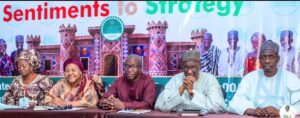
Speaking earlier, SDP Vice-Presidential Candidate, Dr. Usman Bugaje, said Northern Nigeria must critically review its political choices and abandon the sentiments that had contributed to the region’s development challenges.
Bugaje, who presented a concept note at the gathering, said the North and Nigeria had experienced worsening poverty, insecurity, unemployment, inflation and deterioration of public institutions over the past 25 years.
“In the last quarter of a century, Northern Nigeria, indeed the country as a whole, has been going down the drain,” he said.
He questioned the assumption that having leaders from the North in key political positions would automatically address the region’s challenges, citing persistent insecurity and the high number of out-of-school children.
“It is time we began to ask ourselves: Is what we need a Northerner, or do we need a competent and credible person who can deliver?” Bugaje asked.
He said leadership should be assessed by character, competence and courage rather than geographical origin.
“The issue is not necessarily where a leader comes from, but rather his character, competence and courage,” he stated.
The SDP vice presidential candidate also lamented that the North had failed to develop a clear and shared strategy for its future within the Nigerian federation, despite existing development initiatives.
“Where is the vision for the North? And where is the strategy to achieve that vision?” he asked.
He warned that the region’s rapidly growing population, coupled with a shrinking economy, could deepen social and political crises if deliberate planning and sustainable development strategies were not put in place.
“By 2030, when Nigeria is projected to have a population of 300 million, the North could account for about 200 million people.
“The question is: Where will the economy to sustain this population come from? Where will the resources come from to maintain social peace and enable people to live meaningful lives?” he queried.
Bugaje said the conference was designed to bring together religious leaders, women groups, youth organisations, civil society actors and other community stakeholders to deliberate on the region’s future and the kind of leadership it required.
He explained that discussions held on Friday focused on three major questions: what the North needed, the kind of leaders capable of delivering those needs, and what citizens should expect from elected political leaders.
He said the outcome of the engagement would be presented to the public to help guide political choices and give direction to the aspirations of the region.
Also speaking, SDP National Chairman, Dr. Sadiq Umar Abubakar Gombe, expressed satisfaction with the commitment of members of the Arewa Movement for Good Governance, saying the movement had remained united despite challenges since its establishment more than five years ago.
He said the movement’s commitment to bringing Muslims and Christians together through religious leaders and intellectual engagement had produced enduring relationships and initiatives aimed at promoting good governance.
“My second source of joy is that I feel fulfilled today. Wallahi, if I die today, I believe I would have lived a fulfilled life,” Gombe said.
He explained that the movement initially began as an initiative before evolving into a broader platform for engagement, leadership development and political participation.
According to him, the movement had produced leadership documents through contributions from both Christian and Muslim scholars, which were subsequently harmonised into a common document on leadership in Nigeria, alongside the Arewa Movement for Good Governance Charter.
Gombe said the movement later recognised the need to move beyond conferences and discussions by participating directly in the political process.
“To achieve meaningful political participation, we needed a political party. We needed to participate in its leadership, take responsibility and present candidates for elections. Only then could we translate our ideas into practical contributions to governance,” he said.
He said members of the movement had assumed leadership positions within the SDP and were contesting various elective offices, including governorship, Senate, House of Representatives and State Houses of Assembly.
Gombe also disclosed that the SDP had been working to bring opposition parties together under a coalition known as the Coalition for Democracy, adding that the first opposition summit brought together prominent political figures, including Atiku Abubakar, Peter Obi, Prince Adewole Adebayo, Donald Duke and Seyi Makinde.
He announced that the second major summit of opposition political parties would hold on Monday, November 30, with the SDP National Chairman expected to preside over the meeting.
Gombe expressed confidence that the party would achieve its political objectives in the 2027 elections, including the emergence of Adebayo as President and Bugaje as Vice-President.
“By the grace of God, and through our commitment and collective aspiration for good governance and a Nigeria of our dreams, I want to assure you that, Insha Allah, we will conclude this journey in January 2027 with an Adebayo presidency and a Dr. Bugaje vice-presidency,” he said.
He added that the party hoped to have more members elected into political offices at state and national levels to enable them contribute to addressing the country’s challenges.
The conference, organised by the Arewa Movement for Good Governance, AM2G, had the theme, “The North and the Nigerian Political Space: The Imperative of Shifting from Sentiments to Strategy’.
The conference was attended by religious leaders, women groups, youth representatives, academics, civil society actors and political stakeholders, who deliberated on the political future of Northern Nigeria and the country ahead of the 2027 general elections.
Discover more from TheTimes Nigeria
Subscribe to get the latest posts sent to your email.