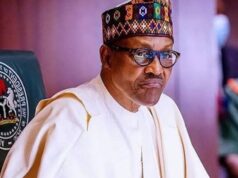
Buhari’s War Against Indiscipline went beyond the visible sphere of civic drills and proper behaviour.1 It also entered the complex terrain of state power. The regime had already signalled through decrees and tribunals that corruption would be treated as an assault on governance. The campaign against disorder in the streets naturally fused with the pursuit of men who had normalised disorder in government. It was in that atmosphere of corrective urgency that Shagari’s Minister of Transport, Umaru Dikko, became more than a fugitive minister. He was a living test of how far the Buhari regime could go to capture one of the most conspicuous symbols of impunity in the Second Republic.
Umaru Dikko had a career in broadcasting at the BBC’s Hausa Service long before he became a politician and cabinet figure.2 When civilian rule returned in 1979 and his brother-in-law, Shehu Shagari, rose to the presidency, Dikko entered the cabinet as Minister of Transport. In the early 1980s, he rapidly became the most recognisable emblem of the shortcomings of the Shagari administration. He chaired a presidential task force created to ease food shortages through the distribution of imported rice, yet the task force attracted persistent accusations of doing the opposite – withholding supply and deepening artificial scarcity, thereby driving prices upwards.3 Import licences were alleged to have flowed towards businessmen with ties to the National Party of Nigeria, and Dikko’s name became associated with a corruption that Nigerians experienced as inflation and hunger. His public conduct made matters worse. In a season of steep hardship, he was reported in newspapers to have remarked that living conditions could not be so dire since Nigerians were not yet eating from dustbins.4 The statement, which was widely publicised, coupled with a combative public style, multiplied enemies for him across various political fronts.
Yet it was Dikko’s posture towards the military that sealed his position in the military’s private catalogue of grievances. He did not pretend to respect soldiers in politics; he insisted, bluntly, that they belonged in barracks and on battlefields. From within the Shagari government, he authorised undercover intelligence gathering on senior officers5, among them Major General Muhammadu Buhari, then commanding the 3rd Armoured Division in Jos. Buhari protested directly to President Shagari, outraged that a serving minister had taken it upon himself to watch a commander in the field. Dikko did not retreat from the act. Instead, he urged Shagari to retire Buhari, warning that the general could not be trusted. In doing so, he widened the breach between a civilian government already anxious about military intention and soldiers who believed politicians were both corrupt and reckless. The men Shagari most needed to keep calm were being given fresh reasons to feel cornered. Dikko’s other moves deepened that hostility.
In the background lay the 1983 re-election campaign, which was widely judged to have been marred by irregularities.6 Dikko’s hand was seen by many as central. For officers already contemplating a return to power, he was a representative figure of the impunity and excesses associated with the Second Republic.
When Buhari, in his first broadcast after the takeover, warned that ‘corrupt officials and their agents will be brought to book’, Dikko understood the direction of the new regime. Within hours of the coup, soldiers arrived at his official quarters in Ikoyi, Lagos, searching and unsettling his household. Dikko, however, was already gone. With the help of friends and a substantial sum of cash, he worked his way to Nigeria’s border with the Benin Republic7, purchasing passage through controls, and from there moved on to Lomé in Togo. He then took a KLM flight to London, which in 1984 was already taking on the character of a refuge for displaced Nigerian political grandees like Adisa Akinloye, former national chairman of the NPN; Joseph Wayas, former Senate President; and Richard Akinjide, former Attorney-General. They had fled as the Buhari government detained, tried and imprisoned politicians on a scale Nigeria had not previously witnessed.
Though in exile, Umaru Dikko did not lower his profile. He became an ardent critic of the Buhari government, repeatedly appearing on television to condemn the new order. His defiance sharpened the regime’s resolve. The authorities wanted him back by all means.
In the wake of Buhari’s anti-corruption offensive, the pursuit of Umaru Dikko acquired a significance larger than one man’s flight. It became a measure of whether the new military government could carry its domestic war against corruption across borders, and whether those who had come to personify Second Republic impunity could be retrieved from exile and made answerable. Yet the attempt to secure Dikko’s return did not unfold within Nigeria alone.
In that period, Nigeria’s relationship with Israel stood as one of those contradictions that African diplomacy sometimes carried.8 Officially, Nigeria had severed relations with Israel in 1973 under pressure from the Organisation of African Unity, yet significant dealings were said to have continued in the shadows, including claims that Nigeria supplied more than half of Israel’s crude oil in exchange for military hardware. Intelligence accounts suggested that Israeli Prime Minister Yitzhak Shamir feared a disruption of that flow under the new Nigerian military government, and that Israel saw in Nigeria’s post-coup arrests an opportunity to ingratiate itself with Buhari’s regime by offering to locate Dikko through Mossad. Theophilus Danjuma was deeply involved in aiding the operation, which Buhari approved.
The facilitation ran through an existing business network, including Elisha Cohen of Solel Boneh, a company long established in Nigeria. Cohen’s wartime encounter with the Nigerian state and his subsequent work for the federal government were presented as the bases for some further engagement. A third party soon facilitated contact between the regime and Cohen, and then between the top hierarchy of the Nigerian Security Organisation (NSO) and Mossad for an operation for which the regime paid a few million dollars.
By the early 1980s, Mossad’s name already carried a particular kind of fear and glamour,9 built on operations such as the capture of Adolf Eichmann in 1960, and later operations linked to the killing of Ali Hassan Salameh, the ‘Red Prince’. Within that aura, the plan to kidnap Umaru Dikko in London was conceived as the work of professionals. It was carefully and tightly organised, and built on patient intelligence gathering. The Israeli team had Alexander Barak and Dr Levi-Arie Shapiro, while the Nigerian side ran through the NSO under Alhaji Lawal Rafindadi, with Major Mohammed Ahmadu Jarfa Yusufu discreetly positioned at the Nigerian High Commission. An extensive search was mounted, drawing on Mossad’s overseas network. An initial attempt to lure Dikko to Paris for a CBS interview failed, and the hunt narrowed back to London until 30 June 1984 when he was reportedly sighted in Bayswater and traced to 49 Porchester Terrace.
In early July, the operation moved from surveillance to action, with operatives in place. A conspicuous canary-yellow van was hired, and an empty Nigerian Airways Boeing 707 cargo aircraft flew into Stansted Airport on 4 July, ostensibly to collect diplomatic baggage. Early on 5 July, the aircraft filed a 3.00 p.m. departure time and claimed “documentation” under diplomatic immunity. At about that same time, Umaru Dikko stepped out of the apartment where he was for what he thought was a routine interview with a journalist, Elizabeth Akua Ohene. He was seized, driven away, and sedated near Regent’s Park Zoo. The operation suffered a critical lapse when his secretary, Elizabeth Hayes, witnessed the abduction through the window and immediately alerted the police. Scotland Yard’s anti-terrorist squad mobilized, and ports and airports were warned. Prime Minister Margaret Thatcher and the Foreign Office were informed. At Stansted, Dikko was delivered in a wooden crate labelled as diplomatic baggage,10 accompanied by Yusufu and Okon Edet – until a customs officer, Charles Morrow, noticed a medical smell and suspected movement. He insisted on inspection. The crates were eventually opened and the scheme collapsed. Dikko was rushed to hospital in Bishop’s Stortford, remained unconscious for 36 hours, and awoke on 6 July under police guard.
The diplomatic consequences were immediate and severe.11 Britain treated the involvement of Nigerian personnel in a grave crime on British soil as a hostile act, warning that implicated diplomats would be expelled. Nigeria denied official involvement, and its High Commissioner, Major-General Haladu Anthony Hannaniya, described the affair as the work of “some patriotic friends of Nigeria.” Britain detained the Nigerian Airways aircraft and arrested 17 suspects. Nigeria promptly retaliated by ordering a British Caledonian Boeing 747 back to Lagos for security reasons. Its 222 passengers were released, but the aircraft was held, producing a day-long standoff before both sides released the planes. The crisis was the worst since 1976, when Nigeria expelled the British High Commissioner after the failed Dimka coup and Britain refused to extradite General Gowon.
Group Captain Bernard Banfa, the managing director of Nigerian Airways, disappeared just as the enterprise began to come apart, slipping back to Lagos beyond British reach. In the aftermath, some of the operatives blamed him for getting “cold feet” and failing to supply the diplomatic paperwork that might have eased the crates through customs. The scale and coordination of the plot pushed suspicion beyond private rogue actors into the realm of state culpability. But Israel and Nigeria avoided any formal admission.
Britain reacted with the reflex of a government whose authority had been slighted in its homeland. While the Nigerian and Israeli operatives who were apprehended faced legal consequences, there was a diplomatic rupture in the relationship between Nigeria and Britain.
For Buhari’s government, the episode was paradoxical: a dramatic assertion of will that ended by weakening its relationship with its former colonial master. The British intelligence services had made their loyalties clear: they preferred dealing with a civilian administration, no matter how flawed, over a military regime.
This distrust came into sharp focus in the case of Umaru Dikko. A central figure in Shagari’s cabinet, Dikko also had personal and political ties to the British establishment, making him one of their most reliable sources of insight into Nigerian politics. Shielding him was, for Britain, both a matter of principle and a way to reinforce their preference for civilian authority. At the time, Margaret Thatcher was Prime Minister, and Buhari understood that her government would not wish to be seen dealing closely with a regime that had come to power through the overthrow of an elected civilian administration. Before the rupture, relations between the two countries had been largely shaped by business: Nigeria was a vast market for British industries and, more importantly, a source of oil. The attempted abduction of Umaru Dikko in London in 1984, however, broke those ties.
Buhari never sought to personally engage Thatcher or to repair the damage. “I didn’t try to use any influence outside our government system,” he reflected, even though he knew Britain had the power to hurt Nigeria’s interests. To him, sovereignty meant insisting that Nigerians should be free to run their country as they saw fit. Britain, having once managed Nigeria as a colony, could offer advice, but should not dictate its course.
Managing the fallout required the Buhari government to hold together two imperatives12 that did not sit easily together: firmness in asserting Nigerian sovereignty and restraint in preserving a relationship the country could not discard. Britain remained Nigeria’s most consequential external partner, with deep commercial ties, significant investments in the Nigerian economy, and enduring influence within the Commonwealth and the United Nations Security Council. When Geoffrey Howe’s parliamentary remark raised the question of whether Hannaniya Haladu should return to London, the Buhari regime read it as a direct challenge to Nigeria’s credibility, and a breach of the mutual restraint both governments had privately sought to maintain in the aftermath of the Dikko affair. Nigeria responded by requesting the withdrawal of British High Commission officials J.D. Harrison and S.J.L. Evans, and signalled that the continued presence of the British High Commissioner, Hamilton Whyte, in Lagos, while Nigeria’s own High Commissioner remained recalled, was no longer politically sustainable.
Nigerian newspapers, reflecting public anger, called for a complete severance of relations.13 The Buhari administration, however, chose a narrower path. It kept the Minister of External Affairs, Dr. Gambari, actively engaged with London, while allowing private intermediaries to help lower the temperature away from the glare of official confrontation. Sir Mobolaji Bank-Anthony, at his own expense, organised private dinners and drew on his contacts in British financial and political circles. Chief Ernest Shonekan met Howe in London in late June 1985, and both men undertook to work towards normalisation from their respective sides.
Nigeria simultaneously moved along three diplomatic tracks. First, Hannaniya Haladu was reassigned as ambassador to Ethiopia, a signal that Nigeria expected Britain, in turn, to reassign Hamilton Whyte so that both countries could appoint fresh high commissioners and reset the relationship without public humiliation on either side. Second, in September 1984, Sir Roger du Boulay arrived in Lagos as Howe’s personal envoy. He met with Buhari and senior officials and conveyed Britain’s continuing commitment to the bilateral relationship and to the Commonwealth connection. Nigeria made clear in those exchanges that its restraint had exceeded what domestic opinion was demanding, and that Britain’s handling of Nigerian fugitives would be closely observed. Third, in January 1985, Nigeria formally submitted an extradition request for Umaru Dikko, supported by court documents alleging that he had received funds from Felix Ayinotu, chairman of Hamer Construction.
Dikko, for his part, had applied for political asylum in Britain, arguing that the charges against him amounted to political persecution. On 6 June 1985, the Home Secretary informed Parliament that the asylum application had been refused, and that the extradition request remained under consideration.
To stabilise relations, the British Foreign Secretary, Geoffrey Howe, was invited to Nigeria for direct talks with the Head of State, General Muhammadu Buhari. Both governments then began to prepare the ground for a visit to Nigeria by Howe. Since diplomatic relations had never been formally severed, what was required was normalisation rather than restoration in the strict sense: a careful clearing of accumulated grievances and a resetting of tone. The visit was postponed, however, by Nigeria’s ECOWAS and OAU summit commitments in July 1985.
Howe did eventually travel to Nigeria, but Buhari was no longer in office to receive him.14 Major-General Ibrahim Babangida had become Head of State. Howe acknowledged publicly, however, that it was the Buhari administration that had done the difficult work of making the visit possible. Ibrahim Gambari had briefed Babangida on how the process had begun, how far it had progressed, and the implications for Nigeria’s foreign relations, especially as Howe had already arrived under a different regime. Babangida chose to honour the initiative, thereby carrying forward the process of rapprochement with Britain.
The extradition of Umaru Dikko remained unresolved.15 In the Buhari regime’s campaign against corruption, the pursuit of Dikko exposed both the reach and the edge of a corrective state. The strategy was to deny Nigerian officials the sanctuary of exile, and to show, through one conspicuous retrieval, that flight from the country would not dissolve responsibility and apprehension. The Second Republic politicians had to answer for their actions before tribunals, the physical location of those politicians notwithstanding. Yet the attempt had limits. London was not Lagos. The failure at Stansted prevented a repatriation, and also shifted the anti-corruption campaign from the domestic arena into a contested international space in which law and intelligence were governed by other forces.
The effects were double-edged. Buhari’s war against corrupt politicians acquired a sharper national meaning: the regime was willing to take risks and pursue suspects wherever they were. At the same time, the Dikko affair hardened the United Kingdom’s posture and narrowed the channels through which the regime might have recovered looted assets or secured extraditions. It supplied a pretext for refusal, turning the United Kingdom from a prospective partner in enforcement into a reliable refuge for fugitives.
The essence of Buhari’s approach remained clear throughout: discipline and anti-corruption were defining creeds in governance, and consequences had to follow the actions of people who betrayed public trust. But the incident also underlined a critical truth of that period. An anti-corruption war could win domestic legitimacy and still lose strategic ground abroad. 16
Discover more from TheTimes Nigeria
Subscribe to get the latest posts sent to your email.