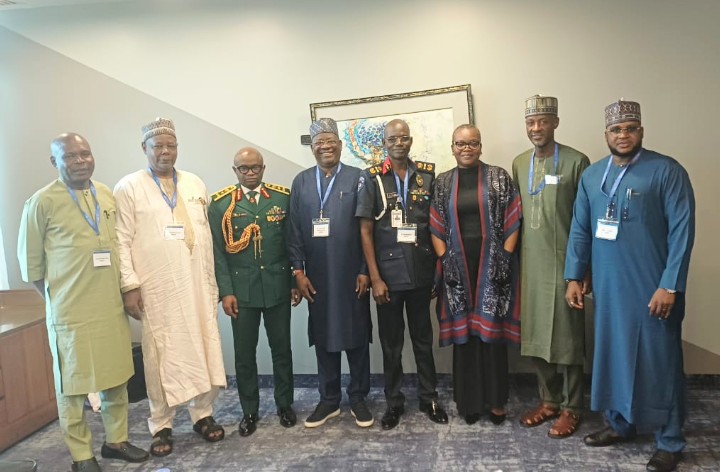
The leadership of the Africa Center for Strategic Studies (ACSS) Nigeria Chapter participated prominently in the recently concluded High-Level Workshop on Counterterrorism Strategy Implementation and Oversight in West Africa, organized by the Africa Center for Strategic Studies Washington DC, in Abidjan, Côte d’Ivoire.
The strategic workshop convened senior security officials, policymakers, legislators, civil society actors, governance experts, and regional stakeholders from across West Africa to strengthen collaboration, deepen strategic coordination, and advance practical implementation and oversight of counterterrorism frameworks within the region.
Nigeria’s delegation reflected a rare and powerful convergence of leadership across the security, governance, legislative, civil society, and policy sectors.
The delegation included Brigadier General Olutayo Muyiwa Adesuyi, Principal General Staff Officer from the Office of the National Security Adviser (ONSA); Dr. Abdullateef O.T. Shittu, Director General of the Nigerian Governors Forum; Dr. Ibrahim Katsina, Head of Peace and Security Department, Nigerian Governors Forum; Senator Abdulaziz Musa Yar’Adua, Chairman Senate Committee on Army; and Hon. Satomi Ahmad, Chairman House Committee on Defence.
Also are ACG David Idowu Ajelabi, Vice President of the ACSS Nigeria Chapter; Suleiman A. Mande, Secretary General of the ACSS Nigeria Chapter; Dr. Jerry Uhuo, Senior Adviser on Policy and Strategy to the Speaker of the House of Representatives; Dr. Kemi Okenyodo, Executive Director of Partners West Africa Nigeria; Dr. Kabiru Adamu, Managing Director of Beacon Security and Intelligence Limited; and Mrs. Pamela West, Staff Officer, Research Department, Office of the National Security Adviser.
The workshop provided a critical platform for assessing the current state of counterterrorism strategy implementation, coordination, and oversight mechanisms across West African countries, while also identifying practical pathways for strengthening institutional cooperation, intelligence sharing, democratic accountability, community engagement, and whole-of-society approaches to addressing violent extremism and insecurity.
Speaking during the engagements, members of the Nigerian delegation emphasized that the evolving nature of insecurity in Nigeria and the wider West African region requires stronger inter-agency collaboration, evidence-based policymaking, improved oversight systems, and sustained partnerships between government institutions, civil society organizations, academia, and regional actors.
The participation of the ACSS Nigeria Chapter leadership further reinforced the growing strategic relevance of the Chapter as a platform for policy dialogue, professional collaboration, thought leadership, and actionable engagement on security governance, peacebuilding, democratic accountability, and national resilience.
The ACSS Nigeria Chapter highlighted the urgent need to move beyond theoretical conversations toward coordinated action capable of translating expertise into measurable national and regional impact. Discussions during the workshop underscored the importance of strengthening implementation frameworks for the National Counter Terrorism Strategy, improving institutional coordination, expanding community trust-building initiatives, and enhancing legislative and governance oversight mechanisms.
The workshop also created opportunities for deeper collaboration between the ACSS Nigeria Chapter and key institutions, including the Office of the National Security Adviser, the Nigerian Governors Forum, the National Assembly, civil society organizations, and regional security stakeholders. Participants acknowledged the critical role that the ACSS alumni network can play in bridging policy, strategy, governance, research, and operational implementation across sectors.
Commenting on the significance of the engagement, leadership of the ACSS Nigeria Chapter noted that the workshop marked an important step toward positioning the Chapter as a formidable network of professionals and institutions committed to supporting national and regional peace, security, democratic governance, and sustainable development.
The Chapter reiterated its commitment to supporting strategic conversations and practical interventions that contribute to strengthening Nigeria’s security architecture, advancing democratic accountability, and promoting collaborative solutions to the complex security challenges facing Africa.
The Africa Center for Strategic Studies continues to serve as one of the foremost platforms for advancing strategic security studies, professional development, and policy engagement between African leaders and the United States in addressing peace and security challenges across the continent.
Discover more from TheTimes Nigeria
Subscribe to get the latest posts sent to your email.