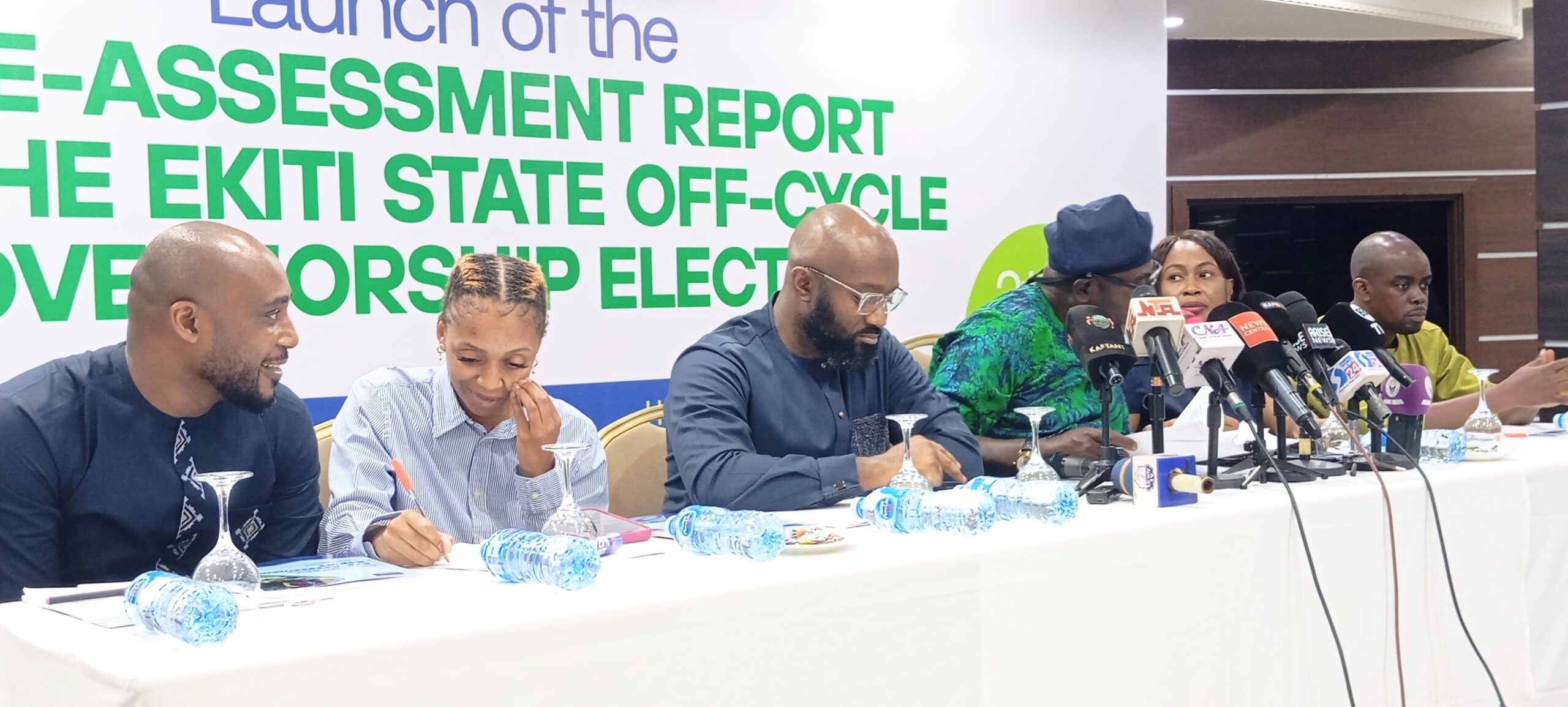
A coalition of seven of the nation’s notable civil society organisations (CSOs) has called for the activation of the Independent National Electoral Commission (INEC) Security and Alert Notification System (ISANS) as part of measures to ensure the success and credibility of the forthcoming Ekiti State governorship election.
The INEC has fixed June 20 this year for the off-cycle governorship election in the state.
The CSOs under the auspices of Election Observation Hub, and the European Union Support to Democratic Governance in Nigeria Phase Two (EU-SDGN II) programme, made the call at a joint media briefing and formal launch of the 143-page Ekiti State Off-Cycle Governorship Election Pre- Election Assessment Report 2026 on Thursday in Abuja.
They said that the INEC ISANS should be activated for rapid response, provide raincoats and protective covering for personnel and materials, and intensify civic and voter education to address apathy and discourage vote trading.
According to them, the assessment is consistent with the EU-SDGN II’s mission of promoting transparent, credible, peaceful and inclusive elections.
They said that the programme’s six components support: The INEC, National Assembly and the Judiciary; Political Parties, Media, Women, Youth, and Persons with Disabilities Civil Society Organisations
The report assesses the political economy of the election, the preparedness of INEC, the media and information environment, the participation of marginalised groups, and the election-related risks that could compromise the integrity, credibility and legitimacy of the process.
The representatives of the coalition are leaders of Centre For Media and Society (CEMESO), ElectHER, International Press Centre (IPC) -Mr Lanre Arogundade, Nigerian Women Trust Fund (NWTF) -Brenda Anigwom, TAF Africa, The Kukah Centre -Esrom Ajanya and Yiaga Africa -Samson Itodo.
“The 20 June 2026 Ekiti governorship election is the first governorship election to be governed by the new Electoral Act 2026. It will test the implementation of key provisions of the new Act and yet to be issued INEC regulations and guidelines including those on electronic results transmission, administrative review of election results and results collation.
“Coming barely seven months before the 2027 General Election, it is a critical stress test of INEC’s operational readiness, the commitment of security agencies to electoral integrity and interest of voters to actively participate in the electoral process that many already perceive as a foregone conclusion.
“Failure here will not remain confined to Ekiti State; it will set a damaging precedent for the Osun State off-cycle governorship election coming soon after and the (2027) general election,” they said.
They said in the key findings and matters arising section that though a ‘peaceful and non-competitive’ election Is not automatically a democratic one; the pre-election environment in Ekiti State is generally calm.
They said, “However, this calmness must not be misread as democratic health. Pre-election activities have so far proceeded without any serious breach of the peace.
“However, the election is widely perceived as uncompetitive, shaped by the residual advantage of incumbency, an apparent elite consensus around the sitting governor, resource asymmetry between the ruling and opposition parties, and internal contradictions within opposition platforms.”
While saying that INEC’s preparedness Is an operational emergency, the coalition noted that the Resident Electoral Commissioner (REC) and the senior management of the INEC State Office are experienced, and key preparatory activities like Continuous Voter Registration (CVR) have been concluded, while BVAS inventory checks, network mapping, RAC assessments and stakeholder engagement are underway.
The coalition, however said the state of election preparedness across the 16 INEC LGA offices stood at 34% as of 14 April 2026.
They said, ” The State Office is yet to receive election funding, and several State and LGA offices, operational vehicles and collation centres require urgent rehabilitation.
“The 32,475 new registrants from the Continuous Voter Registration exercise are being processed, with PVC collection scheduled for 21-25 May 2026 and the display of the register of voters across all 2,445 polling units on 20 May 2026.
“With 36 days to polling day, a one-third preparedness rate is structurally incompatible with the conduct of a credible election on current trajectory. Despite the concluded and ongoing activities by INEC state office, it is important to note that they do not compensate for the absence of core funding and infrastructure as at 14th April 2026.”
The coalition noted that based on a systematic risk mapping Ado-Ekiti (urban violence) and Ikole, Moba and llejemeje (kidnapping exposure) are classified as high-risk LGAs, with Efon, Ikere and Oye as medium- risk.
According to them, the principal threats include vote buying driven by economic hardship, the use of political thugs, the spread of disinformation and hate speech particularly via WhatsApp and local radio and possible militarisation of election security.
” The possible reaction of the politically conscious Ekiti electorate to any perceived manipulation of the process is also a concern,” they said.
They noted that inclusion gaps for women, youths and PWDs despite the existence of progressive laws such as the Ekiti State Political Offices (Gender Composition) Law 2022 and the Discrimination Against Persons with Disabilities (Prohibition) Law 2020, is a disservice as none of the 13 political parties fielded a female governorship candidate.
“No candidate publicly identifies as a person with disability. High nomination fees, informal gatekeeping and entrenched patronage networks continue to constrict the participation of women, youths and PWDs at the highest levels of political competition.
“It must be noted that the political awareness and civic engagement of women, youth and persons with disabilities in Ekiti remains high, making the structural exclusion of these groups from candidate lists even more egregious and inexcusable,” they said.
They also listed other areas of concern that are needed to be strategically addressed to ensure the success of the election.
In their recommendations, the coalition urged all stakeholders to act decisively to consolidate the gains identified in the report and to address the outstanding risks, saying that the Hub’s recommendations are prioritised by urgency.
The highlighted that the most critical actor at this stage is INEC, whose operational failure would cascade across all other areas, this INEC must ensure the timely release and effective utilisation of election funds to complete pending pre-election activities, including the rehabilitation of State and LGA offices, RACs and collation centres.
“Configure and stress-test the BVAS and the IReV to guarantee seamless accreditation, transparent collation and the credible electronic transmission of results in line with the Electoral Act 2026.
“Activate the INEC Security and Alert Notification System (ISANS) for rapid response, provide raincoats and protective covering for personnel and materials, and intensify civic and voter education to address apathy and discourage vote trading.
“Implement priority voting and accessibility measures for vulnerable persons, expand the deployment of assistive devices, and improve the collection of gender- and PWD-disaggregated data To Security and Law Enforcement Agencies:
“Execute Operation Order 08/2026 with strict neutrality, professionalism and intelligence-led deployment, with particular attention to border communities in the northern LGAs of Ikole, Moba and Ilejemeje.
“Adopt a proportionate, rights-based approach in addressing vote trading and avoid heavy-handed tactics that could provoke a public backlash.
“Guarantee the safety of voters, journalists, observers, electoral personnel and election materials throughout the process. To Political Parties and Candidates:
“Sign and uphold the Peace Accord. Commit publicly to issue-based campaigning, reject vote buying, intimidation and the deployment of thugs, and accept credible electoral outcomes.
“Resolve internal party disputes through lawful institutional and judicial channels, and refrain from inflammatory rhetoric or the mobilisation of primordial sentiments.”
The report also tasked the media, civil society, traditional rulers, religious leaders and other stakeholders to act in the interest of the success of the election and democratic advancement in the country.
Discover more from TheTimes Nigeria
Subscribe to get the latest posts sent to your email.