Bilaad Development Trust gathers emerging innovators in Abuja as business leaders call for stronger private-sector funding, local content and housing reforms.
Nigeria’s growing youth population holds enormous potential to drive economic transformation, but business leaders say unlocking that potential will require more than encouraging young people to start businesses.
They are calling for stronger access to finance, structured mentorship, market opportunities and policies that enable young enterprises to survive and scale.
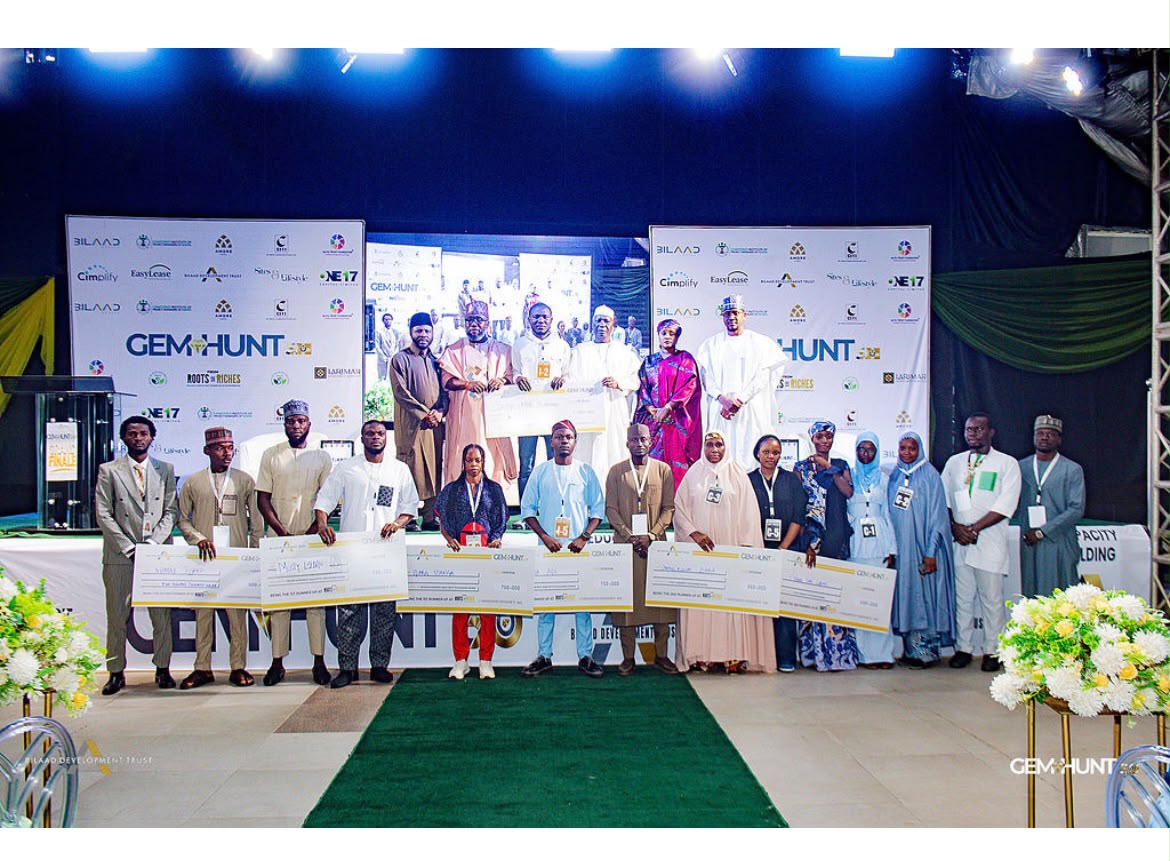
The call was made at the fifth edition of the annual enterprise pitch competition, Gem Hunt 5.0, organised by the Bilaad Development Trust in Abuja.
Held under the theme, “From Roots to Riches: Building Nigeria’s Next Generation of Entrepreneurs,” the 2026 edition brought together emerging entrepreneurs and innovators pitching solutions across technology, renewable energy, agriculture, commodity trading, fashion and other sectors.
For participants, the competition was more than an opportunity to win prize money. It was a platform to expose promising ideas to experienced business leaders, mentors and potential investors.
Three Pillars for MSME Growth
Speaking with journalists on the sidelines of the event, the Chairman of Bilaad Realty Limited and Coordinating Trustee of the Bilaad Development Trust, Dr. Sadiq Suleiman Abdullahi, said young entrepreneurs require more than business ideas to succeed.
He identified high energy costs, limited digital access, inadequate mentorship and the collateral requirements of conventional financial institutions as some of the major obstacles confronting emerging businesses.
According to him, many young entrepreneurs with potentially viable businesses struggle to secure conventional loans because they lack the assets and traditional collateral required by commercial banks.
To address these challenges, Dr. Abdullahi proposed a three-pillar approach.
Alternative Impact Funding
He called on International Oil Companies, commercial banks and other organised private-sector players to channel more Corporate Social Responsibility and impact-investment funding towards early-stage businesses.
Such funding, he argued, could provide young enterprises with the capital required to test, develop and scale innovative ideas.
Strategic Market Linkages
Dr. Abdullahi also highlighted the importance of connecting producers, particularly those operating in rural and underserved communities, with larger and more reliable markets.
He advocated greater digital integration to help small producers access urban consumers, improve distribution and reduce barriers between production and markets.
Capital Mentorship
Beyond financial investment, the Bilaad Realty chairman stressed the importance of what he described as capital mentorship — the transfer of knowledge, experience, networks and relationships from established business leaders to younger entrepreneurs.
For him, mentorship should go beyond motivational speeches to include practical guidance on business management, integrity, operations, market access and relationship building.
Entrepreneurship Beyond Capital
Also speaking with journalists, the Chief Executive Officer of Bilaad Realty Nigeria Limited, Dr. Usman Emmanuel Bassi, expressed confidence in the ingenuity of the young entrepreneurs who participated in the competition.
He praised the contestants for developing solutions around sustainability, local content and indigenous problem-solving.
Dr. Bassi stressed that entrepreneurship should not be viewed solely through the lens of access to large amounts of capital.
“Entrepreneurship is not fundamentally about having vast sums of money; it is about viable ideas, local content and resilience,” Dr. Bassi said.
According to him, the presentations demonstrated that many of the solutions Nigerians need can be developed locally by harnessing indigenous resources and talent.
He argued that relatively modest but targeted financial support could make a significant difference to early-stage businesses, enabling entrepreneurs to move from employing one or two people to creating jobs for five, ten or more workers.
Dr. Bassi also advocated greater attention to intrapreneurship, alongside conventional entrepreneurship, describing it as another avenue through which businesses can create employment, improve productivity and contribute to long-term poverty reduction.
Housing: Another Front for Economic Reform
The conversation at Gem Hunt 5.0 also extended beyond entrepreneurship to one of Nigeria’s most pressing socio-economic challenges — housing.
Dr. Abdullahi observed that property costs in major urban centres such as Abuja have risen significantly over the years, while the purchasing power of many Nigerians has failed to keep pace.
He argued that solving Nigeria’s housing challenge requires a broader approach that takes into account the realities of low-income and informal-sector workers.
Among the measures he proposed are concessionary ethical financing, alternative construction technologies using locally available materials, and a more inclusive mortgage system capable of accommodating Nigerians outside the formal employment structure.
He said housing should not be viewed solely as a real-estate issue, but as part of the broader economic and social infrastructure needed to improve living standards and productivity.
Beyond the Prize Money
The significance of Gem Hunt 5.0 ultimately goes beyond the competition itself.
The initiative is designed to identify young Nigerians with innovative ideas and connect them to the resources, mentorship and networks required to develop those ideas into sustainable ventures.
The organisers have also placed emphasis on three broad areas — Education, Entrepreneurship and Change Advocacy — as part of their wider effort to support young people and address contemporary social challenges.
For the winners, the support package extends beyond cash awards.
Third-place winners across the categories received a ₦500,000 cash award, six months of corporate mentorship and full access to the Bilaad Development Trust network.
Second-place winners received a ₦750,000 cash award, a 12-month mentorship programme, national media visibility and network access.
The Grand Champion received a ₦2 million cash seed prize, alongside 12 months of structured incubation, dedicated investor introductions, national media features and lifetime alumni network benefits.
These interventions point to a broader question for Nigeria: how can promising young people move from having good ideas to building businesses capable of creating jobs, generating wealth and solving real problems?
Gem Hunt 5.0 offers one possible answer — that the journey from roots to riches requires more than inspiration.
It requires access to capital, knowledge, markets, mentorship and the right networks.
And if Nigeria is serious about harnessing the energy and creativity of its young population, the challenge may no longer be finding ideas.
It may be creating the ecosystem that allows those ideas to survive, grow and create opportunities for others.
Discover more from TheTimes Nigeria
Subscribe to get the latest posts sent to your email.