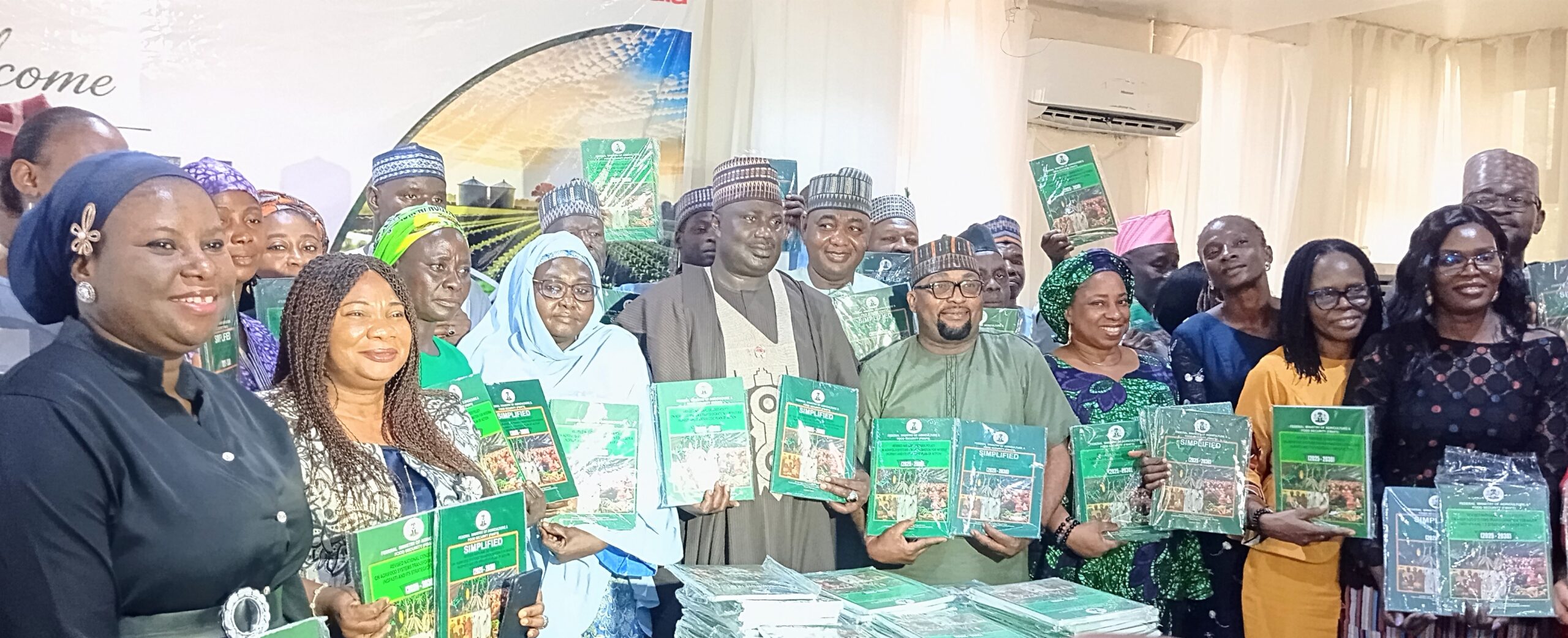
The Federal Government in partnership with the ActionAid Nigeria (AAN) has launched the revised National Gender Policy on Agri-food Systems Transformation for Nigeria (NGPAST), and its Strategic Plan of Action 2025-2030.
The launch yesterday in Abuja is with the aim of ensuring gender mainstreaming in the agricultural sector.
The Minister of Agriculture and Food Security Senator Abubakar Kyari said the unveiling is an important step towards making Nigeria’s agriculture more inclusive, productive, and sustainable.
The Minister represented by the Minister of State, Senator Sabi Abdullahi, acknowledged that gender disparities continue to limit the full participation of many Nigerians, particularly women, who play critical roles across the agri-food value chain.
According to him, the revised policy would provide a clear and practical framework to ensure equitable access to resources, opportunities, and decision-making for both women and men as well as strengthen the integration of gender-responsive approaches across all agricultural programmes and interventions.
The Minister however commended development partners ActionAid Nigeria, AGRA, and GIZ for their collaboration in producing the document, emphasizing that the success of the policy will depend on implementation.
He also urged all relevant institutions and stakeholders to mainstream the policy into their plans, programmes, and budgets, assuring that the government would ensure strong monitoring and accountability to deliver measurable results.
The Country Director of ActionAid Nigeria, Dr. Andrew Mamedu while speaking on behalf of the National Gender Steering Committee, said the policy places gender equity and social inclusion at the heart of agri-food systems transformation
Mamedu, represented by Mrs Olufumilola Olukeye said, ”It recognizes men, women, young people, and persons with disabilities not just as beneficiaries at the margins but as central actors and drivers of food security, livelihoods, innovation and national development.”
He noted that the policy was shaped by evidence, nationwide consultations, and the shared resolve of government, civil society, development partners, the private sector, and farming communities across all six geopolitical zones.
The Country Director of Alliance for Green Revolution in Africa (AGRA), Dr. Rufus Idris expressed support for Nigeria’s revised gender policy on agri-food system transformation, noting that it reflects a shared commitment to inclusive agricultural development across Africa.
He stressed that transforming Africa’s food systems cannot be achieved without prioritizing gender inclusion.
He commended the Federal Ministry of Agriculture and Food Security, alongside partners such as ActionAid, GIZ, and the National Gender Steering Committee, for their roles in developing the policy.
Also speaking, the FCT Secretary of the Small-Scale Women Farmers Organisation in Nigeria (SWOFON), Nnena Mercy, described the event as a significant milestone, recalling her organisation’s involvement in both the initial and revised policy processes.
She stressed that beyond policy formulation, the real measure of success lies in implementation that directly impacts rural women farmers. According to her, the “missing voice” in Nigeria’s development space remains that of rural women, who often lack access to resources and opportunities despite their critical role in agriculture.
Mercy called for deliberate efforts to ensure that the policy translates into tangible improvements in the lives of women farmers, including better livelihoods, access to education for their children, and recognition of agriculture as a viable and meaningful economic activity for national development.
Discover more from TheTimes Nigeria
Subscribe to get the latest posts sent to your email.