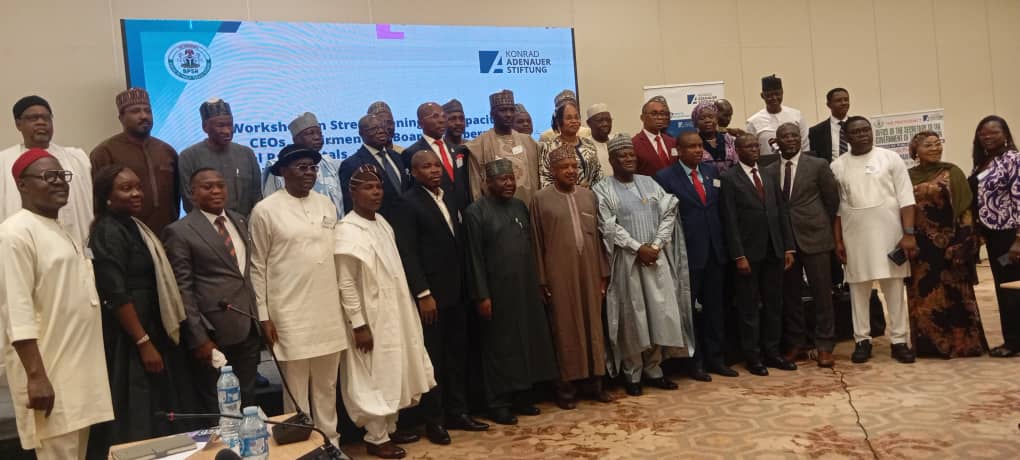
The federal government has charged Chairmen, Chief Executive Officers and members of the Governing Board of Federal Parastatals, Agencies and Commissions to uphold the principles of good governance, accountability, integrity and effective service delivery in line with the Renewed Hope Agenda of the administration of President Bola Ahmed Tinubu.
The Secretary to the Government of the Federation (SGF), Senator George Akume, gave the charge during a three-day Induction Programme for Chief Executive Officers, Chairmen and Governing Board Members of Parastatals, Agencies and Commissions on Monday in Abuja.
It was organised by the Bureau of Public Service Reforms (BPSR), with support from Konrad Adenauer Stiftung (KAS) and the Department of International Development (DFID), now FCDO.
The SGF, represented by the Permanent Secretary, General Services Office (GSO) in his office, Dr. Ibrahim Abubakar Kana, stated that the Induction Programme was designed to deepen participants’ understanding of emerging government policies, processes and procedures, while equipping them with the requisite knowledge to effectively discharge their mandates.
According to him, the Public Service remains the principal vehicle for policy implementation and service delivery in Nigeria, stressing that Parastatals, Agencies and Commissions were established to carry out specific functions within the framework of government policies and national priorities.
He also expressed concern over the increasing instances of conflicts and misunderstandings regarding the roles and responsibilities of Boards and Chief Executive Officers.
He noted that such situations have negatively affected productivity and institutional harmony in some agencies.
“Governing Boards are responsible for providing policy direction and strategic oversight, while Chief Executive Officers are charged with the day-to-day administration and management of their respective institutions,” Akume said.
The SGF emphasized that Governing Boards must operate within the limits of their statutory mandates and should refrain from direct involvement in daily administration.
He further reminded Board Members that their responsibilities are primarily policy-oriented and oversight-driven.
While urging Chairmen and Board Members to familiarize themselves with the enabling laws and operational guidelines governing their institutions, the SGF outlined the critical oversight responsibilities of the Boards.
He listed them to include ensuring that the long-term interests of the Federal Government are protected, promoting sustainable and cost-effective institutional practices, strengthening internal controls and risk management systems, monitoring management performance and supporting strategic development initiatives.
He also disclosed that the BPSR has been directed to conduct impact assessments on agencies whose Board Members and Chief Executives participate in the induction programme.
According to him, this will enable government to assess compliance with extant rules and determine the level of harmony and effectiveness in institutional operations.
Senator Akume urged all appointees to justify the confidence reposed in them through dedicated service, professionalism and commitment to the values of equity, transparency and accountability, while reaffirming the commitment and support of President Bola Ahmed Tinubu’s administration towards strengthening institutions and improving governance structures for enhanced service delivery to Nigerians.
…No compromise mandate-driven leadership -Arabi
Speaking earlier, the Director General of the BPSR, Mr Dasuki Ibrahim Arabi, emphasized the importance of good governance and mandate-driven leadership across the public sector.
He also noted that the batch of Induction training represents the 11th series, conducted by the BPSR as part of its core mandates.
“It is pertinent to state that this Induction training is informed on the deliberate step by the Federal Government to strengthen accountability, promote good governance, and cultivate mandate-driven leadership across the public sector.
“The Induction training is part of the broader mandate of the Bureau of Public Service Reforms (BPSR), to strengthen public institutions, and transform them to a highly functional, professional, customer -focused, and result- oriented institutions.
“Key aspects of the mandate, include, advisory to government on topical issues, Initiating and coordinating reforms, building institutional capacity, performance Management System, promote ethical standards and integrity, and workforce management solutions.
“Particularly, the training programme also aligns with the priority objectives of the Renewed Hope Agenda led by President Bola Ahmed Tinubu, on strengthening Public institutions for effective service delivery and the creation of a more prosperous, inclusive and responsive society for all Nigerians,” Arabi said.
He told the participants that as CEOs/Board members entrusted with strategic leadership roles in institutions that deliver critical services to Nigerians and shape the implementation of national policies, their decisions, conduct, and performance directly influence citizens’ trust in government and the credibility of public institutions.
He said, “This induction, therefore, offers a unique opportunity to reflect on your constitutional and statutory responsibilities, to clarify the boundaries between board and management, and to align your leadership with the principles of transparency, integrity, and results-orientation.
“Effective corporate governance and organizational excellence are the cornerstones of efficient service delivery, institutional sustainability, and public accountability. Your roles as Chairmen and Board Members, as well as Chief Executive Officers, are pivotal in setting the tone at the top -ensuring that public institutions under your stewardship are not only compliant with governance frameworks, but are also innovative, responsive, and resilient in delivering on their mandates.”
The BPSR DG said that the induction aims to provide participants with practical knowledge, policy insights, and performance tools that will enable them to understand the legal, ethical, and operational dimensions of their roles; Strengthen oversight functions and management alignment; Promote transparency, accountability, and inclusive leadership; and ultimately, contribute to national goals through institutional performance excellence.
The event was also attended by the leadership of the Independent Corrupt Practices and Other Related Offences Commission (ICPC), Economic and Financial Crimes Commission (EFCC), Minister of Budget and Economic Planning, SenatorAbubakar Atiku Bagudu, as well as experts in related fields and disciplines.
Discover more from TheTimes Nigeria
Subscribe to get the latest posts sent to your email.