The Global Rights, an international civil society organisation (CSO), the European Union (EU), CSO partners, and other stakeholders have called for the strengthening of democratic governance structures and improvements in Nigeria’s regulatory environment as part of measures to promote societal well-being and development.
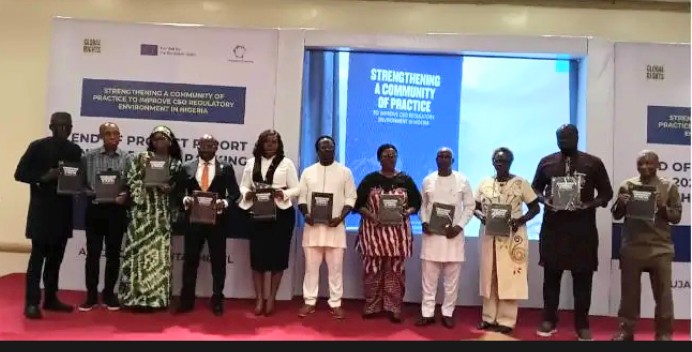
They made the call on Monday in Abuja at the closeout and launch of the End-of-Project Evaluation Report and the 2025 CSO Regulatory Environment Ranking Dashboard under the EU-funded project tagged, ‘Strengthening a Community of Practice (CoP) to Improve the CSO Regulatory Environment in Nigeria’.
Speaking at the event, the Executive Director of Global Rights, Ms Abiodun Baiyewu, said the end of the project does not mark the end of the collaboration established between the CSOs and the EU over the last three years.
According to her, the initiative was never designed as a tick-box project but as a long-term effort requiring cooperation among the federal and state governments, regulators, civil society organisations, women, youth and other stakeholders.
“On the concerns about the future of the initiative after donor funding, the partnership will continue. One of the project’s major achievements was improving relationships between regulators and civil society. Constructive engagement has replaced years of distrust in many areas,” Baiyewu said.
She also commended the Corporate Affairs Commission (CAC) for its transformation over the last three years, urging Nigerians to continue supporting civic engagement, even as she said that criticism of government should not be viewed as hostility.
“The past three years have been a long road, and a great deal of work has gone into implementing this project. It has required collaboration across government and civil society, regulatory agencies, organisations at the federal, state and local government levels, as well as the inclusion of women, youth and groups that are often excluded from policy conversations.
“With or without funding, this collaboration continues. We are seeking funding because resources are critical to sustaining the momentum we have built, but the work itself does not end because a project has ended.
“I have seen significant change in the CAC. It has become more responsive and more willing to engage. We will continue engaging regulators because there can no longer be excuses for avoiding dialogue.
“Civil society exists because citizens deserve accountability. Criticism is not an attack; it is part of building a better society. Government and civil society need one another if Nigeria is to progress. Those in government today may leave someday and then join CSOs to demand the same things we are demanding now,” she added.
On his part, the Head of Cooperation at the European Union Delegation to Nigeria and ECOWAS, Massimo De Luca, speaking virtually, said the EU is committed to promoting good governance, democratic institutions and civic participation in Nigeria.
He said that civil society is indispensable to democratic governance, noting that civil society organisations play critical roles in representing citizens, promoting transparency, advancing human rights and contributing to inclusive policymaking.
He also said the project had focused on strengthening regulatory compliance among CSOs, encouraging dialogue between public institutions and civil society, supporting communities of practice across participating states and promoting evidence-based regulatory reforms.
He noted that the launch of the two knowledge products marked an important milestone and that the conclusion of the project should be viewed as the beginning of a new phase of collaboration rather than its end.
“The ability of civil society organisations to fulfil this role depends on the existence of a regulatory environment that enables, rather than constrains, their work. The first knowledge product is the independent end-line evaluation report, which provides an evidence-based assessment of the project’s achievements, lessons learned and recommendations for future programming.
“The second is the State Ranking Dashboard, an innovative tool that assesses and compares the regulatory environment for civil society organisations across Nigeria’s states. This dashboard has the potential to encourage constructive dialogue, support informed policymaking and promote healthy competition among states to strengthen the enabling environment for civil society.
“The relationships established, the communities of practice nurtured, the knowledge generated and the policy conversations initiated provide a strong foundation for continued collaboration in support of democratic governance and civic participation in Nigeria,” De Luca said.
Also speaking, a former Chairman of the National Human Rights Commission (NHRC) and Chairman of the Governing Board of Global Rights, Prof. Chidi Odinkalu, urged CSOs to embrace compliance as a permanent organisational culture rather than treating it as a donor requirement.
He warned that Nigeria was entering a politically sensitive period that would test the resilience of CSOs, saying meticulous record-keeping and strict compliance with legal obligations would protect organisations from arbitrary state action and that they could learn from the experiences of the late legal luminary and human rights activist, Gani Fawehinmi.
“Compliance is not a project; compliance is a culture. The political environment over the next two years will be increasingly difficult. If organisations want to remain active and relevant, they must build resilience through strong governance systems and full regulatory compliance.
“Late human rights lawyer Gani Fawehinmi kept records of everything, maintained impeccable tax compliance and ensured every legal obligation was fulfilled. That discipline made it difficult for governments to silence him despite repeated attempts. CSOs should learn from him too so that they can’t be found wanting while holding government accountable.
“We must ensure this project does not remain dependent on donor funding alone. There is room for collaboration with universities to make compliance education sustainable and available nationwide,” Odinkalu said.
In her welcome remarks, the Global Rights Programme Manager, Nora Sedi, said the project had strengthened partnerships among CSOs, regulatory agencies, legislators and development partners over the past three years.
She expressed appreciation to the European Union for supporting the initiative and acknowledged the contributions of members of the Community of Practice (CoP), the CAC, the Special Control Unit against Money Laundering (SCUML), the Nigeria Revenue Service (NRS) and other public institutions.
According to her, sustained dialogue between government and civil society remains essential to strengthening Nigeria’s civic space and promoting an enabling regulatory environment for non-profit organisations.
Also, the Co-chair of the National Steering Committee of the Community of Practice (CoP) on Civic Space Strengthening, Dr Ken Henshaw, said the initiative was conceived to reduce excessive regulatory burdens that made compliance difficult for civil society organisations.
He recalled that before the intervention, many organisations were subjected to multiple registration requirements at the federal and state levels, depending on the nature of their programmes, adding that findings from the independent evaluation showed overwhelming support for the project.
“In some states, organisations had to register with several ministries depending on whether they worked on education, women, youth or other thematic areas. It created unnecessary barriers that made our work extremely difficult.
“About 92.2 per cent of beneficiaries rated the project as excellent, while 95 per cent indicated that they intended to continue applying the knowledge and compliance systems introduced under the project. Those are remarkable outcomes for any development intervention,” Henshaw said.
The Evaluation Report and the 2025 CSO Regulatory Environment Ranking Dashboard is products of a three-year initiative that brought together civil society organisations, regulatory agencies, legislators and policymakers to address regulatory bottlenecks confronting CSOs and promote a more enabling civic space.
A total of 39 organisations were surveyed across seven states, including Oyo, Ogun, Osun, Anambra, Ebonyi, Cross River and Akwa Ibom, with representatives of the states in attendance at the event.
Participants were also unanimous in warning that compliance and constructive engagement must continue beyond donor-funded interventions.
They tasked the Community of Practice (CoP), the Corporate Affairs Commission (CAC), the Special Control Unit against Money Laundering (SCUML) of the Economic and Financial Crimes Commission (EFCC), the Nigeria Revenue Service (NRS) and other public institutions with pursuing stronger civic space reforms.
Discover more from TheTimes Nigeria
Subscribe to get the latest posts sent to your email.