The Independent Corrupt Practices and Other Related Offences Commission (ICPC) and Centre for Social Justice (CSJ) have called for sustained implementation of anti-corruption reforms in key public institutions, saying stronger systems and preventive measures remain critical to tackling corruption and improving service delivery in Nigeria.
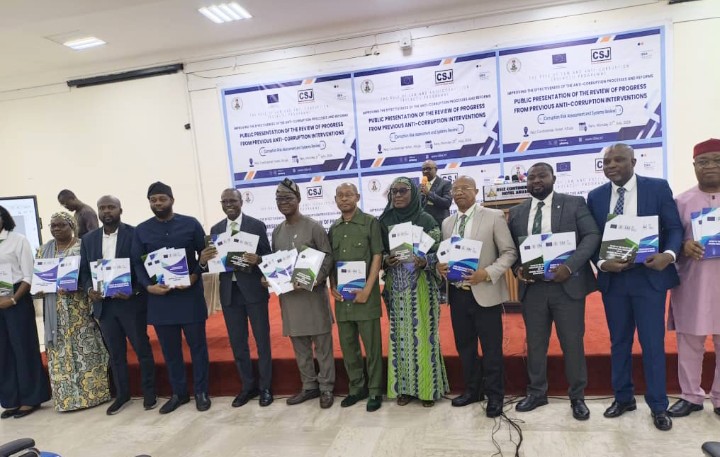
They made the call on Monday in Abuja during the public presentation of the Follow-up System Review Report on the National Health Insurance Authority (NHIA), the Follow-up Corruption Risk Assessment Report on the National Primary Health Care Development Agency (NPHCDA), and the Follow-up Corruption Risk Assessment Report on the Universal Basic Education Commission (UBEC) and selected State Universal Basic Education Boards (SUBEBs).
Speaking at the event, the Chairman of ICPC, Dr Musa Adamu Aliyu, SAN, said the reports were part of the Commission’s preventive mandate to identify systemic weaknesses, evaluate the implementation of previous recommendations and strengthen governance in public institutions.
Aliyu commended the Rule of Law and Anti-Corruption (RoLAC) Programme II for its support and the Centre for Social Justice (CSJ) for partnering with the Commission throughout the exercise, describing the collaboration as a demonstration of the importance of collective action in promoting sustainable anti-corruption reforms.
He noted that the ICPC derives its preventive powers from the Corrupt Practices and Other Related Offences Act, 2000, which empowers the Commission to review systems and procedures in public institutions vulnerable to corruption and recommend corrective measures before weaknesses develop into corrupt practices.
According to him, the reports assessed the extent to which earlier recommendations had been implemented, identified progress made, highlighted outstanding challenges and proposed additional reforms to strengthen institutional performance.
“The value of system studies and corruption risk assessments lies not merely in the production of reports but in the implementation of their recommendations. Their true impact is measured by improvements in governance, accountability, transparency, operational efficiency and service delivery,” he said.
Aliyu stressed that the exercise was not intended to apportion blame but to celebrate progress, identify lessons learnt and renew commitment to strengthening institutional processes and controls.
He noted that the NHIA, NPHCDA and UBEC were selected because of their strategic roles in delivering healthcare and education services that directly affect millions of Nigerians.
While commending the leadership of the three institutions and the participating SUBEBs for implementing several previous recommendations, the ICPC chairman urged them to sustain the momentum by addressing the outstanding reforms.
He maintained that the fight against corruption could not be won through enforcement alone, insisting that resilient institutions with transparent systems, effective oversight and a culture of accountability offered the most sustainable solution.
Also speaking, the Lead Director of the Centre for Social Justice, Barrister Eze Onyekpere, said the reviews were conducted under the project, Improving the Effectiveness of Anti-Corruption Processes and Reforms, with support from the European Union (EU) through the RoLAC Programme.
He said the exercise focused on the NHIA, NPHCDA and UBEC because of their central roles in advancing the rights to healthcare and education and achieving the Sustainable Development Goals.
According to him, anti-corruption laws and policies can only achieve their objectives when institutions effectively implement them, leading to systemic reforms, improved compliance and behavioural change.
Onyekpere urged government institutions to improve the dissemination of review findings, strengthen inter-agency collaboration and institutionalise multi-stakeholder engagement involving anti-corruption agencies, ministries, civil society organisations, development partners and the media.
He also recommended continuous peer learning among government agencies through regular dialogue and benchmarking to encourage the adoption of best practices.
Representing the European Union-funded International IDEA, Mr Emmanuel Uche commended the ICPC for prioritising preventive anti-corruption measures rather than relying solely on prosecution.
He said corruption risk assessments would have little impact without consistent monitoring and follow-up, describing the current review process as an important step in ensuring that institutions implement integrity plans developed after earlier assessments.
Uche noted that while the ICPC possesses statutory powers to recommend sanctions against agencies with persistent governance weaknesses, the Commission had instead adopted a constructive engagement approach that encourages institutional reforms.
He said the reports showed measurable progress by the three institutions, although some gaps remained, adding that none of the agencies reviewed was found to be completely non-compliant.
He also said that the exercise aligns with the implementation of Nigeria’s National Anti-Corruption Strategy, which seeks to ensure that anti-corruption efforts translate into better public services and improved living standards for citizens.
He added that the initiative complements the recently introduced State Service Delivery Transparency Initiative, designed to improve accountability and oversight in the health and education sectors at both national and sub-national levels.
Uche stressed that anti-corruption efforts should not focus only on recovering stolen funds and prosecuting offenders but also on strengthening institutions responsible for delivering essential services.
He likened the approach to protecting the roots of a tree rather than chasing the monkeys eating its fruits, warning that neglecting systemic weaknesses would ultimately undermine governance and service delivery.
The event also witnessed remarks and presentations from relevant government agencies, National Assembly and development partners among others.
Discover more from TheTimes Nigeria
Subscribe to get the latest posts sent to your email.