As the global 16 Days of Activism Against Gender-Based Violence begins today, the African Centre for Security, Governance & Development (CentreSGD) has released a new policy brief examining how artificial intelligence and coordinated digital harassment and threats are undermining women’s political participation across the continent.
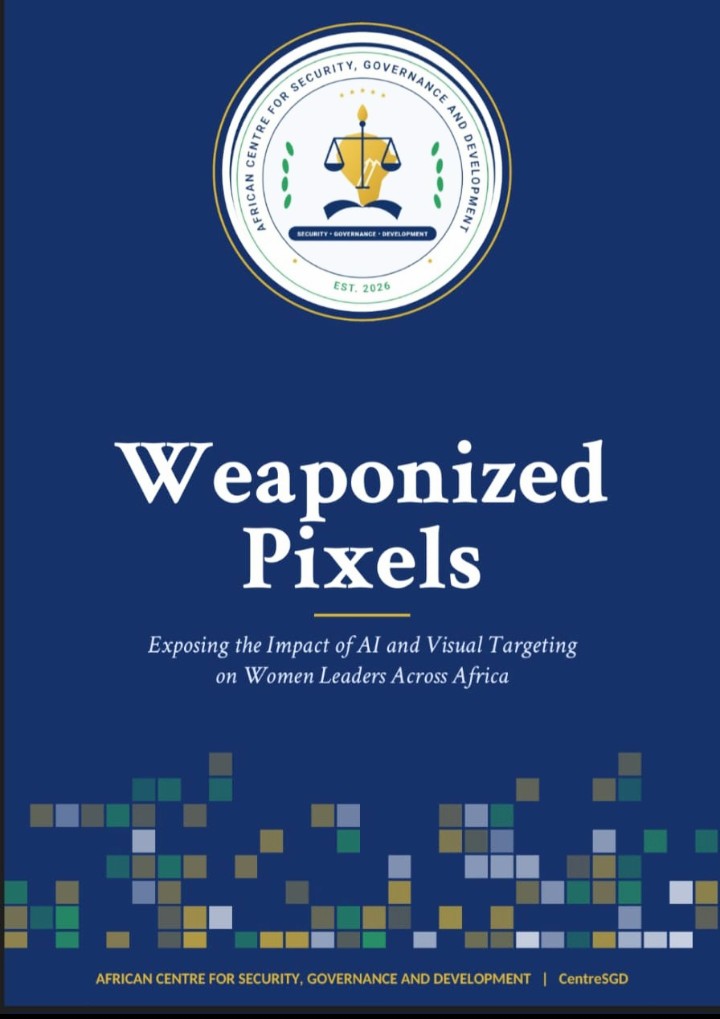
Titled ‘Weaponized Pixels: Exposing the Impact of AI and Visual Targeting on Women Leaders Across Africa’, the brief synthesizes regional and global research to show how fabricated sexual imagery, doctored photos, and synthetic videos are being deployed as low-cost weapons to intimidate female candidates, human rights defenders, and journalists.
The brief launched on Wednesday was signed by Theresa Chigozirim Odinkalu-Okoro, Executive Director of CentreSGD.
With women holding approximately 27% of parliamentary seats in sub-Saharan Africa—and global parliamentary representation rising by just 0.3 percentage points over the past year—CentreSGD warns that unchecked Technology-Facilitated Gender-Based Violence (TFGBV) poses a direct threat to democratic governance.
Key Findings from the Brief
Attacks Target Gender, Not Governance Challenges: An analysis of more than 140,000 X (formerly Twitter) posts directed at women candidates across four Nigerian states (2022–2025) revealed that gender stereotypes and attacks on appearance or personality far outnumbered criticism of competence.
Reporting from Kenya mirrors this pattern, where female politicians are disproportionately targeted over their bodies, age, and morality while male counterparts face scrutiny over policy decisions.
Electoral Attrition: Online abuse tracks the election cycle—shifting from competence attacks prior to campaigns to gendered stereotypes during elections, with smear campaigns peaking afterward. Across 48 reviewed studies, 81% reported fear or distress among targeted women, 62% documented women altering their political messaging, and 20% reported women withdrawing from political roles altogether.
Patchwork Legal Protections: National laws have struggled to keep pace with synthetic media. While South Africa’s Cybercrimes Act criminalizes the non-consensual sharing of intimate images—including simulated imagery—court backlogs hinder enforcement.
Ghana’s Cybersecurity Act covers non-consensual intimate image sharing and related threats, whereas Kenya’s Sexual Offences (Amendment) Bill, 2026 and AI Bill, 2026 remain under legislative review, and Uganda lacks legislation specifically addressing TFGBV.
Institutional and Data Blind Spots: Political parties largely lack internal reporting mechanisms, survivors frequently refrain from coming forward due to stigma, and Africa-specific datasets measuring deepfake prevalence remain scarce.
Seven institutions, one immediate priority each
Rather than treating synthetic abuse solely as a technology issue, Weaponized Pixels assigns an immediate, actionable “First Move” to seven Arms of Government & other duty bearers:
1. The Executives: Designate a lead government agency for TFGBV, publish a national action plan, and establish fast-track deepfake removal channels between electoral commissions and tech platforms.
2. The Legislators: Explicitly criminalize the creation, sharing, and threatened sharing of AI-generated intimate imagery, backed by statutory takedown deadlines—using the 48-hour benchmark set by the U.S. TAKE IT DOWN Act as a ceiling, with shorter windows during election periods.
3. The Judiciary: Expedite interim takedown and protection orders, adopt victim-centered closed hearings, and train judicial officers on synthetic media forensics.
4. Tech Companies: Remove non-consensual intimate deepfakes within 48 hours of a report (and faster during active elections), invest in African-language content moderation, and publish regional transparency data.
5. The Media: Verify audio, images, and video through digital forensics before publication, and report on fabricated smears without reproducing or linking to harmful fakes.
6. Civil Society Organizations: Monitor election-period abuse in local languages to close evidence gaps, document cases to evidentiary standards, and provide digital safety and legal support to candidates.
7. International Development Partners: Fund African-led primary research on AI-generated abuse, multi-year judicial and regulatory capacity building, and dedicated TFGBV survey modules similar to Kenya’s 2025/26 Mini Demographic and Health Survey.
”When fabricated pixels are used to drive real women off the ballot, democracy itself is being doctored,” “Legal gaps, slow platform responses, and a lack of institutional accountability have made digital abuse a low-risk, high-impact tool for silencing women leaders. Protecting women from synthetic abuse is inseparable from protecting democratic participation across Africa.”
Discover more from TheTimes Nigeria
Subscribe to get the latest posts sent to your email.