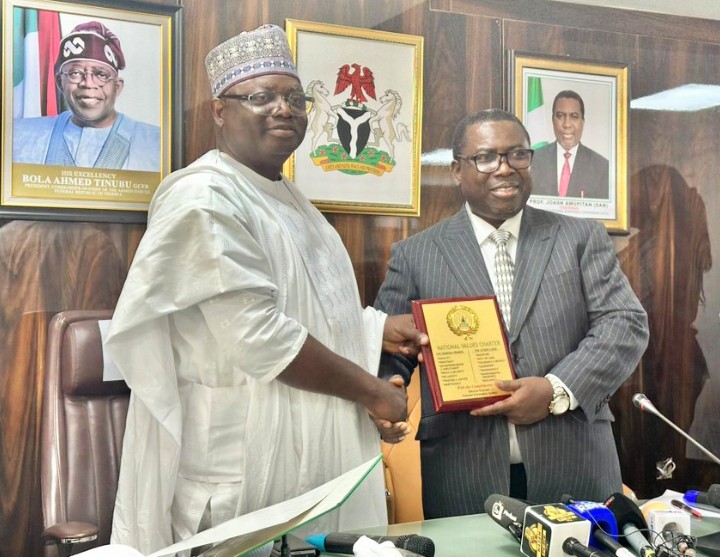
Ahead of the 2027 general elections, the Independent National Electoral Commission (INEC) and the National Orientation Agency (NOA) have agreed to deepen institutional collaboration to tackle electoral malpractices, including voter apathy, misinformation and to strengthen civic education across the country.
They made the commitment when the Director-General of the NOA, Mallam Lanre Issa-Onilu, led the agency’s management team on a visit to the Chairman of INEC, Prof. Joash Amupitan, SAN, at the Commission’s headquarters in Abuja, on Wednesday.
The NOA and INEC helmsmen acknowledged that while significant progress has been made in improving the conduct of elections through technology and administrative reforms, sustaining public confidence in the electoral process will require sustained voter education and strategic communication capable of countering widespread disinformation.
Prof Amupitan described the occasion as “a vital meeting of minds and a reunion of institutions constitutionally saddled with the responsibility of educating Nigerians on democratic culture.”
“As we prepare for the 2027 general elections, it becomes immediately clear that INEC cannot build a robust democracy in isolation. We can procure a modern voter accreditation system. We can optimise the INEC Result Viewing Portal (IReV) to international standards.
“We can map out the most efficient logistics for election material deployment. But all these technological and administrative triumphs mean nothing if citizens remain detached, uninformed, cynical or completely uneducated about the power of their votes,” Amupitan said.
He recalled from his academia experience how investments in information technology failed to achieve their intended objectives because insufficient attention had been paid to training users.
He said, “If you don’t invest in knowledge and capacity, all the technology in the world will amount to very little. Civic education must accompany every electoral reform.”
Speaking on the importance of NOA as Nigeria’s foremost institution for civic orientation, Amupitan said, “The NOA is the custodian of the values that make democracy work. You speak the language of our people, you understand their local realities, and you know how to navigate the cultural nuances that shape public opinion.”
Citing Section 3 of the NOA Act 1993, Amupitan said the agency’s mandate to energise Nigerians to their rights and responsibilities and eschew electoral malpractice” makes partnership with INEC an absolute necessity, not a secondary option.
He also warned that Nigeria’s democratic progress remained threatened by declining voter participation, growing distrust in public institutions and the increasing spread of false information, particularly through social media.
He said, “We are battling a silent but dangerous enemy in our electoral cycle — voter apathy and cynicism. We also see a sophisticated, orchestrated wave of fake news and disinformation designed to make ordinary Nigerians believe that their votes will not count.”
Amupitan cited instances where old videos depicting electoral violence were recycled during recent off-cycle elections to discourage voters, as well as false claims that INEC had stockpiled Permanent Voter Cards (PVCs) for a political party.
He urged both organisations to develop a coordinated communication strategy capable of exposing false narratives before they gain traction.
“Together, INEC and the National Orientation Agency must rewrite this narrative,” Amupitan said.
The INEC boss also said that electoral education should begin well before election periods, saying the era of ballot box snatching and arbitrary alteration of results had been significantly curtailed through innovations such as the Bimodal Voter Accreditation System (BVAS) and electronic transmission of results.
He emphasized the recent Federal Capital Territory Area Council elections and the June 2026 Ekiti governorship election as evidence of improvements in election management.
He said, “We recorded over 90 per cent early opening of polling units, impressive biometric authentication through BVAS and exceptionally swift, transparent result uploads on IReV,. Administratively and technologically, the template is working. We need to spread this message.”
Speaking earlier, the NOA Director-General, Mallam Lanre Issa-Onilu commended INEC for what he described as noticeable improvements in the conduct of recent off-cycle elections.
“From our own reports during the last three off-season elections, we’ve seen a drastic reduction in genuine complaints,” Issa-Onilu said.
He noted that the emergence of a new generation of young voters after the 2023 general election exposed significant gaps in civic and democratic knowledge.
He said, “The last election, in particular, saw what we refer to as Gen Z come of age. But it came with its own drawbacks. We saw a huge knowledge gap, and we found that very dangerous for us as a country.”
According to him, democratic education should not be confined to election periods.
He said, “Education is not ad hoc. It has to be something that you do continuously,. We need to let Nigerians understand the electoral process and even what happens after elections, including judicial processes. Many people are not aware of what actually goes on.”
Issa-Onilu also urged that collaboration between both institutions should extend beyond election cycles to include year-round civic education and democratic orientation.
Issa-Onilu stressed that through advocacy with stakeholders in the nation’s politics, the issues of violence and poor participation in the nation’s electoral system would be addressed.
“Democracy is the principle and the metric upon which this country either survives or fails. The right of citizens to decide who will lead them is something we must protect and promote,” he said.
He called for stronger institutional support for the agency’s Civic Values and Democracy Education Department, noting that voter education requires sustained investment if Nigeria is to reverse declining voter turnout and strengthen public trust in democratic institutions.
Discover more from TheTimes Nigeria
Subscribe to get the latest posts sent to your email.