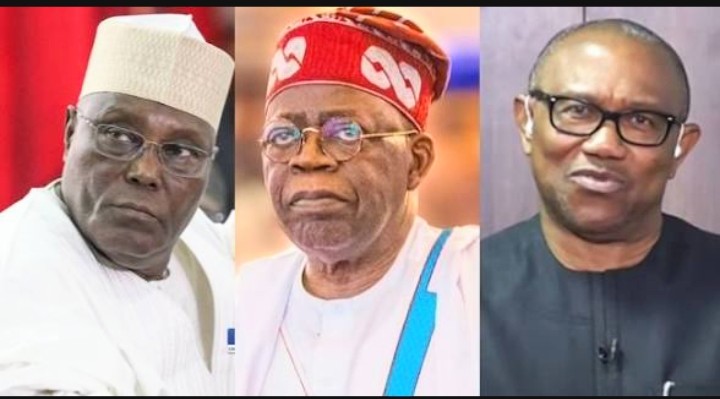
The Independent National Electoral Commission (INEC) has begun the nationwide publication of the personal particulars of candidates nominated by their political parties for the 2027 presidential and National Assembly elections.
The presidential election is scheduled for January 16, 2027.
The publication, which commenced on Saturday, is in compliance with the provisions of the Electoral Act, 2026.
Section 29(3) of the Electoral Act requires INEC to make candidates’ personal particulars public within 21 days of receiving them, allowing voters and other stakeholders to scrutinise the documents submitted by aspirants.
The publication of the documents comes ahead of the official commencement of campaigns for the 2027 presidential election on August 19.
Prominent among those whose details have been displayed are President Bola Tinubu of the All Progressives Congress (APC), Alhaji Atiku Abubakar of the African Democratic Congress (ADC), Mr Peter Obi of the Nigeria Democratic Congress (NDC), and Prince Adewole Adebayo of the Social Democratic Party (SDP), among others.
The names and credentials of presidential candidates nominated by their political parties for the 2027 general election were also displayed.
The exercise, which took place simultaneously across the country, was conducted at INEC state headquarters and constituency offices.
The display is intended to enable members of the public to inspect the credentials, affidavits and other personal documents submitted by the candidates.
In the Federal Capital Territory (FCT), the publication was carried out at the commission’s headquarters and across the six Area Council offices, in line with the Commission’s Revised Timetable and Schedule of Activities for the 2027 General Election.
The Administrative Secretary of INEC in the FCT, Mrs Bimbo Oladunjoye, who represented the Resident Electoral Commissioner, said the publication of candidates’ particulars is a statutory obligation under Section 29(3) of the Electoral Act, 2026.
Oladunjoye explained that the law requires the commission to display the personal particulars, affidavits, academic credentials and other relevant documents submitted by candidates in the constituencies where they seek election, thereby allowing members of the public to scrutinise the information.
According to her, the display covers the particulars of presidential candidates as well as National Assembly candidates contesting elections in the FCT, while similar exercises are being conducted simultaneously in all INEC offices nationwide.
She urged citizens, political parties, civil society organisations, election observers, the media and other stakeholders to take advantage of the opportunity to carefully examine the information displayed and raise any concerns through the channels provided by law.
She reiterated the commission’s commitment to conducting every stage of the electoral process strictly in accordance with the Constitution, the Electoral Act, 2026, and INEC’s Regulations and Guidelines.
“The Commission is on course with its preparations for the 2027 General Elections and will continue to carry out every stage of the electoral process in accordance with the Constitution, the Electoral Act, 2026, and the Commission’s Regulations and Guidelines,” she said.
INEC reaffirmed its commitment to conducting free, fair, credible and transparent elections and called on all stakeholders to continue supporting the commission in delivering a successful electoral process.
Saturday’s publication of candidates’ particulars forms part of the legal safeguards built into Nigeria’s electoral system to promote openness and accountability.
It enables voters, political parties and interested members of the public to verify the credentials and personal information submitted by candidates before the commission publishes the final list of nominated candidates.
Under the Electoral Act, 2026, the documents currently on display do not constitute the final list of candidates, as political parties still have until August 22, 2026, to withdraw or replace nominated candidates where necessary.
The electoral umpire is expected to publish the final list of candidates for the presidential and National Assembly elections on September 12, 2026, ahead of the 2027 general election.
The personal particulars and academic credentials submitted by President Tinubu revealed that he listed only his university qualification in the educational qualifications section of his EC9 nomination form, leaving the spaces provided for his primary and secondary school qualifications blank.
The commission also published the documents of the vice-presidential candidates nominated by the political parties.
President Tinubu listed a Bachelor of Science (B.Sc.) in Business Administration obtained from Chicago State University, United States, in 1979.
He attached copies of his Bachelor of Science degree certificate and his National Youth Service Corps (NYSC) certificate as supporting documents accompanying his nomination papers.
Peter Obi, in the documents submitted to INEC, described his occupation as “public servant.”
The documents showed his complete educational history from primary school to university.
He indicated that he was born on July 19, 1961, in Onitsha, Anambra State.
His records showed that he attended St Augustine’s Primary School, Anambra, where he completed his primary education in 1973; Christ the King College (CKC), Onitsha, where he obtained the West African School Certificate (WASC) in 1978; and the University of Nigeria, Nsukka, where he obtained a Bachelor of Arts (B.A.) in Philosophy in 1984.
Obi also attached his National Youth Service Corps (NYSC) certificate, showing that he completed the mandatory national service between May 1985 and March 1986.
Former Vice President Atiku Abubakar stated that he was born on November 25, 1946, in Jada, Adamawa State, and listed his occupation as “Businessman.”
Atiku listed his educational qualifications beginning with the First School Leaving Certificate (FSLC), obtained in 1954, the West African School Certificate (WASC), obtained in 1961, and a Master of Arts (M.A.) in International Relations, which he said he obtained in 2020.
He also stated that he served in the Nigerian Customs Service from 1969 to 1989 before voluntarily retiring.
Full list of 2027 presidential candidates released by INEC:
Bola Tinubu – All Progressives Congress (APC)
Atiku Abubakar – African Democratic Congress (ADC)
Peter Obi – Nigeria Democratic Congress (NDC)
Senator Sandy Onor – Peoples Democratic Party (PDP)
Omoyele Sowore – African Action Congress (AAC)
Donald Duke – Peoples Redemption Party (PRP)
Okwori Ada Elizabeth Frederick – National Democratic Party (NDP)
Chukwu Anita Zugwai – Young Progressives Party (YPP)
Rufai Adekunle Omoaje – Action Alliance (AA)
Adenuga Sunday – Boot Party
Memeh Samuel – Democratic Liberty Alliance (DLA)
Nwanyanwu Daniel Danerechukwu – Zenith Labour Party (ZLP)
Okereke Sunday Chibuzor – Labour Party (LP)
Okereke Iken Esther – National Rescue Movement (NRM)
Abbas-Bin Aliyu – Action Democratic Party (ADP)
Dikwa Suleiman Mohammed – New Nigeria Peoples Party (NNPP)
Adebayo Adewole Ebenezer – Social Democratic Party (SDP)
Seyi Makinde – Allied Peoples Movement (APM)
Yusuf Kabiru – Action Peoples Party (APP).
Vice-presidential candidates:
Kashim Shettima (APC)
Rotimi Amaechi (ADC)
Rabiu Kwankwaso (NDC)
Shehu Hussaini (AA)
Egbeola Olawale Mertins (YPP)
Ike Chinazam (ADP)
Mustapha Usman Turaki (Boot Party)
Balogun Alex (DLA)
Chikwuemeka Uchenna Anthony (NDP)
Magashi Haruna Garba (AAC)
Umaru Babangida (PDP)
Konto Hajja Bintu (LP)
Hassan Khalid (ZLP)
Samuel Magdalene Gali (NRM)
Abubakar Isah (NNPP)
Buba Musa (PRP)
Bugaje Usman Mohammed (SDP)
Ibrahim Adamu Bala (APM)
Ofordile Peace Egobia (APP).
Discover more from TheTimes Nigeria
Subscribe to get the latest posts sent to your email.