…Abdulsalami warns against character assassination, fake news
…Ndahi: 2,510 security incidents, 381 electoral offences recorded
…Amupitan: Elections are not ‘total wars’ but competitive job interviews
…Adebayo questions relevance of accord without justice, accountability
…Obi urges voters to punish violators at polls
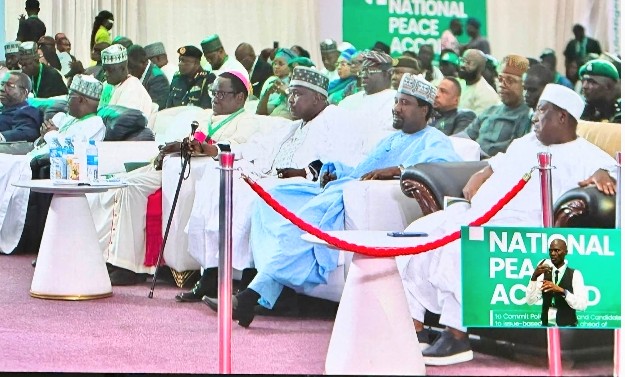
Presidential candidates and leaders of political parties contesting the 2027 general elections on Tuesday signed a National Peace Accord in Abuja, committing themselves to peaceful, issue-based campaigns and rejecting violence, hate speech, personal attacks, misinformation and other conduct capable of undermining the electoral process.
The accord was signed under the auspices of the National Peace Committee (NPC), chaired by former Head of State, General Abdulsalami Abubakar (retd.), ahead of the commencement of campaigns for the presidential and National Assembly elections on Wednesday, August 19.
However, the absence of the presidential candidate of the African Democratic Congress (ADC), former Vice President Atiku Abubakar, was notable at the ceremony.
President Bola Ahmed Tinubu of the All Progressives Congress (APC) was also not physically present but was represented by the Secretary to the Government of the Federation, George Akume, who signed the accord alongside APC National Chairman, Prof. Nentawe Yilwatda.
Among the presidential candidates who signed the accord in person were Peter Obi of the Nigeria Democratic Congress (NDC), Omoyele Sowore of the African Action Congress (AAC) and Prince Adewole Adebayo of the Social Democratic Party (SDP).
Other presidential candidates and political leaders at the event included Donald Duke of the Peoples Redemption Party (PRP) and Ambassador Aliyu Bin Abbas of the Action Democratic Party (ADP), while representatives of the Senate President, Godswill Akpabio, and Speaker of the House of Representatives, Tajudeen Abbas, also attended.
Governorship and National Assembly candidates, political party chairmen, the Independent National Electoral Commission (INEC) chairman, security officials, civil society representatives and diplomats also participated in the ceremony held at the International Conference Centre, Abuja.
The accord commits political actors to peaceful conduct before, during and after the elections, issue-based campaigns, respect for the rule of law and rejection of violence, intimidation, hate speech, misinformation, ethnic and religious incitement.
Campaign on Issues, Not Personal Attacks -Abdulsalami Abubakar
Represented at the ceremony by a member of the National Peace Committee, Gen. Martin Luther Agwai (retd.), Gen. Abdulsalami Abubakar warned political parties, candidates, campaign councils and spokespersons against turning the 2027 campaign into a platform for name-calling, personal insults and character assassination.
He said political campaigns had, over the years, increasingly neglected party manifestos and programmes, creating an atmosphere in which political actors resorted to personal attacks and inflammatory rhetoric.
According to him, the development had removed dignity and decency from public discourse and created a toxic environment capable of inciting citizens against the state, political parties and candidates.
Abdulsalami said the NPC had facilitated 30 peace accords since 2015, including five at the national level ahead of the 2015, 2019 and 2023 general elections and 25 at the sub-national level, including off-cycle governorship elections.
He said the committee had also established independent faith-based peace structures in 23 states to complement its peace-building efforts.
The former Head of State urged political parties, candidates, campaign councils and spokespersons to campaign on issues of significant concern to Nigerians.
“Please campaign based on issues that are of significant concern to Nigerians. Avoid the spread of false and fake news, personal attacks and insults,” he said.
He urged political actors to promote respect and tolerance for differing opinions, ensure civility in public discourse and comply with the spirit and letter of the accord.
Abdulsalami said the accord was anchored on the Constitution, the Electoral Act and other extant laws, adding that it was intended to remind political actors of their obligations throughout the electoral process.
He also disclosed that the committee had established an Election Security Information (ESI) Hub to monitor electoral offences and broader security developments and assess their potential impact on elections across the country.
According to him, the hub monitors, verifies and analyses security developments, producing trend assessments and contextual analysis to support early warning, preventive engagement and evidence-based decision-making.
Peace Accord Sets Boundaries for Political Competition -Asabe Ndahi
The Programme Officer and Project Manager of The Kukah Centre, Barrister Asabe Ndahi, said the Peace Accord was designed to establish clear boundaries within which political competition must take place.
“Today, we are here to establish the boundaries within which political competition must take place.
“We’re here also today to set up for the 2027 campaigns before political competition escalates into electoral conflict,” she said.
Ndahi stressed that political competition should not degenerate into violence or intimidation.
She said, “Our competition will not become war and disagreements will not degenerate to violence. Political mobilisation will not become intimidation. Electoral disputes will not become conflict, and information will not become a weapon against electoral integrity.”
She disclosed that monitoring of the 2023 electoral cycle revealed significant breaches of the previous Peace Accord.
According to her, the biggest violation was the commitment to issue-based campaigns, which accounted for 43 per cent of recorded breaches.
She said the provision against insults and violence recorded 13.5 per cent violations, while fake news and disinformation accounted for nine per cent.
Ndahi said 58 per cent of violations relating to issue-based campaigns were attributed to party spokespersons, with 22 states affected.
She identified Kaduna, Plateau, Kano, Lagos, Rivers and Benue among the states most affected.
“Political language is not just communication. In a tense electoral environment, it can actually become a risk signal,” she warned.
Ndahi said the committee had continued to monitor electoral developments since the 2023 elections, including at least 70 off-cycle elections, by-elections and re-run polls, during which attacks involving candidates, party supporters and campaign teams had been recorded.
2,510 security incidents recorded
Ndahi also disclosed that the ESI Hub recorded 2,510 security incidents between June 2025 and August 2026.
She identified Zamfara, Borno, Kaduna, Niger, Benue and Plateau among the most affected states, with banditry, kidnapping, terrorism and other forms of insecurity posing major threats.
The hub also recorded 381 electoral offences during the period, with the Federal Capital Territory, Osun, Oyo and Lagos recording significant incidents.
She listed vote-buying, political violence, thuggery, physical attacks, intimidation, misinformation, party conflicts, electoral malpractice and voter suppression among the leading electoral threats.
Ndahi warned that electoral violence usually had a history before manifesting as an actual incident.
She identified intra-party disputes, factionalisation, defections, litigation, misinformation, vote inducement, threats, intimidation, thuggery, hate speech and attacks on campaign rallies as major risk factors requiring early intervention.
She urged political parties and candidates to engage in vigorous but respectful debates centred on policies, programmes and issues affecting Nigerians.
Campaign supporters, she said, must mobilise responsibly without violence or intimidation, while party spokespersons must verify information before disseminating it.
“For the party and candidate spokesperson, we expect a lot from you because this is where most of the issues start,” she said.
“We expect respectful messaging. Kindly verify information and avoid inflammatory or inciting statements.”
She also urged the media and civil society organisations to verify information before publication and base their advocacy on evidence.
Security agencies, she added, must remain neutral, exercise restraint and provide equal protection to all citizens and candidates.
Traditional and religious leaders were also urged to use their influence to promote peace and discourage inflammatory rhetoric throughout the campaign period.
Punish peace accord violators at the polls -Obi
The NDC presidential candidate, Peter Obi, urged Nigerians to use their votes to punish political parties and candidates who violate the commitments contained in the Peace Accord.
Asked what punishment should await candidates who breach the agreement, Obi said the electorate should vote against them.
“Well, the punishment is that Nigerians should not vote for them,” he said.
Obi argued that politicians seeking public office should be exemplary and should not require an agreement to compel them to behave responsibly.
“We don’t even need to sign this. We’re seeking an office where we should be exemplary,” he said.
The former Anambra State governor also called for a credible 2027 election in which the votes of Nigerians would count.
“I don’t have any fear going into next year’s election except to say that, please, for the sake of the children of Nigeria, can we have an election where people’s votes will count?” he asked.
Reacting to deaths recorded during the recent Osun State governorship election, Obi said no Nigerian should lose his or her life because of an election.
He urged political actors to conduct themselves responsibly to prevent a recurrence of election-related deaths.
On whether he still believed in Nigeria’s electoral process, Obi said he had to participate in the process because he wanted to change it.
“Because I want to change the process, I have to go through it. So, I have to believe in it,” he said.
Elections not ‘total wars’ -Amupitan:
The INEC Chairman, Prof. Joash Amupitan, said the Peace Accord was being signed at a critical point in the electoral calendar, with campaigns scheduled to commence on Wednesday, August 19.
He said the presidential and National Assembly elections would hold on January 16, 2027, while the governorship and House of Assembly elections would take place on February 6.
Amupitan said the timing of the accord was deliberate, stressing that political actors needed to establish the ethical boundaries of their campaigns before nationwide political activities commenced.
He expressed concern over the resurgence of hate speech, toxic polarisation, coordinated misinformation and personality-driven political discourse.
According to him, campaigns were increasingly shifting from policy discussions to character assassination, identity-based provocation and inflammatory rhetoric.
He urged candidates to focus on the major challenges confronting Nigerians, including economic growth, insecurity, infrastructure, healthcare, education and social inclusion.
“Electoral contests in a constitutional democracy are not total wars; they are competitive job interviews before the electorate,” Amupitan said.
He urged parties to make the 2027 election a “marketplace of ideas” where candidates would explain not only what they intended to do but how they planned to achieve their objectives.
“Focus on what and how. Tell the voters what you will do for the economy, security and education and how you intend to achieve it,” he said.
“Let the 2027 campaign be a marketplace of ideas, not a theatre of war’
Amupitan warned parties against using social media and digital platforms to spread false information, premature election results and other content capable of undermining confidence in the electoral process.
He disclosed that INEC was preparing to deploy about 1.4 million ad-hoc personnel across more than 176,000 polling units, adding that the commission had spent the past eight months improving its technology, logistics and personnel training.
He, however, cautioned that technological improvements could not substitute for responsible political behaviour.
“It is not the signatures written on this Accord today that preserve democracy; it is the character of the leaders who hold the pen,” he said.
The INEC chairman assured Nigerians that the commission would remain neutral in the 2027 elections.
“Let me state unequivocally that INEC has no interest in who wins or loses any election, nor does it favour any political platform. Our only interest is a lawful, transparent, credible and inclusive process,” he said.
APC committed to peaceful campaign -Akume
Representing President Tinubu, SGF George Akume said the President and the APC were committed to the principles contained in the accord.
Akume commended the National Peace Committee for promoting peaceful elections and said Nigeria had recorded improvements in election management through technology deployed by INEC.
He cited permanent voter cards, biometric voter accreditation and other technological measures as developments that had strengthened the electoral process.
He urged political parties to avoid ethnic and religious sentiments and instead campaign on policies that expand opportunities and improve the lives of Nigerians.
“As the campaign season kicks off, I commit myself and my party, the All Progressives Congress, to the tenets of this accord,” Akume said.
He said the APC rejected violence, hate speech, misinformation, including misinformation generated through artificial intelligence, and incitement on social media.
Candidates must respect process -Sowore:
The AAC presidential candidate, Omoyele Sowore, was among the opposition candidates who signed the accord in person.
His participation formed part of the broader commitment by participating political parties and candidates to peaceful political competition as the 2027 campaign season begins.
Peace accord meaningless without justice -Adebayo
The SDP presidential candidate, Prince Adewole Adebayo, questioned the effectiveness and relevance of the Peace Accord, arguing that signing agreements would achieve little without justice, accountability and respect for democratic principles.
He argued that previous peace agreements had been violated without meaningful consequences and accused government institutions of intimidating opposition politicians.
Adebayo said a credible electoral environment required government institutions, security agencies and INEC to perform their constitutional responsibilities independently and transparently.
The SDP candidate also questioned whether the recently concluded Osun State governorship election represented an improvement in Nigeria’s electoral process, citing deaths recorded during the poll.
Don’t preach peace while encouraging violence -IGP Disu
The Inspector-General of Police, Olatunji Rilwan Disu, represented by Deputy Inspector-General of Police Umar Shehu Nadada, warned political actors against conduct capable of threatening electoral security.
Disu said election security was not created on election day but built throughout the electoral cycle through the conduct of political parties, candidates and their supporters.
He called for campaigns centred on policies and competing visions rather than ethnic mobilisation, religious division, hatred, intimidation and violence.
The police chief warned that inflammatory statements could spread rapidly through television and social media and trigger violence in communities.
He also warned against the use of armed groups, criminal elements or illegal firearms to intimidate political opponents or disrupt political activities.
According to him, political parties must take responsibility for the behaviour of their supporters and campaign organisations.
“You cannot publicly preach peace while privately encouraging violence,” he said.
Disu also called for greater inclusion of women, youths, persons with disabilities and other traditionally underrepresented groups in political activities.
Atiku’s absence raises questions
While several leading presidential candidates and party representatives signed the accord, former Vice President Atiku Abubakar, the ADC presidential candidate, was absent from the ceremony.
His absence was particularly notable given the significance of the agreement as political parties prepare to commence nationwide campaigns.
The organisers, however, maintained that the accord remained a framework for peaceful political competition and expected all political actors to abide by its principles, whether or not they were physically present at the signing ceremony.
Accord enters campaign season
The National Peace Committee introduced the Peace Accord ahead of the 2015 general elections as part of efforts to promote peaceful elections, mediate political disputes and encourage political actors to accept electoral outcomes.
The 2015 accord was signed by the then-presidential candidates Goodluck Jonathan and Muhammadu Buhari and preceded Nigeria’s first democratic transfer of power from an incumbent ruling party to an opposition party since the return to democratic rule in 1999.
The initiative was subsequently extended to the 2019 and 2023 general elections and several off-cycle governorship elections.
Established in 2014 in response to threats ahead of the 2015 elections, the National Peace Committee comprises eminent elder statesmen who intervene in critical national issues through high-level mediation and alternative dispute-resolution mechanisms.
The committee said the second phase of the 2027 initiative would follow the elections and focus on acceptance of electoral outcomes and the broader commitment to democratic stability.
With campaigns officially commencing on Wednesday, August 19, the challenge now lies in whether the candidates and political parties will translate the commitments made in Abuja into responsible conduct on the campaign trail.
The presidential and National Assembly elections are scheduled for January 16, 2027, while the governorship and House of Assembly elections are scheduled for February 6.
Discover more from TheTimes Nigeria
Subscribe to get the latest posts sent to your email.