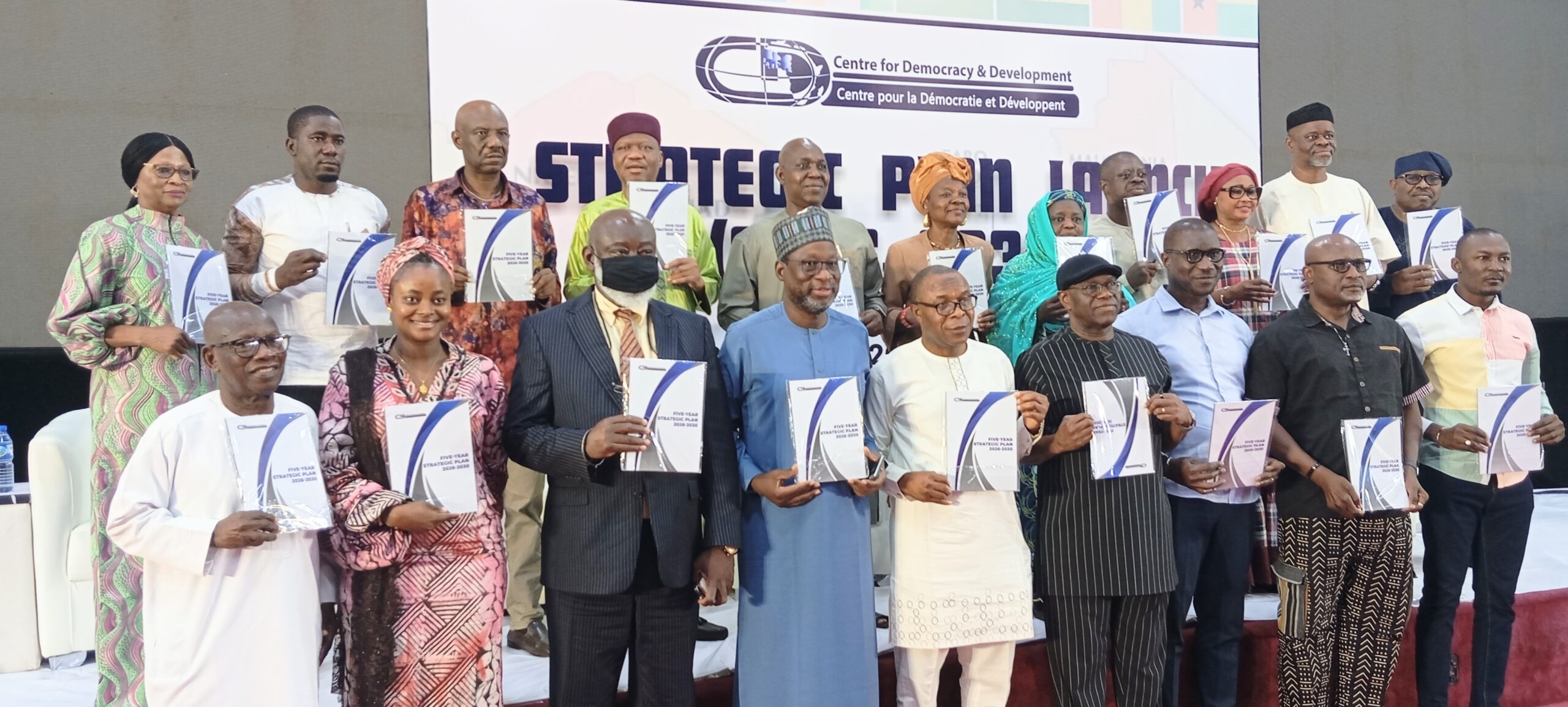
The Centre for Democracy and Development (CDD-West Africa) has unveiled a five-year strategic plan to reverse the troubling trajectory of democratic backsliding and worsening poverty across West Africa.
The Director of CDD-West Africa, Dr. Dauda Garuba, disclosed this at the unveiling of the plan in Abuja.
According to him, despite nearly three decades of progress in promoting democratic governance and regional stability, recent developments showed that the gains were increasingly under threat.
He noted that the region now faces a mix of progress and setbacks, with countries like Senegal and Ghana maintaining democratic stability, while others grapple with authoritarian tendencies and democratic governance decline.
He cited the resurgence of military coups and constitutional manipulations by civilian leaders in countries like Côte d’Ivoire, Guinea and Togo, alongside the declining public trust in elections and governance systems weakened by corruption.
“The rise of military-led populism in Mali, Burkina Faso, Niger and Guinea-Bissau further complicates the region’s democratic landscape,” he said.
The CDD-West Africa boos noted that beyond governance and security concerns, the region also faced a worsening humanitarian situation.
Garuba explained that democracy and development are interconnected, stressing the need for collaborative action among governments, civil society, businesses and international partners to achieve sustainable progress.
He recalled that the CDD-West Africa, as a think-and-do tank was established in 1997 to facilitate research, capacity building, advocacy, and convening on questions of democracy, peace and security, and people-centred development.
“Over the last 29 years of its existence, CDD-West Africa has grown in leaps and bounds, promoting democratic accountability, facilitating conflict prevention and peacebuilding, and supporting communities in their daily engagement with issues of poverty and inequality in the most ambitious collaborative manner with regional and continental bodies such as the Economic Community of West African States (ECOWAS) and the African Union (AU).
“These efforts directly benefit stakeholders by strengthening democratic processes, enhancing regional stability, and fostering inclusive development, aligning with their strategic interests and priorities.
“Despite these achievements, West Africa faces both progress and setbacks. While countries like Senegal and Ghana show signs of democracy, others struggle with growing authoritarianism. Peace is fragile, especially in the Sahel, and many people still face poverty and inequality.
“Recently, CDD-West Africa has seen democratic progress threatened by military coups, changes to constitutions by civilian leaders (as in Cote d’Ivoire, Guinea, Republic, and Togo), less trust in elections, poor governance linked to corruption, and the rise of military-led populism in countries like Guinea, Mali, Burkina Faso, Niger, and Guinea-Bissau.
“For peace and security, even ECOWAS’s successes now face new types of instability. These include terrorism, conflicts over land and resources, crime, and kidnappings, all creating complicated emergencies.
“In 2020, a SIPRI study found that Africa had the most deaths from conflict in the world. This confirms earlier Centre’s study on ‘Breaking the Vicious Cycle of Resource Violence in West Africa’ (see Dauda Garuba, Okechukwu Ibeanu, and Jibrin Ibrahim, 2009), which claims that West Africa experienced some of the worst violence in Africa since gaining independence.
“Regarding people-centred development, poverty and inequality have worsened in West Africa. The 2024 Global Report on Food Crisis estimates that 44.3 million people in West Africa and the Sahel face acute food insecurity, with 9.7 million forcibly displaced by food crises in 13 countries and 14 million children acutely malnourished in 14 countries.
“Rather than stand by as West Africa faces these challenges, CDD-West Africa will use its 2026-2030 Strategic Plan to take action. We aim to defend democracy, stop violence, and support development for all people.
“The new plan focuses on stopping democratic decline, preventing conflict, rebuilding peace, and reducing inequality. Stakeholders may ask how these objectives will be achieved and what measurable outcomes to expect. We will work to strengthen democratic institutions, involve the public more, and improve living conditions.
“The plan treats democracy and development as closely linked, and we believe that working together brings real progress. We are also committed to managing the Centre more effectively. We hope that governments, businesses, civil society, regional and continental groups, and development partners will find this plan useful and support our efforts,”.
…How ‘the champions’ undermined democratic culture -Ibrahim
Delivering a keynote, a former director of CDD, Prof. Jibrin Ibrahim, said that economic development was only meaningful when it benefitted the majority of people.
The CDD Senior Fellow said that Nigeria and West Africa had struggled to achieve people-centred development, as they were discouraged from effective economic planning by institutions such as the IMF and the World Bank.
Drawing on global examples such as China, India and Brazil, Prof. Ibrahim emphasised that countries that had successfully reduced poverty did so through deliberate, centralised planning, unlike those that relied solely on market forces and made limited progress.
He stressed that the crisis of democracy was often caused by self-proclaimed democrats who ultimately undermined it.
“The ideology of the market as the pathway to progress had remained sacrosanct, by the World Bank and IMF, irrespective of the facts of the matter until this month when the two are reversing themselves,” he added.
He recalled an example of Nigeria whose Tafawa Balewa administration went ahead to endorse central planning, a tradition the military continued very much against Western patrons and the IMF/World Bank, especially the development of iron and steel.
He said, “Thus only the defunct Soviet Union was able to take up building the Ajaokuta Steel Company but which was still successfully stalled by the same influences.”
He said that the way forward is conscientising the individual citizen as a guarantor of democracy in him or herself rather than relying on leading crusaders for democracy.
H emphasized that the so-called champion of democracy ended up betraying and not being different from those regarded as their opposite.
He cited examples of Abdoulaye Wade of Senegal; Alpha Conde of Guinea; Olusegun Obasanjo of Nigeria and Mamadou Tandja of Niger Republic, who tried to undermined democracy because of their selfishness and sit-tight syndrome.
…CDD-West Africa arresting decay -Odah
Speaking earlier, the Chairperson of the International Governing Council of the CDD-West Africa, Comrade John Odah who led the way on how CDD would fulfil its recommitment to arresting democratic decay with the strategic plan.
“As we all know, research outcomes are lame if they remain on shelves and in cupboards. Making research outcomes to inform policy action requires simultaneously addressing the gap between research outcomes and research users, as well as improving the actual update of research outcomes by actors,” Comrade Odah said.
According to him, to enhance its strategy of instrumentalising research, the CDD-West Africa will actively foster partnerships with African universities, research institutions, and think tanks across the region, with the intention of enriching its research capacity, encouraging intellectual exchange, and amplifying collective impact on democratic governance and development.
He said, “By working closely with academic and research partners, the Centre aims to ensure its policy recommendations are grounded in rigorous scholarship and reflective of diverse perspectives throughout West Africa.”
For Dr. Kuti Ango Dada who represented the Head of the Conference of Speakers of African legislatures, democracy is at an inflection point in Africa and that the challenges to constitutional order require collective institutionalism, which the CDD-West Africa is championing.
…Democratic ground shifting globally -Fayemi
Also, a former governor of Ekiti State and founding Director of CDD-West Africa, Dr. Kayode Fayemi who was more elaborate on the paradox drew attention to how, 30 years after the events leading up to the formation of CDD, nearly the same set of problems persist.
While noting few cases like Senegal and Ghana where civil engagement seems to have prevailed in reinforcing the democratic aspiration, Dr Fayemi, however, noted that the sub-region is at a critical junction.
“The ground is shifting around the globe in which West Africa is not an Island. There is paralysis on the continent as to require mission rejig of a CDD,” Fayemi said.
The former governor scored the CDD high in coalition building on a continental scale, a claim he reeled out a long list of institutions or coalitions that resulted viz the Institute of Security Studies in South Africa; the Centre for Conflict Resolution in Cape Town, South Africa; Citizen Forum for Constitutional Reform; West African Democracy Network; International Criminal Court Coalition; the West African Civil Society Forum (WACSOF) among others.
On his part, a leading public researcher and analyst, Mr. Waziri Adio, endorsed the idea of the world, West Africa and Nigeria all going through a flux.
He also said he sees the CDD-West Africa as an important institution, saying institutions which endure are those which develop strategic view of things.
A former Senior Fellow at CDD-West Africa, Dr, Dayo Kusa; and Dr. Danjuma Aku who stood for ECOWAS Commissioner for Political Affairs, Peace and Security, said that the centre can develop an applicable version of the African Peer Review Mechanism (APRM) and should take that as a challenge.
Prof Victor Adetula who served as intellectual coordinator of the Strategic Plan process said it was a case of realigning vision and mission with emerging realities without CDD-West Africa losing its continental vision.
He listed gender, climate change, youth and sustainability as the strategic objectives.
The unveiling of the 35-page “Five-Year Strategic Plan 2026-2030” also featured a panel discussion session.
Members of the panel included Dr. Nana Tanko, chief executive officer of the African Policy Research Institute; Dr. Hussaini Abdu, country director of CARE International-Nigeria; and Prof. Okechukwu Ibeanu, a former INEC National Commissioner among others.
The panellists agreed that democracy had not entirely failed but that both governments and citizens shared responsibility for its weaknesses.
They also argued that the breakdown of the social contract, poor infrastructure, healthcare and governance have fuelled instability and the return of coups to the region.
The high-profile public presentation is an assurance that the sub-region and Africa continent can retool the aim of contributing to reversing the ugly trends.
Discover more from TheTimes Nigeria
Subscribe to get the latest posts sent to your email.