The Global Rights -Nigeria, some other Civil society organisations (CSOs) and the National Human Rights Commission (NHRC) have raised concern over the country’s worsening insecurity, especially that over 34,000 Nigerians have been killed in incidents linked to mass atrocities within the last five years.
The figures included at least 6,518 Nigerians killed in mass atrocity incidents in 2025 alone.
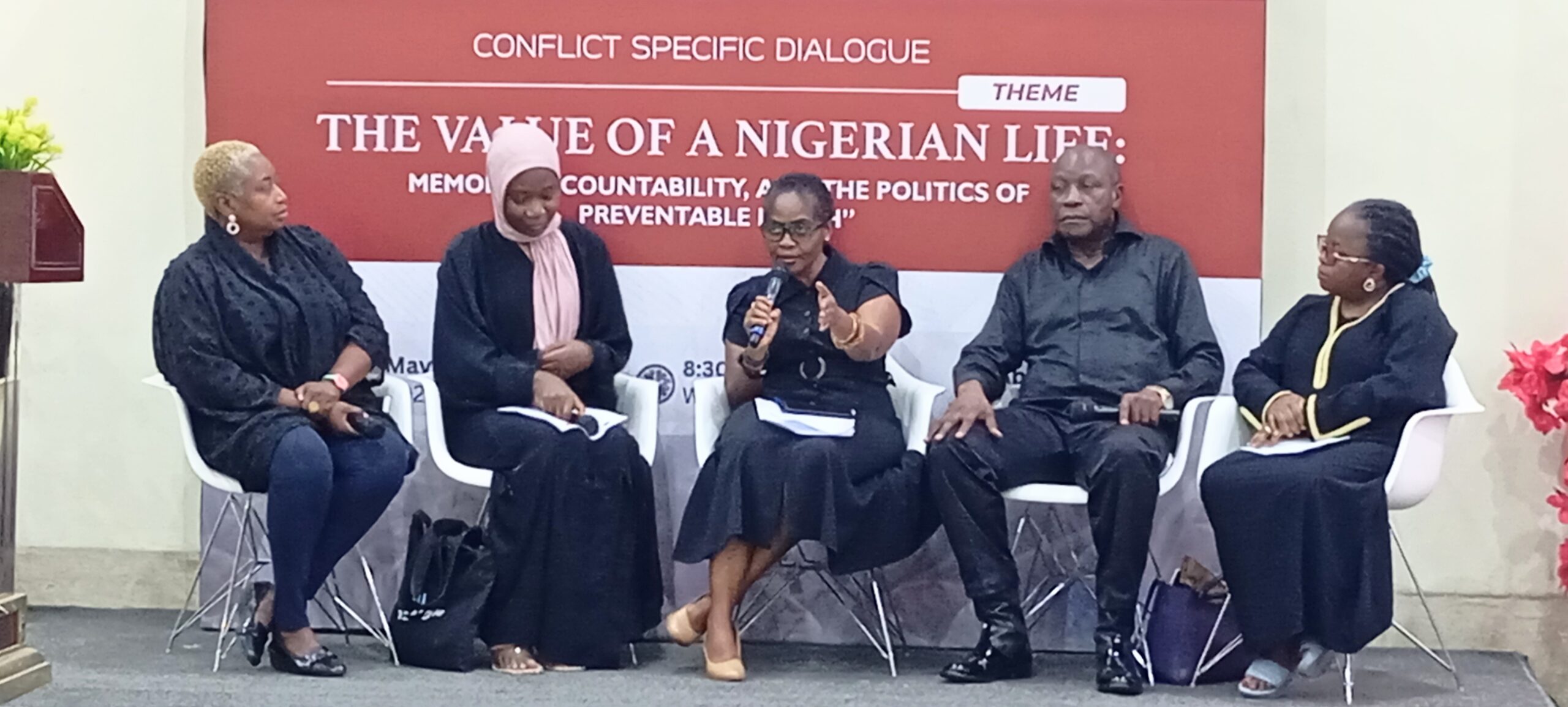
They raised the concern during a Conflict-Specific Dialogue (CSD) held Thursday in Abuja, as part of activities marking the 9th Nigeria’s National Day of Mourning (NDOM) scheduled for May 28.
The event brought together rights advocates, security analysts, and civil society actors with the theme: “The Value of a Nigerian Life: Memory, Accountability, and the Politics of Preventable Death.”
Led by the Global Rights, Amnesty International-Nigeria, Sesor Empowerment Foundation and other partners, the CSOs called for urgent reforms in Nigeria’s security and justice systems.
They warned that the continued cycle of killings, abductions, and impunity is pushing communities to the brink.
Speaking at the event, the Programme manager of Global Rights, Noya Sedi, highlighted that Nigeria is trapped in a pattern of recurring violence that is both predictable, preventable and that each statistic represents a human life cut short.
“We gather in a moment that is both necessary and difficult. Necessary, because too many lives have been lost in ways that were preventable. Difficult, because behind every statistic we reference a person—a child, a parent, a sibling, and a friend,” Sedi said.
She added that violence has spread across multiple regions, from Benue and Borno to Plateau and Zamfara, adding that insecurity has become a persistent national reality rather than isolated incidents.
She referred to Global Rights data, which stated that at least 6,518 Nigerians were killed in mass atrocity incidents in 2025 alone, with thousands more in preceding years.
She said that the National Day of Mourning (NDM), first established in 2018, emerged from the absence of reliable documentation and national accountability for violent deaths.
She said, “Part of the reason this movement began was because many of these deaths were happening without adequate documentation or accountability. Over the years, that gap became impossible to ignore.
“The mourning initiative is not symbolic alone but an act of civic resistance. The NDM exists to remember the dead and to insist that the living cannot continue to inherit the consequences of silence, delay, and inaction.”
On his part, Co-Chair of the Community of Practice Against Mass Atrocities, Mr Ken Henshaw, gave a more detailed breakdown of casualty figures, revealing that between 2019 and 2026, at least 40,411 people have been killed and 23,187 abducted across the country.
According to him, the initiative to document mass killings began as a response to government inaction and what he described as a “culture of indifference” toward human life.
“We launched Nigeria Mourns as a counter-culture to what seemed like a government where there was no emergency or empathy. We imagined our efforts would push authorities into action. Unfortunately, it did not. Despite years of advocacy, violence has escalated, not declined.
“Today, eight years after the first National Day of Mourning, we are still mourning, still documenting, and still demanding accountability,” Henshaw said.
He also noted that insecurity under the current administration remains severe, saying, “Between 2023 and now, at least 19,980 people have been killed and 12,362 abducted. Nigeria continues to experience widespread and systematic violence against civilians.”
He bemoaned the growing reliance on amnesty programmes for armed groups, arguing that such policies undermine justice and embolden perpetrators.
“The approach of buying off atrocious killings through ill-thought-out amnesties fails to address the root causes. It closes case files that should be investigated and pardons people who should be prosecuted,” Henshaw said.
He warned that criminal actors are becoming increasingly brazen, often publicising attacks and issuing warnings before strikes, a development he said signals weakening state capacity.
He said, “We are witnessing perpetrators who no longer hide their identities. It would seem they know they have overwhelmed the security forces.”
Also speaking, the Executive Secretary of NHRC, Dr. Anthony Ojukwu, SAN, represented by Benedict Agu in a keynote described the scale of killings as both staggering and unacceptable.
He said, “More than 34,000 Nigerians have been killed in incidents linked to mass atrocities in the last five years. These are not figures. They are biographies.”
In emotion-laden voice, he painted vivid images of victims, describing farmers who never returned home, schoolchildren whose desks remain empty, and worshippers killed in places of prayers.
“What does it say about a society that we are able to speak these numbers without breaking? That is the question this Day of Mourning compels us to confront,” he said.
He said: “The National Day of Mourning is a day on which we do something that ought to be unremarkable in any democracy: We pause. We refuse to look away. And we say, with the full authority of our institutions and the full weight of our grief and sorrow, that the lives lost to violence in this country will not be reduced to incident reports, nor absorbed into the silent arithmetic of national statistics.
“More than 34,000 Nigerians have been killed in incidents linked to mass atrocities in the last five years. These are not figures. They are biographies. They are the farmer who left at dawn and did not return at dusk. The schoolchild whose desk now sits empty. The mother whose name is etched into the memory of a village but recorded nowhere in a national register. The worshipper whose final prayer was interrupted by gunfire. The young woman taken from her dormitory and held for ransom on the open market of her own country.
“In the North-East, protracted insurgency continues to undermine civilian safety and to corrode the prospects of recovery. In the North-West, banditry, abduction economies, and territorial criminality have hardened into structures that, troublingly, no longer surprise us. In the North-Central, recurring farmer-herder violence, militia activity, and unresolved land conflict continue to generate cycles of killing and displacement.
“In the South-East, the conjunction of separatist tensions and coercive law enforcement has fed instability. And in the South-South and South-West, resource-related tensions, political violence, and organised criminality threaten the social fabric.
“And so, the work of this Dialogue is not merely commemorative. It is constitutive. In this light It, I am suggesting five imperatives that I believe must guide our work in the year ahead.
“First, we must strengthen prevention. Early-warning systems must not exist on paper. They must function in practice. The state must develop, and be seen to develop, the institutional capacity to act on credible warnings before, not after, communities are attacked.
The event also featured a panel discussion titled, “Mourning Without Justice,” where speakers, including retired police commissioner Emmanuel Ojukwu, Amnesty International’s Barbara Magaji, and HumAngle Media’s Hauwa Shafi Nuhu, highlighted the continued cycle of violence and weak accountability.
The panel lamented a policing and justice system in which victims of violence do not receive justice or compensation, while perpetrators often escape punishment.
They also criticised the pardon, de-radicalisation and reintegration of so-called repentant terrorists into communities where victims have not received any form of redress.
“When justice is not done, the trauma of the victims continues and more attacks are carried out. That is the sad cycle,” one of the panelists said.
According to them, this could lead to a breakdown of social cohesion, with victims eventually becoming aggressors by attacking returning terror suspects and the prevailing slogan has become: “No justice, no peace.”
On the way forward, the forum agreed that Nigerians should be encouraged to be strengthened and not to lose hope in the country, but to continue speaking up and engaging with authorities to fulfil their constitutional responsibilities.
In her closing remarks, Global Rights Executive Director, Ms Abiodun Baiyewu, stressed that Nigeria’s insecurity trend was worsening despite years of advocacy.
She compared Nigeria’s death toll with conflict zones like Sudan, Iran, Gaza and Ukraine, arguing that the scale of daily killings in the country outstrips all of them despite not formally in a state of war.
“The communal toll of the insurgency carnage is alarming. Some communities no longer exist due to the activities of terrorists,” she said, urging continued civic pressure on leaders. We have to keep hope alive. But we must also keep demanding accountability,” Baiyewu said.
Discover more from TheTimes Nigeria
Subscribe to get the latest posts sent to your email.