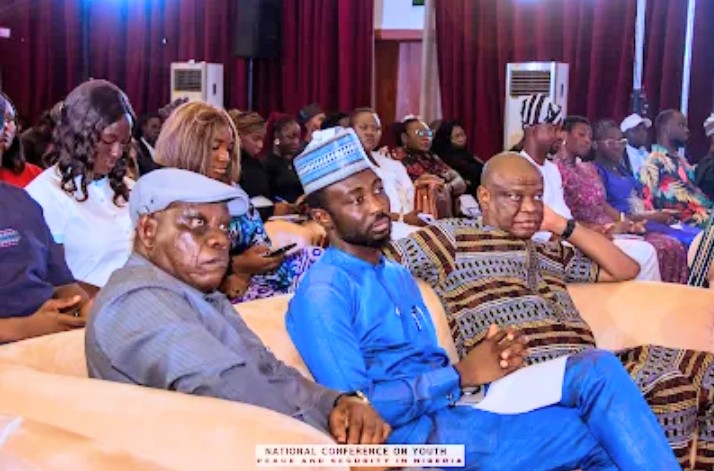
The Building Blocks for Peace Foundation (BBFORPEACE) and other partners have called for concerted and strategic inclusion of young people in peacebuilding, governance and national development efforts.
They made the call on Tuesday in Abuja at a national on youth, peace and security in Nigeria; and the launch of the BBFORPEACE Plan 2026–2030, organised by the BBFORPEACE, in partnership with Institute for Peace and Conflict Resolution (IPCR). Federal Ministry of Youth Development; as well as Champion of Peace Youth and Women Initiative.
The conference themed “Bridging Policy and Practice: Multi-Stakeholder Engagement in Youth Peace and Security Frameworks Implementation”, among others was to deliberate strategies for implementing the Youth, Peace and Security (YPS) agenda in Nigeria.
Executive Director of the BBFORPEACE, Mr Rafiu Adeniran Lawal, said the current socio-political and economic realities including insecurity, unemployment, shrinking civic spaces, have continued to place pressure on national unity and social cohesion.
According to him, the government took bold steps by adopting the National Action Plan on Youth, Peace and Security, a national roadmap for the engagement of young people in peace and security across the nation.
He said that the National Action Plan on Youth, Peace and Security is a major opportunity for transforming the country’s peacebuilding architecture, stressing that effective implementation of the framework could significantly address the nation’s security challenges.
“Beyond physical violence, we are also confronted by rising unemployment, shrinking civic spaces, misinformation, distrust in institutions, and increasing social fragmentation, all of which continue to place enormous pressure on national peace and cohesion.
“And in the middle of all these challenges are millions of young Nigerians. Young people are often portrayed only as victims of violence or instruments of instability. But that narrative is incomplete and unfair. Across this country, young people are also leading mediation efforts, countering hate speech, promoting social cohesion, preventing violence, supporting humanitarian responses, and building bridges across divided communities.
“This is precisely why the National Action Plan on Youth, Peace and Security is so important and relevant to Nigeria at this moment. The National Action Plan is not merely a policy document. It is a recognition that sustainable peace in Nigeria cannot be achieved without the inclusion, participation, protection, and leadership of young people.
“It is an acknowledgment that young people must not only be consulted occasionally, but systematically integrated into peacebuilding, governance, conflict prevention, security decision-making, and national development processes.
“The Youth, Peace and Security agenda challenges us to move beyond seeing youth as passive recipients of policy to recognizing them as strategic partners in building peaceful and resilient communities.
However, while Nigeria has made commendable progress by adopting the National Action Plan, the bigger challenge before us is implementation,” Lawal said.
He said that the unveiling of the BBFORPEACE strategic plan aligns with the five pillars of youth peace and security around participation, protection, prevention, partnerships, disengagement and integration.
He also said that when young people are empowered, included, trusted, and invested in, they become one of the greatest forces for national stability, innovation, reconciliation, and development.
Also speaking the Director-General, IPCR, Dr Joseph Ochogwu, said the institute was proud to co-host the conference, noting that youth inclusion remained central to sustainable peace and national development.
Ochogwu, represented by a Director and Chief Research Fellow at the institute, Chukwuemeka Mbah, said the Youth, Peace and Security agenda was not merely a policy framework but a call to action.
He said, “Young people are not simply beneficiaries of peace; they are leaders, innovators and change-makers whose voices must shape the future of our nation.”
He added that peace could only be achieved through collaboration among government institutions, civil society, development partners and youth-led organisations.
Delivering the keynote a public affairs analyst and Chairman, Partnership Against Violent Extremism (PAVE), Mr Jaye Gaskia noted that global and national frameworks often fail because the people expected to implement and benefit from them are not meaningfully involved in their design.
He urged stakeholders to rethink the implementation of youth-focused policies, insisting that young people should lead processes designed for them.
“If it is a youth peace and security framework, who should lead its implementation?” Gaskia said insisting that youth participation should go beyond symbolic representation.
He also said that civic spaces for young people to engage in governance and policy conversations must be protected and expanded.
He said, “The weakening of youth institutions and engagement platforms across the country, warning that shrinking civic spaces could undermine democratic participation and peacebuilding efforts. Peace is not merely the absence of conflict, it is the presence of justice, opportunity, fairness and hope.”
On her part, the Permanent Secretary, Federal Ministry of Youth Development, Dr Maryam Keshinro, reaffirmed the ministry’s commitment to promoting youth inclusion in governance and decision-making processes.
Keshinro, represented by Chief Youth Development Officer, Vivian Iorzua, said the government recognised young people as critical actors in conflict prevention, peacebuilding and national development, adding that stronger partnerships would be needed to advance the Youth, Peace and Security agenda.
“Platforms such as this conference are essential for translating policy frameworks into actionable outcomes and building sustainable partnerships for impact,” she said.
Discover more from TheTimes Nigeria
Subscribe to get the latest posts sent to your email.