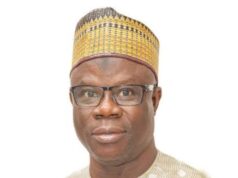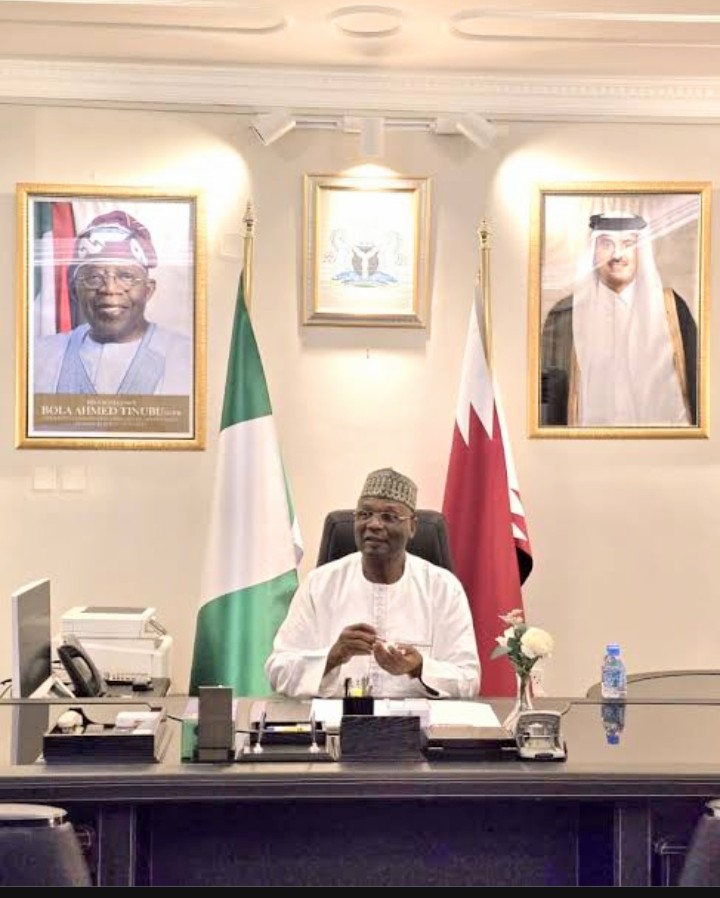
The newly appointed Nigeria’s Ambassador to the State of Qatar, Prof. Mahmood Yakubu, has arrived in Doha to formally assume his diplomatic duties.
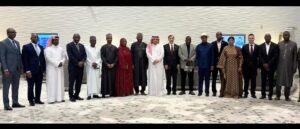
He was received at the airport by the Director of the Protocol Department at the Qatar Ministry of Foreign Affairs, Ambassador Ibrahim Yousif Abdullah Fakhro, who was joined by 13 African Ambassadors led by Ambassador of Republic of Guinea and current President of the Bureau of the African Group of Ambassadors to Qatar, Thierno Abdoulaye Sow; the Secretary General of the Gas Exporting Countries Forum (GECF) Dr Philip Mshelbila and the President of Nigerians in Diaspora Organisation (NIDO) in Qatar Michael Ndukaihe Ihekwaba.
The 13 African ambassadors and heads of mission were from Guinea, Algeria, Burundi, Morocco, Tanzania, Mali, Niger, Burkina Faso, Ghana, Senegal, Togo, Benin and the Central African Republic.
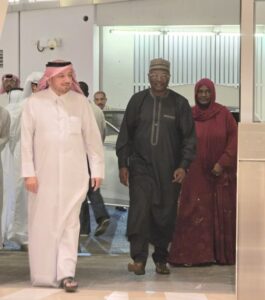
Prof. Yakubu also held brief interactions with several diplomats, including the Ambassadors of Mali, Dedeou Sidibe; Senegal, Cheikh Tidiane Sall; and Tanzania, Habibu Mohammed.
Following the airport reception, he met with staff of the Nigerian Embassy in Doha, the Qatari capital.
The new Nigerian Ambassador was the immediate past Chairman of the Independent National Electoral Commission (INEC).
Prof. Yakubu, who was the first INEC Chairman to complete two tenures, serving from November 2015 to October 2025, brings decades of experience in academia, public administration and governance to his new diplomatic assignment.
He was among the 32 ambassadorial appointees whose names President Bola Tinubu forwarded to the Senate for confirmation in November 2025.
After the Senate confirmation, the President, on 6th March, approved the names of 65 ambassadors-designate and Yakubu was assigned as Nigeria’s ambassador to Qatar.
During his time at the electoral commission, he supervised the conduct of the 2019 and 2023 general elections, as well as several off-cycle governorship elections.
He also served as Executive Secretary of the Tertiary Education Trust Fund (TETFund), having been appointed to the position in 2007 by former President Umaru Yar’Adua, where he initiated and implemented managerial reforms and different infrastructure and academic support programmes aimed at strengthening Nigeria’s higher education institutions.
As ambassador, Yakubu is expected to leverage his extensive administrative and leadership experience to strengthen bilateral relations between Nigeria and Qatar, especially in the areas of energy, trade, investment, geopolitics, as well as cultural and diaspora engagements.
Prof. Yakubu’s posting to Qatar is also seen as strategic, due to the cordial relationship and strong economic ties between the two countries.
Nigeria and Qatar formally established diplomatic relations in 2010, with both opening embassies in Abuja and Doha in 2013.
The visit by former President Muhammadu Buhari to Qatar in 2016, followed by Qatar’s ruler, Tamim bin Hamad Al Thani’s visit to Nigeria in 2019, laid the foundation for a wide range of collaborations.
Also, President Bola Tinubu’s visit to Qatar in 2024, during which several agreements and Memoranda of Understanding were signed, further deepened the political and economic ties between the two countries.
On the energy mix of the two countries, while Nigeria has been a member of OPEC since 1971, playing a crucial role in the organization’s efforts to stabilize global oil markets, Qatar, on the other hand, was a member of OPEC from 1961 but withdrew its membership effective January 1, 2019, to focus on its natural gas production
This notwithstanding, energy is a natural area of cooperation between Nigeria and Qatar and the key diplomatic goal would be to leverage Qatar’s expertise as a top LNG exporter and Nigeria’s vast natural gas reserves to advance mutual energy initiatives and cooperation.
Prof. Yakubu now has the task of aligning Nigeria’s decade of gas initiative with Qatari technical expertise and investment capital; and eventual realization of President Tinubu’s economic reform programme, anchored on foreign exchange unification and subsidy removal, into concrete and sustainable foreign direct investment flows from the energy-rich West Asian country.
Discover more from TheTimes Nigeria
Subscribe to get the latest posts sent to your email.